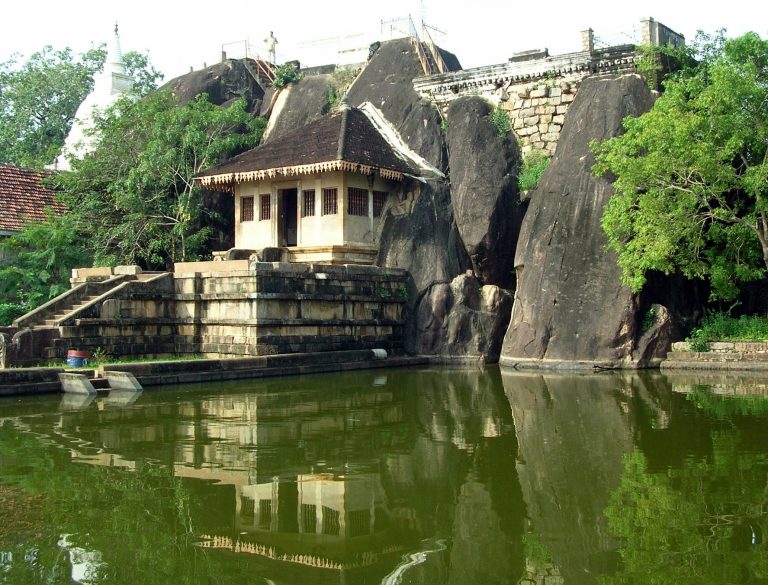
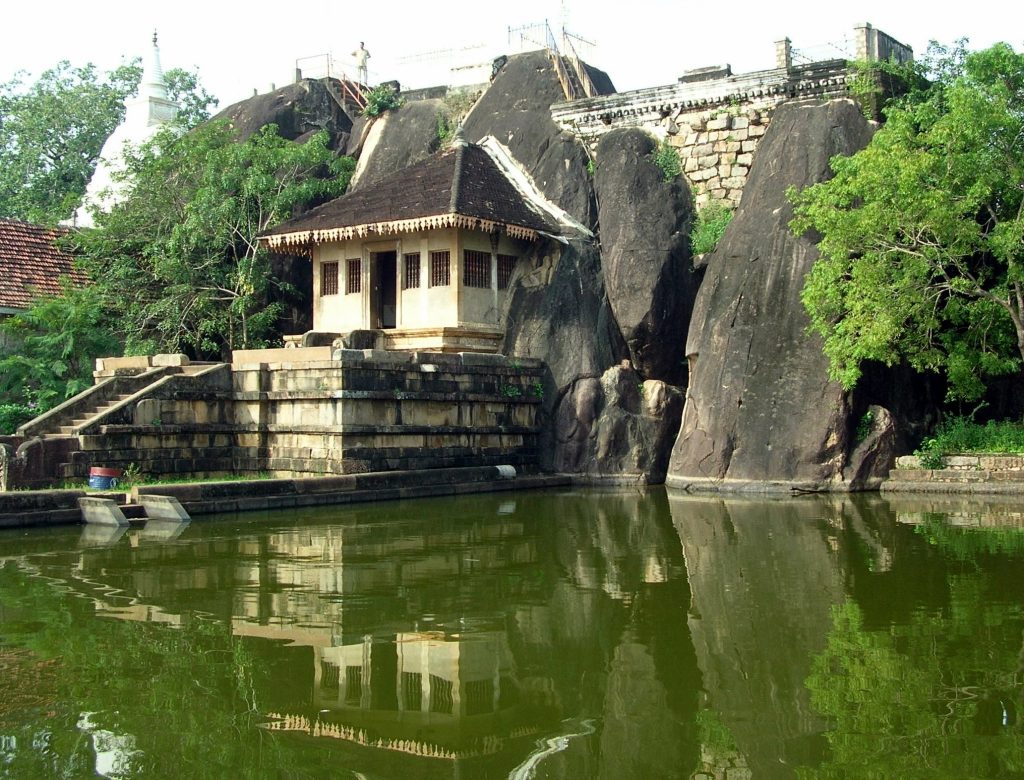
Isurumuniya is a small rock temple in Anuradhapura, south of the Sri Maha Bodhi. It sits among granite boulders beside the Tissa Wewa reservoir. Its fame rests on its stone carvings: bathing elephants above a pond, and a man seated beside a horse. Then there are the “Isurumuniya Lovers”, a carved couple now kept in the temple’s small museum.
Is it worth visiting?
Go if you are already exploring the Sacred City of Anuradhapura and want something on a human scale after the huge stupas. Isurumuniya is compact, its carvings are what make it special, and the rock top is also a good place to end the day.
Think twice if you only have an hour in Anuradhapura and haven’t yet seen the Sri Maha Bodhi or Ruwanwelisaya, because Isurumuniya rewards a slow look, not a quick tick.
A brief history
Tradition says King Devanampiya Tissa founded the temple in the 3rd century BC to house 500 newly ordained monks, young men of high caste. It was rebuilt several times during the Anuradhapura period. Later, in the 5th century, King Kassapa I restored it and gave it a new name. An early inscription found at the temple carries part of that name, Bo-Upulvan.
Today it is still a working Buddhist temple, with a cave shrine cut into the rock, a newer image house with a large reclining Buddha, and a small stupa on top of the boulders.
The carvings by the pond
You see the best-known reliefs before you even reach the steps. A pond lies at the foot of the rock. Just above the water, the rock face has carvings of elephants, shown as if they are bathing. Some face you, some are side-on and some appear only in part. The historian D. T. Devendra suggested the difference in style means two sculptors worked on them, perhaps at different times.
On the rock face above the pond, a man sits in a relaxed royal pose, a horse’s head beside him. Nobody agrees on who he is. Senarat Paranavitana, the former Archaeological Commissioner, read him as Parjanya, a Vedic rain god, and the horse as Agni, fire. Ananda Coomaraswamy, by contrast, saw the sage Kapila, and D. T. Devendra even suggested Alexander the Great and his horse. Whoever he is, though, he is worth a long look.
The Isurumuniya Lovers and the museum
The famous Lovers, however, are not on the rock. Instead, the carved slab is in the Isurumuniya site museum, which the Department of Archaeology runs inside the temple grounds. It sits alongside other stone sculptures from the site, such as a group known as the Royal Family.
The Lovers show a seated man with a woman on his thigh, her face turned coyly away and one finger raised. The style shows the influence of Gupta art from north India. The popular story says they are Prince Saliya, son of King Dutugemunu, and Asokamala, the low-caste girl he gave up the throne to marry. Others have suggested the god Kuvera and his queen, but nobody has proved any of these identities. Expect a small room, not a grand gallery.
Climb the rock
Steps lead up through the boulders to the small stupa on top. From there you look across Tissa Wewa and over the treetops of the ancient city, and recent visitors (2025–26) single out the sunset over the reservoir. Visitors warn that the bare rock gets very hot under bare feet by midday, so go early or late in the day, and consider bringing socks.
Tickets, dress and timing
Isurumuniya is a temple, and recent visitors (2025–26) report that it charges its own small entrance fee. This is separate from the Central Cultural Fund ticket for the Anuradhapura sacred city. The reported amount varies, so carry some small notes. The CCF’s own pages also don’t list Isurumuniya as part of its ticket.
As at any Buddhist temple, cover your shoulders and knees, take off shoes and hats before entering, and don’t pose for photos with your back to a Buddha statue. Our guide to temple etiquette in Sri Lanka has more.
Isurumuniya is easy to reach by tuk-tuk or bicycle from the rest of the sacred city. Next door, between the temple and the reservoir, is Ranmasu Uyana, the old royal pleasure garden, with rock-cut bathing pools and a carved circular chart, the Sakwala Chakraya. Archaeologists read the chart as a Buddhist map of the universe or an early map of the world. If you have a spare morning, Mihintale, where tradition says Buddhism arrived in Sri Lanka, lies east of the city.
Frequently asked questions (FAQs)
What is Isurumuniya famous for?
Its stone carvings: the bathing elephants above the temple pond, the man and horse on the rock, and the Isurumuniya Lovers, now kept in the temple’s site museum.
Is Isurumuniya included in the Anuradhapura ticket?
The Central Cultural Fund doesn’t list it as part of its Anuradhapura ticket. However, recent visitors (2025–26) report that the temple charges its own small fee.
Who are the Isurumuniya Lovers?
Nobody knows for sure. The popular story says Prince Saliya and Asokamala, but scholars have suggested other identities, including the god Kuvera and his queen.
Where can I see the Isurumuniya Lovers carving?
In the Department of Archaeology’s site museum inside the Isurumuniya temple grounds.
What should I wear to Isurumuniya?
Clothes that cover your shoulders and knees. You take off shoes and hats at the temple, and the rock gets hot, so socks help.
Sources: en.wikipedia.org (Isurumuniya), en.wikipedia.org (Isurumuniya Museum), ft.lk, srilanka.travel (attractions.php), srilanka.travel (stargate at ranmasu uyana), en.wikipedia.org (Ranmasu Uyana), archaeology.gov.lk, calisphere.org, ccf.gov.lk, gov.uk and recent visitor reports. Header photo: Pierre André Leclercq / Wikimedia Commons, CC BY-SA 4.0.