

Most etiquette in Sri Lanka is ordinary good manners. The rules that really matter involve religion: how you dress at a temple, how you treat images of the Buddha (in photos and on your skin), and what changes on Poya, the full-moon day each month. Get those right and you will rarely put a foot wrong.
The short version
- Cover your shoulders and knees at Buddhist temples, and take off your shoes and hat before you go in.
- Don’t pose for photos in front of or beside a Buddha statue. Photograph the statue, not yourself with it.
- If you have a Buddha tattoo, keep it covered, from the moment you land.
- No alcohol is sold in liquor shops and bars on Poya days, once a month at full moon.
- At some Hindu temples, men go in bare-chested. At Nallur Kandaswamy Temple in Jaffna there are no exceptions.
- Use your right hand to eat and to pass things to people.
What to wear at temples
The rule at Buddhist temples is simple: shoulders and knees covered, shoes and hats off. The UK government’s travel advice says so, and the Temple of the Sacred Tooth Relic in Kandy turns away visitors in shorts, sleeveless tops or revealing clothes. It does have suitable clothing at the entrances if you are caught out, and you hand in your shoes at reception booths before going in. The same rules apply at the Dambulla Cave Temple, where shoes come off at the top of the climb.
A light scarf or sarong in your daypack solves most problems: wrap it over shorts or round bare shoulders and you’re fine almost anywhere. Recent visitors (2025–26) report that stone terraces and rock floors get uncomfortably hot underfoot by midday, so go early if you can; some carry thin socks for the walk.
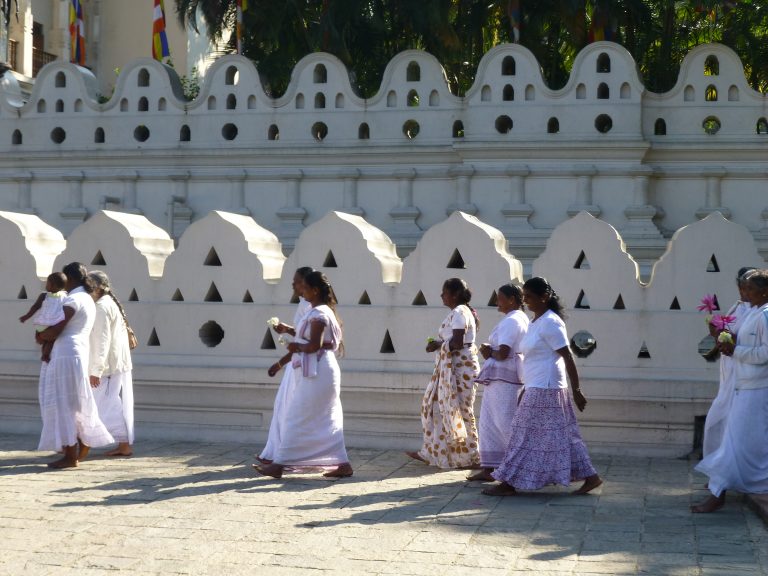
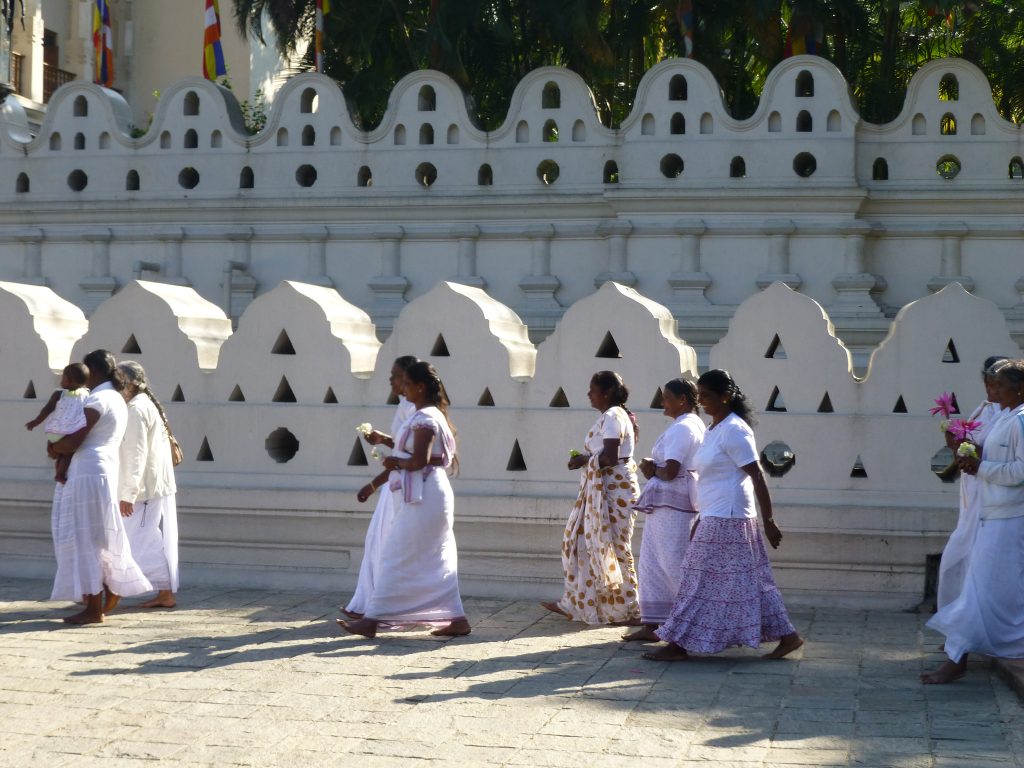
You’ll notice many local worshippers dressed in plain white, especially on Poya days. Visitors aren’t expected to copy this, but pale, simple clothes never look out of place. When you walk round a stupa or shrine, go clockwise, keeping it on your right; that is the direction Buddhists follow.
Buddha images, photos and the law
This is the one area where a careless moment can turn into a legal problem. The UK government warns that disrespecting Buddhist images and artefacts is a serious offence that can lead to arrest. Sri Lanka’s Penal Code makes it an offence to deliberately wound religious feelings by words, gestures or objects.
Photos. Sri Lanka Tourism says it is strictly forbidden to be photographed in front of or beside any statue or mural, and the UK government says not to pose standing in front of a Buddha statue. In practice that rules out the classic shot with your back to a statue, as well as anything playful. It isn’t a theoretical risk: in 2012 three French tourists were convicted after a photo lab reported their pictures from a temple in central Sri Lanka, which included a pretend kiss on a Buddha statue. They were sentenced to six months’ hard labour, suspended for five years. Photographing the statue itself, respectfully, is fine where photography is allowed. Inside shrines, follow the signs; Sri Lanka Tourism also points out that flash can damage old murals.
Tattoos: the honest position. No law specifically bans Buddha tattoos. Even so, the UK government warns that visible tattoos of the Buddha can get you refused entry or deported, and that has happened. In 2013 a British man was refused entry at the airport over a Buddha tattoo. In 2014 a British nurse, a practising Buddhist with a Buddha seated on a lotus tattooed on her arm, was detained on arrival at Colombo airport and deported. Sri Lanka’s Supreme Court later ruled her arrest unlawful and, in 2017, ordered Rs 800,000 in compensation. That ruling helped her years later; it won’t help you at the immigration desk. If you have a Buddha tattoo, wear sleeves or trousers that cover it when you fly in and whenever you are out, not only at temples.
Monks
Monks are given respect in everyday life as well as at temples. Women should avoid touching a monk or sitting right next to one; if you need to hand something over, put it down for him or pass it through a man. Recent visitors (2025–26) report that the front seats on buses are kept for clergy, and that people stand to give their seats to monks, older passengers and pregnant women. Ask before you photograph a monk, as you would with anyone else.
Poya days
Every full-moon day is a Poya, a public holiday when many Buddhists go to the temple. Liquor shops and bars close on every Poya day by order of the Department of Excise, and Sri Lanka Tourism says simply that alcohol is not sold on Poya. The Excise Department’s exemptions for tourist-board hotels cover New Year and Christmas, not Poya. Recent visitors (2025–26) report that some hotels will still serve guests a drink with dinner, but don’t count on it, and don’t drink in public: the UK government says that drinking in public on religious holidays could be culturally insensitive. Our Sri Lankan food guide covers what to eat and drink on the other days.
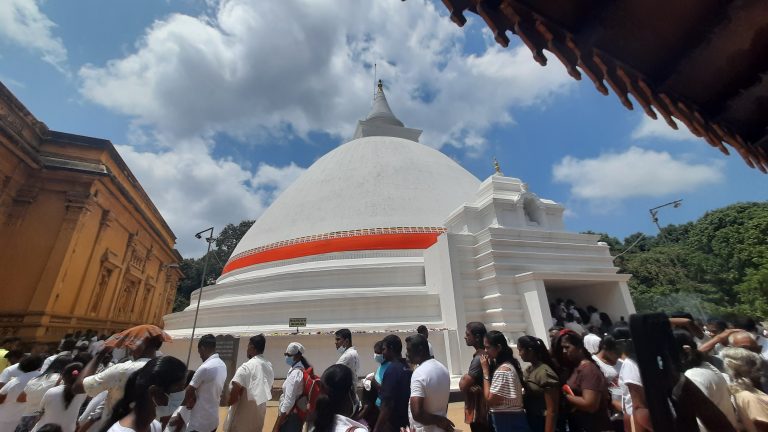
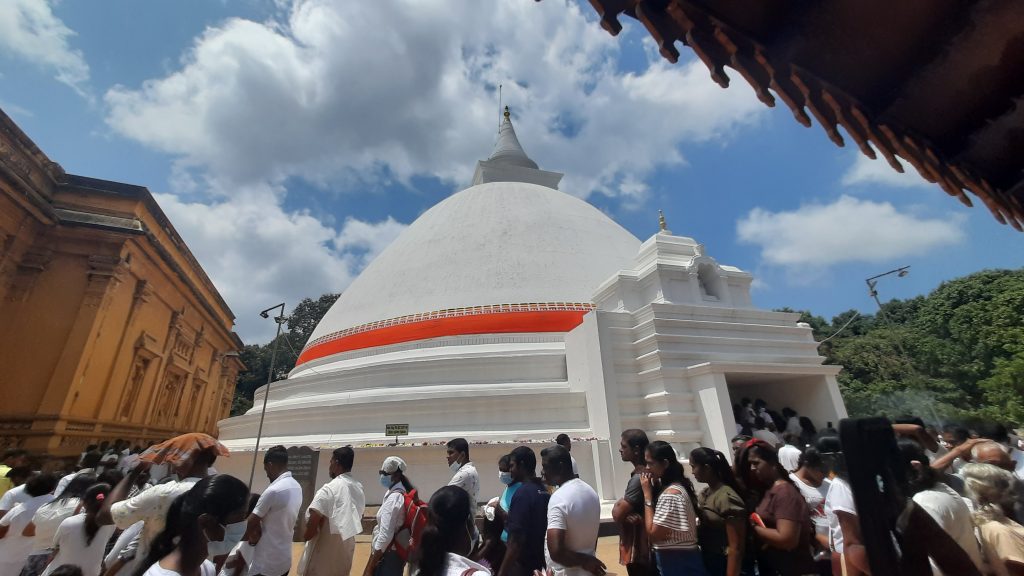
Vesak, the May full moon, is the biggest, and liquor shops also close on the day after it. Poson, in June, centres on Mihintale, where tradition says Buddhism arrived in Sri Lanka. Expect large crowds at the main temples on Poya days, and check the dates locally before you plan a big temple visit or a celebratory dinner.
Hindu temples (kovils)
Hindu temples have their own customs, and they vary. At Nallur Kandaswamy Temple in Jaffna, men enter bare-chested; the Sunday Times reported in 2023 that the temple’s custodian refused to make exceptions even for visiting politicians. Everyone takes off their shoes, and the Northern Province Tourism Bureau asks visitors to keep their voices down, switch off their phones and not touch the statues. Recent visitors (2025–26) report that men are asked to remove their shirts at other kovils too, mainly before the inner shrine. The easiest guide is to watch what local men do at the door. Women should dress modestly.
At mosques and churches, dress modestly too, and follow what other visitors do at the door.
Everyday manners
- Greetings: the Sinhala greeting ayubowan (“may you live long”) is said with the palms pressed together at the chest and a slight bow. A smile and a hello in English is also fine.
- Right hand: eat, and give or take things, with your right hand, or with both hands. The left hand is traditionally used for cleaning. Eating with your fingers is common, especially rice and curry.
- Homes: take your shoes off before you go into someone’s house.
- Heads: don’t touch anyone on the top of the head, including children.
- Beaches: nude and topless sunbathing are not allowed. Away from the beach, Sri Lanka Tourism advises women to dress modestly, especially at religious sites.
- Cameras: don’t photograph military bases, government buildings or VIP vehicles, and don’t fly drones near them.
- LGBT+ travellers: same-sex sexual activity is illegal in Sri Lanka, though the UK government says it is not aware of any prosecutions.
Before you go
Read the “Laws and cultural differences” section of the UK government’s Sri Lanka travel advice and the travel tips from Sri Lanka Tourism. If you’re visiting Kandy, the Temple of the Tooth’s own FAQ sets out its dress rules.
Frequently asked questions (FAQs)
Can you be deported from Sri Lanka for a Buddha tattoo?
Yes, it has happened. There is no specific law against Buddha tattoos, but a British tourist was deported over one in 2014 and another was refused entry in 2013. Keep it covered from the moment you land.
Can I take photos with Buddha statues in Sri Lanka?
Photograph the statue, but don’t pose in front of or beside it. Sri Lanka Tourism says this is strictly forbidden, and in 2012 three tourists were convicted over posed photos with Buddha statues.
What should I wear to temples in Sri Lanka?
Clothes that cover your shoulders and knees. You take off your shoes and hat before going in, and at the Temple of the Tooth shorts and sleeveless tops are not allowed.
Can you buy alcohol on Poya days?
Not from liquor shops or bars, which close on every full-moon Poya day. Some hotels serve guests discreetly, but don’t rely on it.
Do men have to take off their shirts at Hindu temples?
At Nallur Kandaswamy Temple in Jaffna, yes, with no exceptions. Some other kovils ask the same, so watch what local men do at the entrance.
Sources: gov.uk, srilanka.travel (travel tips), sridaladamaligawa.lk, srilanka.travel (attraction), en.wikipedia.org (Blasphemy law in Sri Lanka), aljazeera.com, gulf-times.com, abc.net.au, en.wikipedia.org (Poya), en.wikipedia.org (Uposatha), themorning.lk (vDTcpdNsIzNAKNYcR97p), themorning.lk (YOrNju4xQh4IQwZc7LM4), en.wikipedia.org (Circumambulation), sundaytimes.lk, tourismnorth.lk, en.wikipedia.org (Añjali Mudrā), theculturalatlas.org and recent visitor reports. Header photo: Ji-Elle / Wikimedia Commons, CC BY-SA 3.0.


