Check before you travel Hill-country railway: repairs after Cyclone Ditwah Checked 23 November 2026
Cyclone Ditwah damaged the hill-country railway in November 2025, and it is reopening in stages. Trains from Colombo Fort reached Peradeniya and Gampola again on 2 October 2026, but earth slips near Kadigamuwa station, between Rambukkana and Peradeniya, have blocked the line several times since. From 25 October 2026 the Department of Railways suspended all trains between Rambukkana and Peradeniya and Gampola until further notice, until repairs are finished and the line is confirmed safe; passengers with reserved seats on cancelled trains can claim a full refund at any railway station. Kandy station itself is not served yet. Trains between Nanu Oya and Badulla, which stop at Haputale, Ella and Demodara, restarted on 20 June 2026. The section between Gampola and Nanu Oya is still under repair, so you cannot yet go by train from Colombo or Kandy all the way to Ella. Check the latest services before you plan a rail journey, and book reserved seats on the Sri Lanka Railways seat reservation site.
Sri Lanka’s trains are slow, often late and sometimes packed, and the ride through the hill country is still worth every bit of the effort. As a foreign visitor you can book reserved seats yourself on the official Sri Lanka Railways site, up to 30 days ahead, with your passport number. If those seats are gone, unreserved tickets are sold at the station on the day. Here is how booking works, what the classes are, and which stretches are worth planning around.
How to book a reserved seat as a foreigner
Reserved seats are sold on the Sri Lanka Railways seat reservation site. According to the railway’s own FAQ:
- Bookings open 30 days before the day of travel and close 2 hours before departure.
- You need to create an account and log in to book.
- Every passenger’s passport number is required. Without them, the booking can’t be completed.
- You can book up to five seats at a time. You can’t choose seats; they are allocated automatically.
- You pay by Visa, Mastercard, American Express, Diners Club or Discover card, or with LankaQR. A 5% convenience fee is added to the total.
- The seat is only yours once payment goes through. If you are slow to reach the payment page, someone else may get it.
- Tickets are tied to the passport number they were booked under and can’t be transferred.
On the busiest trains, speed matters. In January 2025, The Morning reported that seats on Ella trains had sold out within 42 seconds of going on sale, and the Sunday Times reported tourists paying resellers several times the official price. Be logged in, with everyone’s passport numbers to hand, before seats are released. Recent visitors (2025–26) give different release times, so check on the site itself a few days before you need to book.
Cancelling is done in person: take a copy of your passport to a railway station counter that offers the mTicketing service. More than 7 days before departure you get 75% of the ticket fee back, between 2 and 7 days 50%, and nothing in the last 48 hours. The convenience fee is never refunded.
Your e-ticket and the “M-ticket” question
Many older guides and forum posts say you must swap your online booking (the “M-ticket”) for a paper ticket at the station before you travel. Sri Lanka Railways’ FAQ now says the opposite: no physical ticket is issued, and the e-ticket sent to your email, shown on your phone or printed at home, is what you travel on.
In practice, carry both a printout and your passport. Staff can check that the name and passport number on the ticket match the traveller, and a printout is easier to show than a phone with a flat battery. If anything looks wrong, go to the ticket counter before the train comes in, not after.
When seats sell out: unreserved tickets and split journeys
“Sold out” online only means the reserved seats have gone. Unreserved second- and third-class tickets are sold at the station on the day, and they can’t sell out. The catch is that you may stand, especially if you board part-way along the line. Boarding at the station where the train starts gives you the best chance of a seat.
Sri Lanka Railways also sells unreserved commuter tickets for second and third class online through Pravesha, up to 7 days ahead, with a QR code checked at the station or on the train. The site says these e-tickets are not valid on intercity trains, so check that your train is covered before you buy.
Recent visitors (2025–26) report two other tricks that sometimes work:
- Split the journey. If no reserved seats are left for the whole run, seats may still be available on shorter sections. Book each section separately, for example breaking a hill-country trip at Nanu Oya. Book it as two tickets rather than assuming you can get off and back on with one.
- Ask on the day. Cancellations and no-shows free up seats; station staff or the guard may be able to move you into one.
Official seats versus resold tickets
You will find plenty of agencies, hotels and websites offering “guaranteed” train tickets, sometimes at several times the official fare. In early 2025, Sri Lankan newspapers reported groups buying up seats on the Ella trains the moment they went on sale and reselling them to tourists, with tickets priced around Rs 2,000 ($6.01 · convert) resold for up to Rs 16,000 ($48 · convert). Sri Lanka Railways lodged complaints with the police, and officials said passengers’ identity documents would be checked on board.
The risks of buying a resold seat:
- A ticket booked under someone else’s passport or identity card number isn’t transferable, so you could be turned away from the reserved carriage.
- Refunds are paid only at a station counter against the passport the ticket was booked with, so if the train is cancelled or you change plans, the money may be gone.
- You pay a mark-up on top of the official fare and the 5% convenience fee.
If someone books for you, such as your guesthouse or driver, make sure they use the official site and enter your own name and passport number, and ask for the e-ticket to be sent to you. If the seats are gone, our guide to booking yourself, using an agent or hiring a driver weighs up the options.
Classes: observation saloon, air-conditioned, second and third
Sri Lanka Railways sells four classes of reserved seat:
- Observation saloon: a first-class carriage at the rear of some day trains on the hill-country line, with a large rear window looking back along the track. Seats face backwards. Recent visitors (2026) report that the observation car advertised for their train wasn’t attached on the day, so don’t build your trip around it.
- Air-conditioned saloon: first class with air-conditioning. Comfortable, but recent visitors note that it is in the lower classes that you can open the windows for photos.
- Second class reserved: a guaranteed seat, with windows you can open: a good middle ground for scenery.
- Third class reserved: basic, but a reserved third-class seat beats standing in second.
Overnight trains have sleeping berths. Unreserved carriages are second and third class only.

The main lines and where they go
- Main Line: Colombo Fort to Badulla, 290 km through Rambukkana, Peradeniya Junction, Gampola, Nawalapitiya, Hatton, Nanu Oya, Pattipola, Haputale, Bandarawela, Ella and Demodara. Kandy itself is on a short branch from Peradeniya Junction, and some trains to the hills don’t call there.
- Coastal Line: Colombo Fort to Beliatta via Kalutara, Aluthgama, Hikkaduwa, Ambalangoda, Galle and Matara, much of it beside the sea.
- Northern Line: from Polgahawela on the Main Line through Kurunegala, Anuradhapura, Vavuniya and Kilinochchi to Jaffna and Kankesanthurai.
- Batticaloa Line: branches off the Northern Line at Maho Junction and runs east through Habarana and Polonnaruwa to Batticaloa.
- Trincomalee Line: leaves the Batticaloa Line at Gal Oya Junction for Trincomalee.
Smaller lines run to Matale, Puttalam, Mannar and up the Kelani Valley. Cyclone Ditwah damaged parts of the network in late 2025, and the hill-country line is reopening in stages: see the travel update at the top of this page. For buses, tuk-tuks and drivers, see our guide to getting around Sri Lanka, and for the two classic hill-country journeys, Colombo to Ella and Kandy to Ella.
The scenic stretches worth planning around
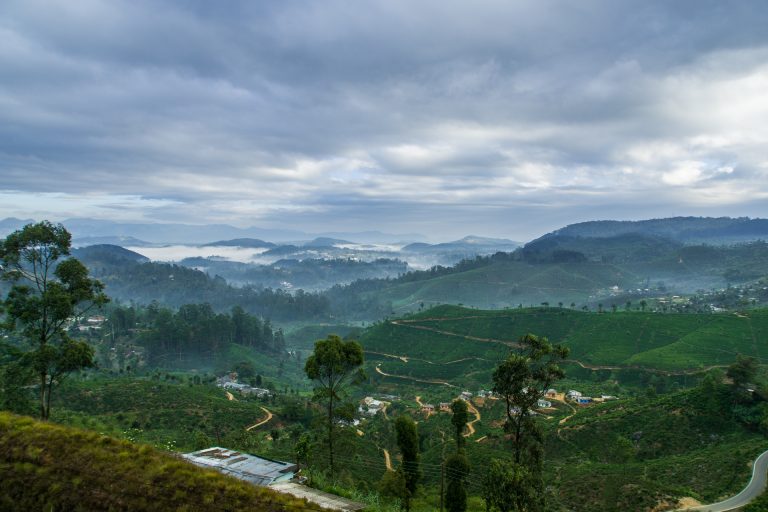
The Main Line is the one people come for. West of Kandy it climbs the Kadugannawa incline, where the track runs along the side of sheer cliffs. Beyond Nanu Oya, the station for Nuwara Eliya, it reaches the highest point on the network at Pattipola, 1,898 m above sea level, then drops through tea country and forest to Haputale and Ella. Just past Ella, the line crosses Nine Arch Bridge and then winds round the Demodara loop, where it spirals to change height. Our 4 days in the hill country itinerary is built around this line. Our guide to the hill-country train ride goes through this stretch section by section, with where to sit and how to stay safe.
On the Coastal Line, the views are of beaches, rivers and lagoons. It is a flatter and more everyday ride than the hills, and an easy way to move between beach towns without a car.
If you only have time for one short scenic ride, the section between Nanu Oya, Haputale and Ella is the one we would pick. Mornings are usually clearer in the hills; cloud and mist often build later in the day.
On board: safety and practical tips
- Stay inside the carriage. The UK government’s travel advice warns that visitors have died after hanging out of open doors and windows. The doorway photo is tempting; it isn’t worth it.
- Check times with Sri Lanka Railways or at the station the day before. Times change and trains often run late, so don’t plan a tight connection at the other end.
- Keep your passport with you, not in your big bag: it is part of your ticket.
- Bring water, snacks and a warm layer: the hills are much cooler than the coast.
Frequently asked questions (FAQs)
How far in advance can I book Sri Lankan trains?
Reserved seats go on sale 30 days before the day of travel on the official Sri Lanka Railways seat reservation site, and online booking closes 2 hours before departure. Popular hill-country trains can sell out within minutes.
Can foreigners book Sri Lanka train tickets online?
Yes. Create an account on the official seat reservation site and enter each traveller’s passport number. Visa, Mastercard, American Express, Diners Club and Discover cards are accepted, with a 5% convenience fee.
Do I need to exchange my e-ticket at the station?
Sri Lanka Railways’ FAQ says no physical ticket is issued: the e-ticket, printed or on your phone, is valid for travel. Carry your passport too, as the ticket is tied to its number.
What can I do if the train to Ella is sold out?
Buy an unreserved ticket at the station on the day; these can’t sell out, though you may have to stand. Some travellers also find seats by booking the journey in shorter sections.
Is it safe to buy train tickets from resellers?
It’s risky. Tickets are tied to the passport or identity card number they were booked under and can’t be transferred, and refunds are only paid against that passport. Book on the official site in your own name.
Can I take the train from Kandy to Ella?
The Main Line links Kandy’s Peradeniya Junction with Nanu Oya, Haputale and Ella, but parts of the hill-country line have been under repair since Cyclone Ditwah. See the travel update at the top of this page for what is running.
Header photo: Alexey Komarov / Wikimedia Commons, CC BY-SA 4.0.