Wewurukannala Vihara is a Buddhist temple about 1.5 km inland from Dikwella on Sri Lanka’s south coast, on the road to Beliatta. It is known above all for a giant seated Buddha that rises above the palm trees behind the old white temple, and for the passage you walk through on the way to it: a hall of life-size figures acting out the punishments of hell.
Is it worth visiting?
Go if you are staying around Dikwella and Hiriketiya, Tangalle or Matara and want a couple of hours away from the beach. It is an easy detour off the coast road and nothing like the island’s ancient rock temples: loud colours, painted plaster and a statue you can’t miss.
Think twice if you are travelling with young children who scare easily, because the hell scenes are graphic. And if you are after ancient ruins, this isn’t the place: the temple’s history goes back to the 18th century, but its main sight, the giant Buddha, dates from 1969.
The old temple at the front
The temple dates back to the late 18th century and the reign of the Kandyan king Rajadhi Rajasinha. Its oldest part is the image house at the front of the complex: a white building with arched doorways and painted lions above them, with small white stupas in the courtyard in front. This is the building you see first from the courtyard, with the giant Buddha’s head appearing over its roof.
Inside the shrine rooms, painted figures of worshippers kneel in rows before seated Buddhas, and the walls are covered in murals. The temple also keeps a large mechanical chiming clock made by a local craftsman, W. Elaris de Silva, in the 1920s.

The hell tunnel
Between the old temple and the statue you pass through a passage often called the tunnel of hell. It is lined with life-size models of demons and sinners showing what Buddhist teaching says awaits people who do wrong: sinners boiled in cauldrons, sawn in half and disembowelled, among other scenes.
It is meant as a moral lesson, and Sri Lankan pilgrims walk through it as part of the visit. Still, the figures are crude, colourful and very literal, and recent visitors (2025–26) are divided: some find it the most memorable part of the temple, others find it disturbing. With young children, have a look first and decide.
The giant seated Buddha
The great seated Buddha was unveiled in 1969. It sits against a multi-storey building filled with paintings of the life of the Buddha, which also houses a small museum.
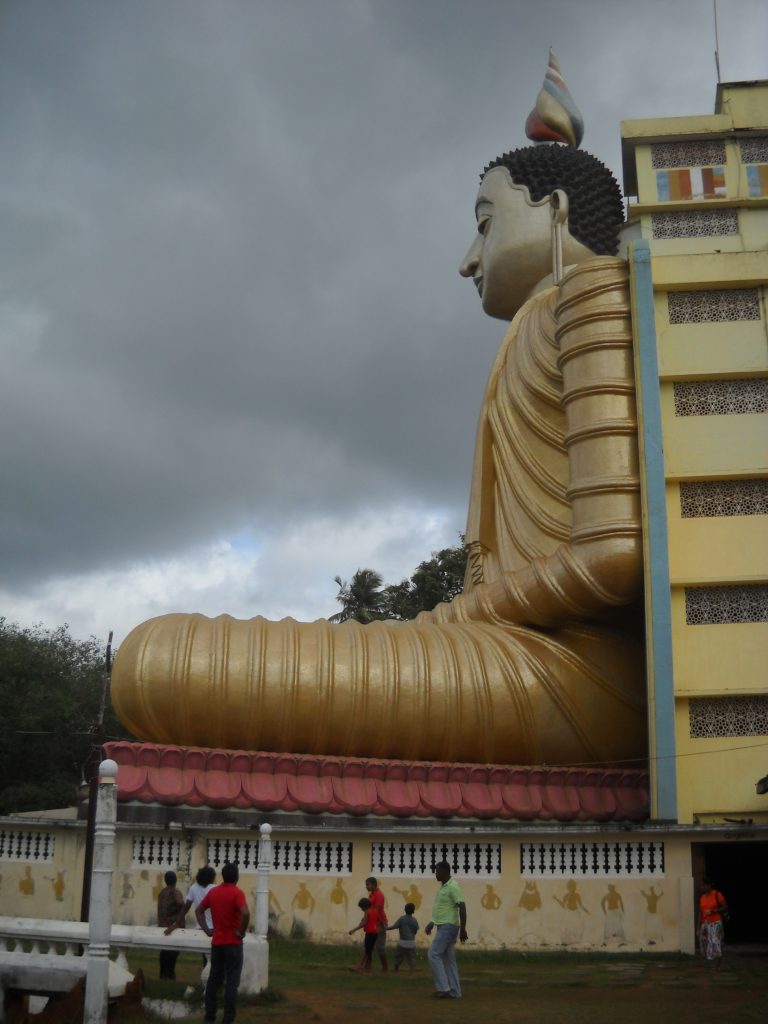
You will often read that this is the largest seated Buddha in Sri Lanka. Published figures for its height disagree widely, so we don’t quote one here; stand in the courtyard and judge for yourself. Recent visitors (2025–26) report that you can climb the stairs inside the building, past the painted floors, to the level of the Buddha’s head, with a small extra charge for the top.
Tickets, donations and dress
No official ticket price or opening hours are published. Recent visitors (2025–26) report:
- a small cash entry charge for foreign visitors;
- requests for donations inside, including in the hell tunnel, so carry small notes and give what you think is fair;
- hot paving underfoot by midday, since you walk the courtyards barefoot, so mornings are more comfortable.
Allow an hour or so. This is a working temple and is often busy with worshippers, especially on full-moon poya days. Cover your shoulders and knees, take off your shoes and hat before entering the shrine rooms, and never pose for a photo with your back to a Buddha statue: the UK government’s travel advice warns that disrespecting Buddhist images is a serious offence in Sri Lanka. Our guide to cultural etiquette in Sri Lanka covers the rest.
Getting there
Dikwella is on the A2 coast road, about 22 km east of Matara. At the town, the Beliatta road turns inland, and the temple is about 1.5 km along it.
- By bus: buses running along the coast between Matara and Tangalle stop in Dikwella. From there take a tuk-tuk up the Beliatta road.
- By tuk-tuk: from Hiriketiya or Tangalle this is the simplest option. Agree the fare, including waiting time, before you set off.
- By train: Wewurukannala is a stop on the railway extension from Matara to Beliatta, which opened in 2019. Check train times at Matara station before you rely on it.
Around Wewurukannala
The temple fits easily into a day on the coast: a morning here before the heat, then lunch and a swim back at Hiriketiya. If temples are what you came for, pair it with Mulkirigala Rock Temple, inland from Tangalle, where cave shrines climb a great rock on terraces of steep stone steps.
Frequently asked questions (FAQs)
Where is Wewurukannala Vihara?
About 1.5 km inland from Dikwella on the road to Beliatta. Dikwella is on the A2 coast road, about 22 km east of Matara.
How tall is the Wewurukannala Buddha?
Published figures disagree widely, so we don’t quote one. It is often described as the largest seated Buddha in Sri Lanka, and it was unveiled in 1969.
Is there an entrance fee?
No official price is published. Recent visitors (2025–26) report a small cash entry charge for foreign visitors and requests for donations inside, so bring small notes.
Is the hell tunnel suitable for children?
The figures show graphic punishments, such as people boiled in cauldrons and sawn in half. Older children may find it fascinating, but look first if yours scare easily.
What should I wear to Wewurukannala?
Clothes that cover your shoulders and knees. You take off your shoes and hat before entering the shrine rooms, and the courtyard paving gets hot by midday.
Can you climb up inside the Buddha?
Recent visitors (2025–26) report that stairs inside the building behind the statue lead up to the level of the Buddha’s head, with a small extra charge for the top.
Sources: dailymirror.lk, en.wikipedia.org (Dikwella), en.wikipedia.org (List of the tallest statues…), srilanka.travel (IslandLeisuredoc1.pdf), en.wikipedia.org (A2 highway (Sri Lanka)), en.wikipedia.org (Coastal line (Sri Lanka)), railway.gov.lk, gov.uk, srilanka.travel (travel tips) and recent visitor reports. Header photo: Eleleleven / Wikimedia Commons, CC BY-SA 2.0.