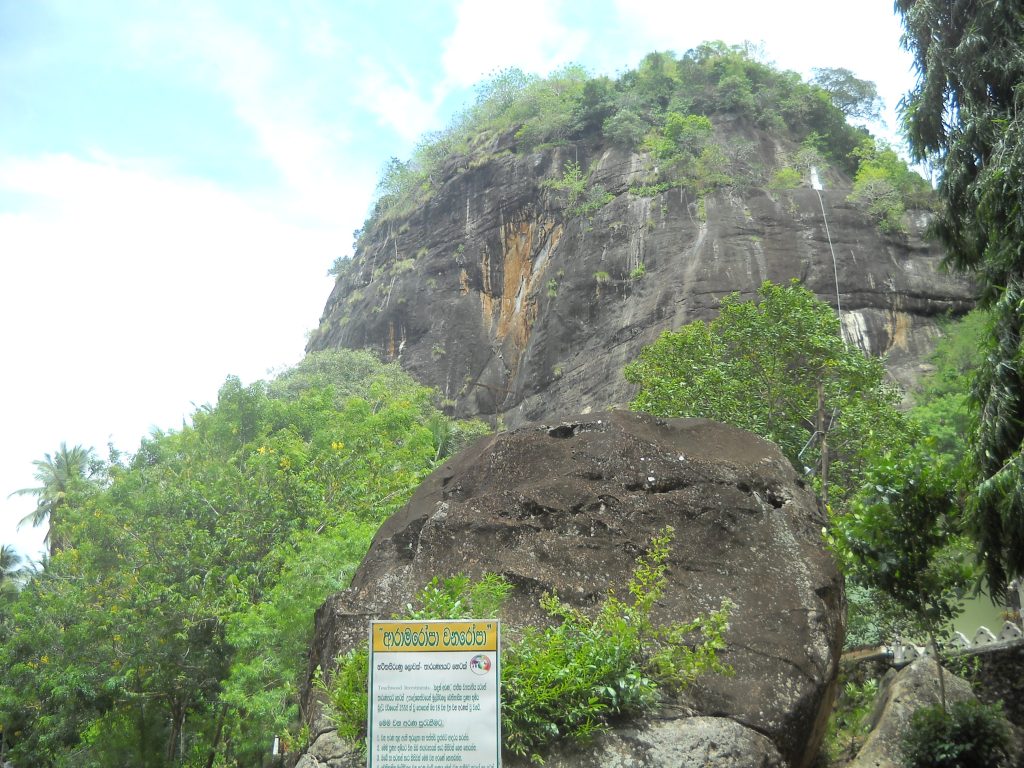

Mulkirigala Raja Maha Vihara is a Buddhist temple built into a 205-metre rock inland from Tangalle, in Hambantota District. Its cave shrines climb the rock on a series of terraces, joined by steep stone steps, and hold Buddha statues, including a large reclining Buddha, and wall paintings.
Is it worth visiting?
Go if you are staying on the south coast around Tangalle and want to see a working cave temple with painted shrines, as a half-day trip away from the beach.
Think twice if steep climbs are hard for you: the shrines are reached by long flights of steps, and the upper terraces are a stiff climb in the heat.
History
The site is more than 2,000 years old: early Brahmi inscriptions on the rock date from the 2nd–1st centuries BC. The Mahavamsa chronicle credits King Saddhatissa with building a temple here, and the site was developed again in the 18th century under the Kandyan king Kirti Sri Rajasinghe, when the Dutch knew the rock as “Adam’s Berg”.
The temple also has a place in the study of Sri Lankan history. In the 19th century the British civil servant George Turnour obtained a Pali commentary on the Mahavamsa preserved at Mulkirigala, which helped him with his English translation of the chronicle.

What to see
- The cave shrines: seven image houses (viharas) spread over the terraces, with statues of the Buddha, including a large reclining Buddha.
- The paintings: Kandyan-period murals of the life of the Buddha and Jataka stories, such as the Vessantara Jataka, line the shrines.
- The upper terrace: a Bo tree and a stupa.

Visiting the temple
- Dress and behaviour: this is a working temple. Cover your legs and shoulders and take off your shoes and hat at the shrines. Don’t pose for photos in front of or beside statues and murals, and don’t use flash, which can damage old paintings. See Sri Lanka Tourism’s travel tips.
- Tickets and hours: there is no official published fee or opening time. Recent visitors (2025–26) report paying an entrance ticket as foreign visitors, but reported amounts vary, so check at the entrance.
- The climb: visitors recommend going early in the morning, before the heat, and taking water.
Getting there
The temple is inland, off the roads from Tangalle and Dikwella on the south coast, and most visitors come by tuk-tuk or car from Tangalle. Tangalle is on the A2 coast road from Colombo through Galle and Matara; the coastal railway ends at Beliatta, inland from Tangalle. It is easy to combine with a few days on the beach, or with a stop at Koggala Lake or Unawatuna on the way along the coast.
Frequently asked questions (FAQs)
Where is Mulkirigala?
Inland from Tangalle and Dikwella on the south coast, in Hambantota District. Most visitors come by tuk-tuk or car from Tangalle.
How old is Mulkirigala temple?
Early Brahmi inscriptions on the rock date from the 2nd–1st centuries BC. The temple was developed again in the 18th century under King Kirti Sri Rajasinghe.
Is there an entrance fee?
No official fee is published. Recent visitors (2025–26) report an entrance ticket for foreign visitors, with varying amounts, so check at the entrance.
What should I wear?
Clothes that cover your legs and shoulders. Take off your shoes and hat at the shrines, and don’t pose for photos beside statues or murals.
What is the link with the Mahavamsa?
George Turnour obtained a Pali commentary on the Mahavamsa preserved at Mulkirigala, which helped him translate the chronicle into English in the 19th century.
Sources: en.wikipedia.org (Mulkirigala Raja Maha Vihara), ceylontoday.lk, thuppahis.com, archaeology.gov.lk, srilanka.travel, gov.uk, en.wikipedia.org (Coastal line (Sri Lanka)) and recent visitor reports. Header photo: Gobbler / Wikimedia Commons, CC BY-SA 3.0.