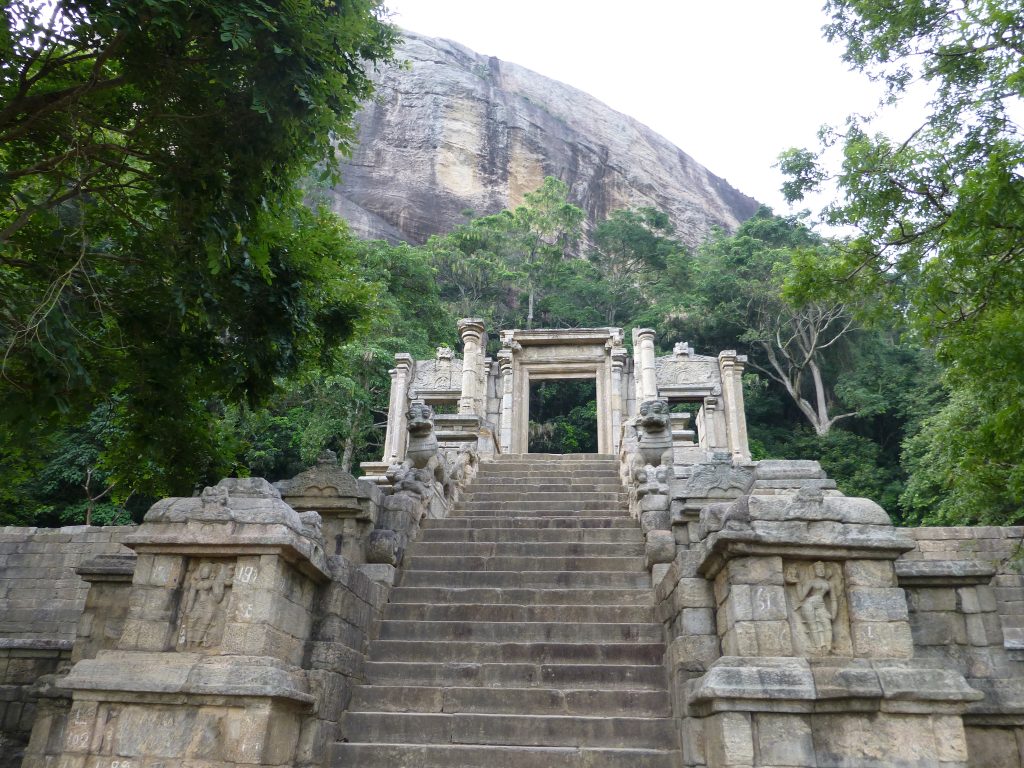
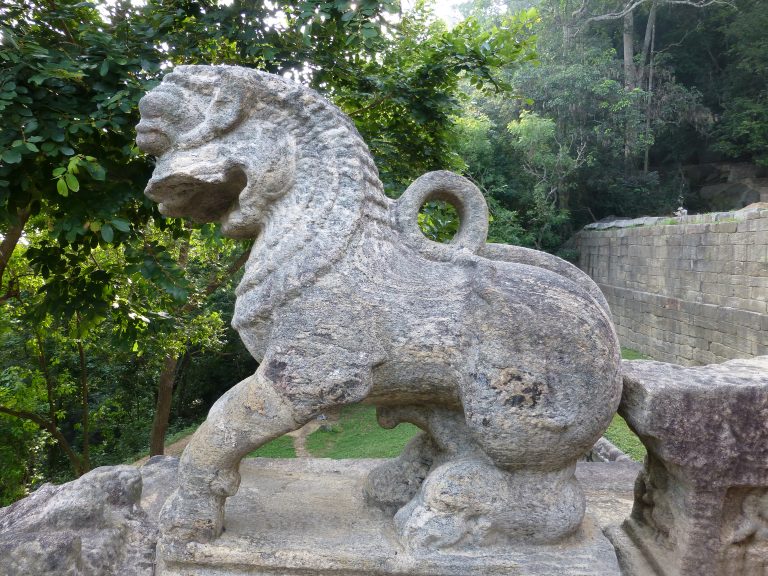

Yapahuwa is a granite rock in the Kurunegala District, between Kurunegala and Anuradhapura, that served for a short time as Sri Lanka’s royal capital in the 13th century. People come for one thing above all: a steep stone stairway carved with dancers, dwarfs and a pair of lions, climbing to a carved gateway high on the rock.
Is it worth visiting?
Go if you like carved stone and quiet ruins, and want a rock-fortress climb without Sigiriya’s queues. You can see the stairway closely, take your time over the details, and often have it almost to yourself.
Think twice if you dislike steep steps or heights. The upper flight is narrow and very steep, and the path above it to the summit is rough. Yapahuwa is also out on its own, so it works best as a stop on the road between Colombo or Kurunegala and Anuradhapura, not as a long detour.
A short-lived capital
King Buvanekabahu I (who reigned from 1272 to 1284) moved his court here from Dambadeniya in the early 1270s, when invasions from south India made the old capitals hard to defend. He brought the Tooth Relic with him and built a shrine for it on the rock. Below, he ringed the site with moats and ramparts.
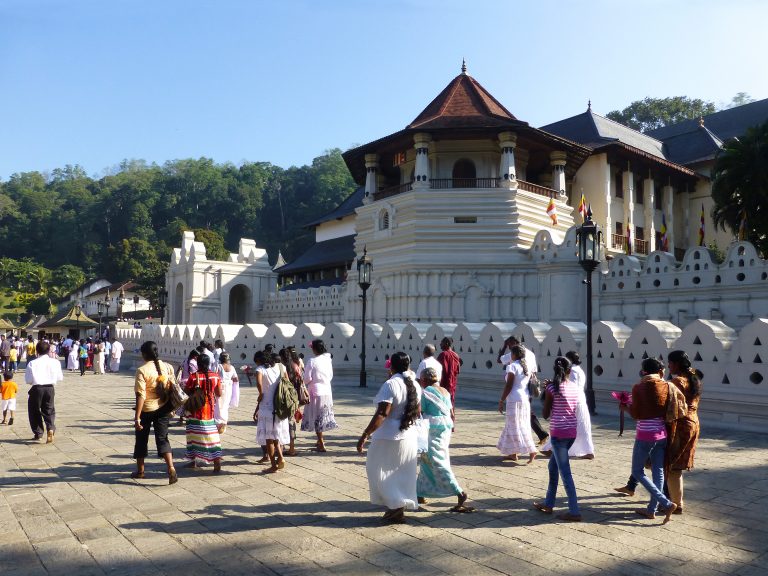
It did not last. After the king’s death in 1284, a Pandyan army from south India took Yapahuwa and carried the relic away. The relic was later brought back to Sri Lanka, but Yapahuwa never served as capital again, and the rock was left largely to monks. Today the relic is kept at the Temple of the Sacred Tooth Relic in Kandy.
Monks had been here long before the king. Monks lived in caves on the rock, and one cave carries an inscription in the early Brahmi script.
The stairway and the lions
This is why you come. The stairway climbs in stages through the old defences to an ornamental stone gateway. The final flight is the one to look at closely. Its balustrades end in makara, the mythical sea creatures of Sri Lankan temple art, and the stone panels along the sides are carved with dancers, guardian figures and the stocky dwarfs (gana) who seem to hold the structure up.
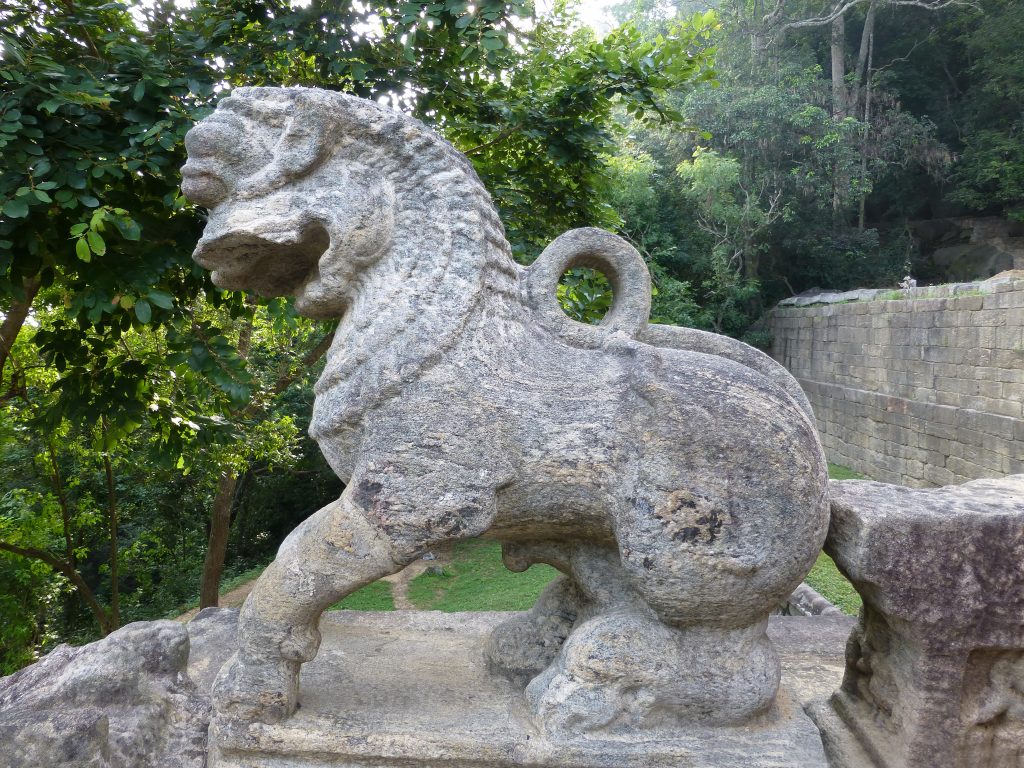
At the top, two stone lions sit either side of the steps. They have a style of their own, and the Central Cultural Fund notes that some scholars see Chinese influence in the stairway’s decoration, alongside clear south Indian (Pandyan) influence. A Yapahuwa lion was once on Sri Lanka’s 10-rupee note, in the series first issued in 1991.
Take your time here. The carvings are clearest in the early morning and late afternoon, when the light comes in low across them.
Up to the summit
Above the gateway, a steep path continues to the top of the rock. Recent visitors (2025–26) report about 20 minutes of scrambling on uneven ground, and say it is worth it for the open view over paddy fields and forest. On top are the remains of a stupa, a Bodhi tree enclosure and caves once used by monks. Only foundations and scattered ruins remain of the royal buildings.
Wear shoes with grip, not flip-flops. Recent visitors also warn about the monkeys around the entrance, so keep bags zipped and food out of sight.
At the foot of the rock
Two smaller sights are easy to add on the way out.
- Yapahuwa Rajamaha Vihara: a working temple at the base of the rock, founded in the Kandyan period. Its cave shrine holds Buddha statues and Kandyan-style paintings, which the Central Cultural Fund has recently conserved.
- The site museum: a small Department of Archaeology museum near the temple, open since 2010, with finds from Yapahuwa and boards on its history. Recent visitors mention sculptures and coins.

Both are religious or protected sites: cover your shoulders and knees, take off shoes and hats at the shrine, and don’t pose for photos with your back to a Buddha statue. Our guide to temple etiquette in Sri Lanka has the details.
Tickets and getting there
Yapahuwa is not on the Central Cultural Fund’s ticket price list, and no official price is published. Recent visitors (2025–26) report paying LKR 2,000 ($6.01 · convert) per foreign adult at the entrance, so carry cash. Also in Kurunegala District, the Arankele forest monastery has ancient meditation walkways in still-used forest.
The nearest main railway station is Maho Junction, where the line from Colombo divides for Anuradhapura and the east. From Maho, take a tuk-tuk to the site, or arrange a pick-up through your accommodation. With a car and driver, Yapahuwa fits neatly into a day’s drive from Colombo or Kurunegala towards Anuradhapura.
Compared with Sigiriya, Yapahuwa’s rock is smaller and its summit holds less, but its stairway is far more richly carved, and the Central Cultural Fund describes the climb as less strenuous. If you have time for both, see Sigiriya for the scale and Yapahuwa for the stonework.
Frequently asked questions (FAQs)
Why is Yapahuwa famous?
For its ornate 13th-century stone stairway with carved dancers, dwarfs and a pair of lions, and for its role as the royal capital that briefly held the Tooth Relic.
How much is the Yapahuwa entrance fee?
There is no official price online, and Yapahuwa is not on the Central Cultural Fund’s price list. Recent visitors (2025–26) report paying LKR 2,000 ($6.01 · convert) per foreign adult.
How hard is the climb at Yapahuwa?
The main stairway is short but very steep, and recent visitors report a further 20 minutes on a rough path to the summit. Wear shoes with good grip.
Is Yapahuwa better than Sigiriya?
They are different. Sigiriya is bigger and better known; Yapahuwa is quieter, with the more richly carved stairway.
How do I get to Yapahuwa by train?
Take a train to Maho Junction, on the line from Colombo towards Anuradhapura and the east, then a tuk-tuk to the site.
Header photo: Ji-Elle / Wikimedia Commons, CC BY-SA 3.0.