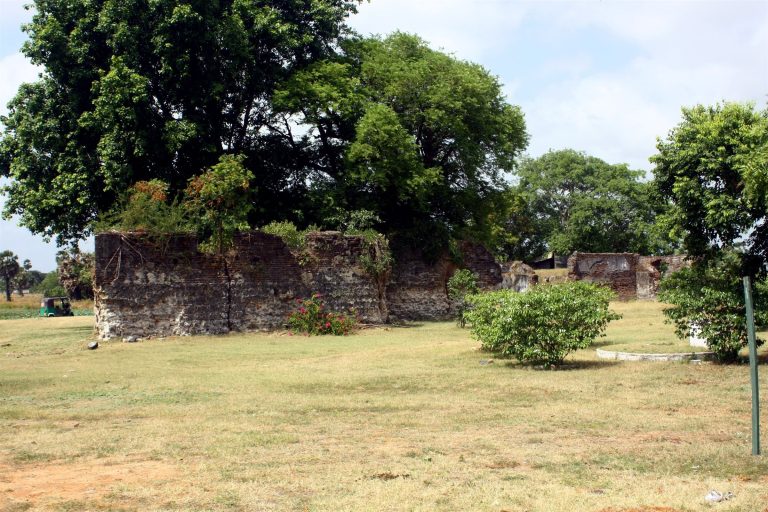
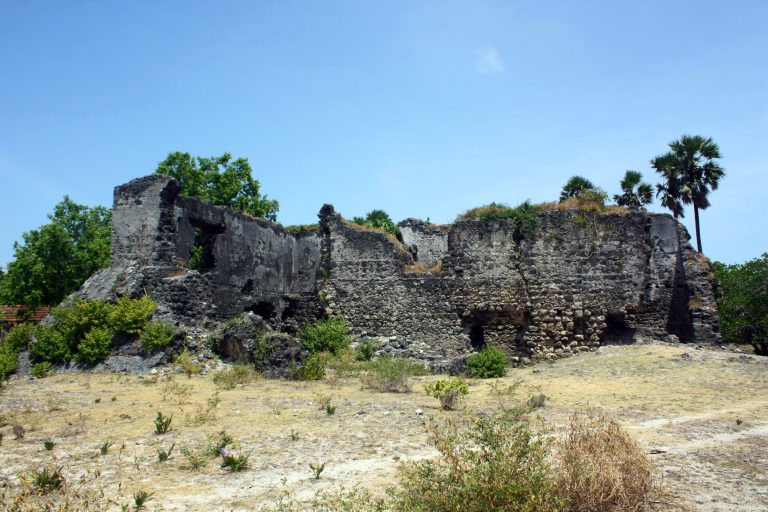
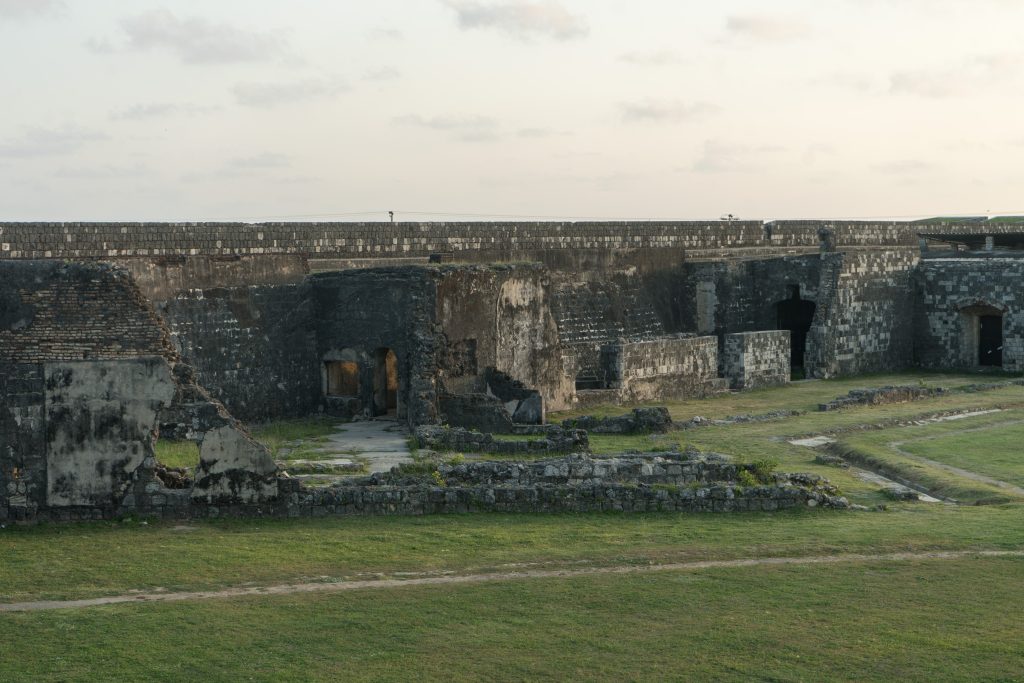
Jaffna Fort is the five-sided Dutch fort on the edge of the lagoon in Jaffna, a short walk from the town centre. You cross a moat to get in, climb onto the ramparts and walk round bastions rebuilt in coral stone. Inside, there is less than the walls promise: the civil war left the church, the governor’s houses and most other buildings as ruins, and much of the interior is lawn.
Is it worth visiting?
Go if you like old fortifications and wide views. From the ramparts you get the lagoon on one side and the town on the other, and the fort’s story, from the Portuguese to the Dutch, the British and three decades of war, is Jaffna’s own history in one place. It fits easily into a day in town.
Think twice if you are expecting a lived-in fort like the one in Galle, with streets, cafés and old houses to wander through. Here you get walls, ruins and closed-off sections, and almost no shade.
From Portuguese fort to Dutch star fort
The Portuguese built the first fort here early in the 17th century, after they took the kingdom of Jaffna. The Dutch captured it in 1658 and rebuilt it as a pentagon with a bastion at each corner, named after Dutch provinces: Holland, Zeeland, Utrecht, Gelderland and Friesland. Seen from above, the shape is a five-pointed star. The work went on for well over a century; the outer defences around the moat were still being finished in the 1790s.
The British took the fort in 1795 and kept a garrison here until 1948. By then the walls enclosed the old governor’s residence, the Queen’s House and the Kruys Kerk, a Dutch Reformed church built in 1706 in the shape of a Greek cross.
War damage and restoration
The fort was fought over during the civil war. In 1990 the LTTE besieged the army and police garrison inside for months; in September 1990 the army withdrew, and the LTTE held the fort until the army retook Jaffna in 1995. The shelling and fighting wrecked almost everything inside the walls. The 1706 church was left as rubble and the Queen’s House as a shell. Local people also carried off stone to rebuild homes destroyed in the war.
After the war ended in 2009, the Department of Archaeology began conserving the fort, with part of the money coming from the government of the Netherlands. Before work could start, the moat and the grounds had to be cleared of mines, shells and hidden ammunition. The bastions and ramparts have since been rebuilt with new coral stone, which you can pick out by its paler colour. The Department still lists the fort’s conservation as an ongoing project, and the buildings inside remain ruins.
What you can walk today
- The moat and outer works: walk round the outside first. The wide grassy slopes, the outer walls and the water-filled moat show how the Dutch layered their defences.
- The ramparts and bastions: the main reason to come. Climb up and follow the walls for views over the lagoon and back across the town.
- The church ruins: broken sections of the Kruys Kerk’s thick walls, which give you an idea of its size.
- The Queen’s House: the shell of the British-era residence. The Daily News described it in 2021 as crumbling and marked unsafe, so look from outside.
- Closed areas: some parts are fenced off for restoration work, and recent visitors (2025–26) report that others are still used by the army. Don’t photograph soldiers or military buildings.
Tickets, timing and practical tips
Tickets. Recent visitors (2025–26) report a ticket office at the main entrance and a fee of about USD 5 for foreign adults, paid in rupees, with a much lower price for Sri Lankans. No official price list or opening hours are published, so check at the gate. From Jaffna you can also take the boat to Nainativu for the Nagapooshani Amman Temple and the Nagadeepa Purana Viharaya.
When to go. The fort is open ground with almost no shade, and Jaffna is hot for much of the year. Go in the early morning or the late afternoon; late in the day you can watch the sun go down over the lagoon from the ramparts.
What to bring. Water, a hat and shoes with some grip; the paths and steps are uneven stone.
Getting there. The fort is on the lagoon shore at the edge of the town centre, a short tuk-tuk ride from the public library. Walk from the centre or take a tuk-tuk.
Around the fort. Combine it with the library and an evening puja at Nallur Kandaswamy Temple. If forts are your thing, the Portuguese and Dutch fort on Mannar Island is on the road south, and a ruined one, Pooneryn Fort, stands on the southern shore of the lagoon. Our week in northern Sri Lanka fits all of these into one trip. Our guide to colonial forts in Sri Lanka compares them with Galle and the east-coast forts.
Frequently asked questions (FAQs)
Who built Jaffna Fort?
The Portuguese built the first fort early in the 17th century. The Dutch captured it in 1658 and rebuilt it as a five-sided fort, and the British held it from 1795 to 1948.
Can you walk on the walls of Jaffna Fort?
Yes. The ramparts and bastions have been rebuilt and you can walk along them, though some sections are closed for restoration or used by the army.
Is there an entrance fee for Jaffna Fort?
Recent visitors (2025–26) report a fee of about USD 5 for foreign adults, paid in rupees at the main entrance. No official price list is published, so check at the gate.
What happened to Jaffna Fort during the war?
The LTTE besieged the garrison in 1990 and held the fort from September 1990 until the army retook Jaffna in 1995. The fighting destroyed most buildings inside, including the 1706 Dutch church; the Department of Archaeology has been restoring the walls since the war ended.
When is the best time to visit Jaffna Fort?
Early morning or late afternoon, because there is almost no shade. In the late afternoon you can watch the sunset over the lagoon from the ramparts.
Header photo: Alexey Komarov / Wikimedia Commons, CC BY-SA 4.0.