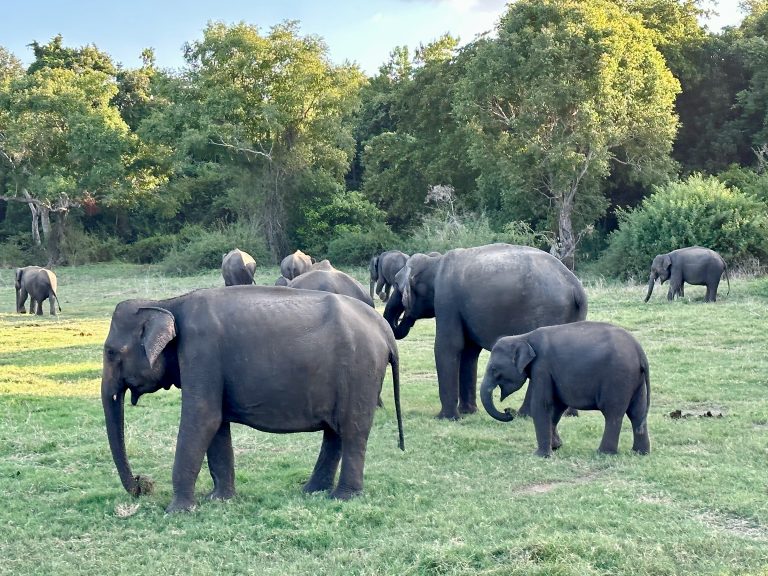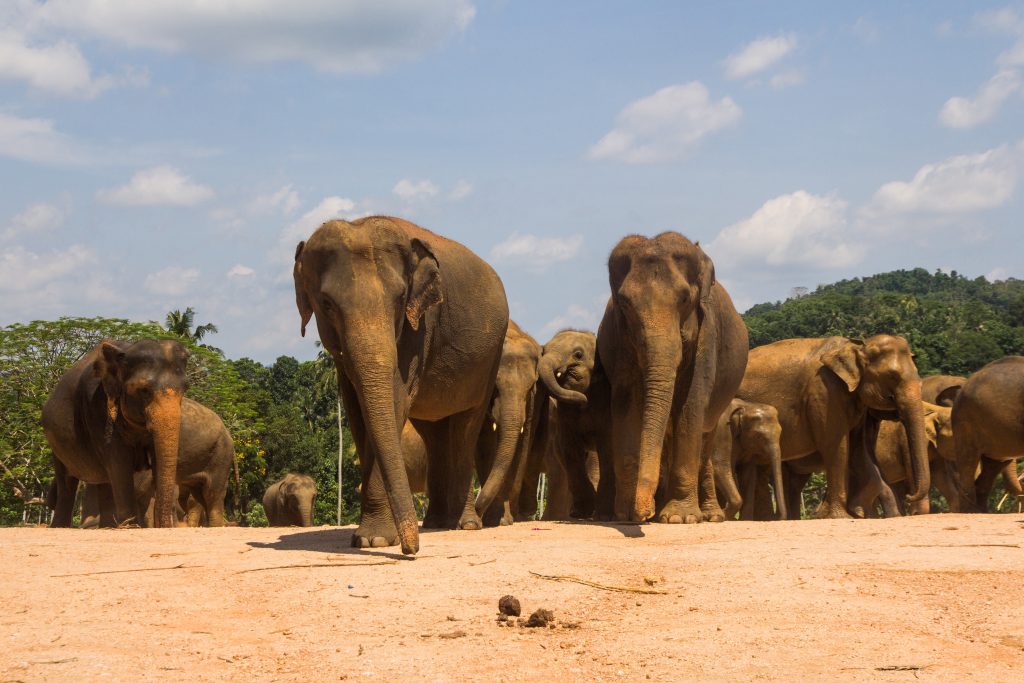
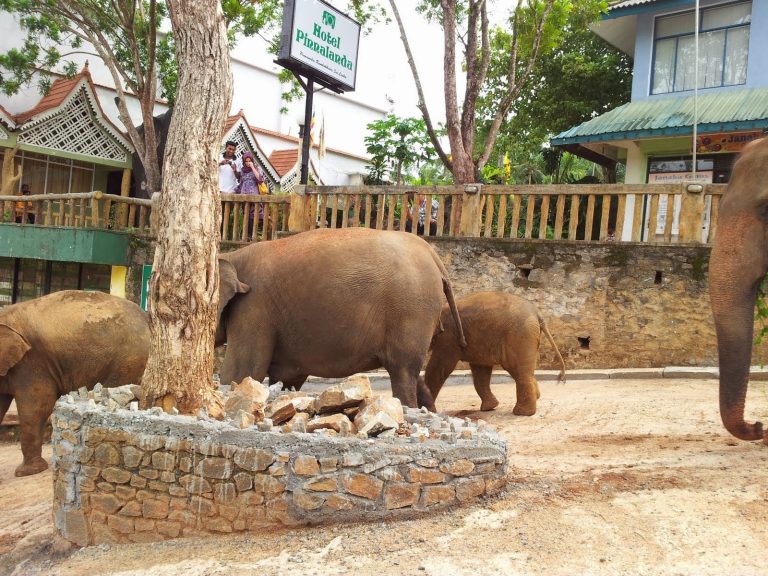
If you want to see elephants in Sri Lanka, you have two very different choices. Pinnawala Elephant Orphanage, near Kegalle on the way from Colombo to Kandy, is a government-run captive herd. There you watch elephants close up at feeding and bathing times. A safari in a national park such as Minneriya, Kaudulla or Udawalawe is different. From a jeep, you see wild elephants living on their own terms. This guide sets out what each involves, what animal welfare groups say, and how to choose.
The short answer
- Choose a wild safari if the welfare of the animals matters to you and you can spare half a day near a park. World Animal Protection’s advice is that the best place to see elephants is in the wild.
- Choose the Elephant Transit Home at Udawalawe if you want to see young elephants close up. Staff raise orphaned calves there for release back into the wild, and visitors only watch.
- Think carefully about Pinnawala, especially its paid extras such as bathing, feeding and walking with an elephant. They are exactly the kind of hands-on contact that welfare groups advise tourists to avoid.
Pinnawala or the wild: is it right for you?
Pinnawala suits you if you are travelling between Colombo and Kandy without time for a safari, or with small children or someone who can’t manage a bumpy jeep ride. You also need to be comfortable with a captive setting. You will see a large herd, guaranteed, at set times.
A wild safari suits you if you would rather see elephants behave naturally, in family groups that choose where to go. You also need to accept that there are no guarantees. Expect an early start or a hot afternoon in an open jeep, and more distance between you and the animals.
What Pinnawala is
The Department of Wildlife Conservation set up Pinnawala Elephant Orphanage on 16 February 1975 with five orphaned calves. Today the Department of National Zoological Gardens runs it. Its first calf was born in 1984. The department says it has recorded 76 births since then, including the first twins in 2021. Sri Lanka Tourism describes the herd as the largest captive herd of elephants in the world.
The name can mislead. The orphanage now breeds elephants as well as caring for orphans, and it does not aim to return its herd to the wild. The department describes the herd as a conservation population kept under human care. It could support reintroduction, the department says, only if wild populations declined drastically or disappeared.

The day revolves around the herd’s walks to the Ma Oya river. According to the department’s published schedule, the main herd goes down to bathe from 10 am to noon and again from 2 to 4 pm. A smaller group of about seven goes at 8.30 am and at noon. Beside the standard ticket, the department sells three extras. There is a basket of fruit to feed the elephants, a 10-minute pass to bathe an elephant in the river, and a 10-minute “Elephant Walk” beside one. The walk began in July 2026.
What welfare groups say
World Animal Protection surveyed elephant tourism venues across Asia, including Sri Lanka, between November 2014 and May 2016. In its 2017 report, the venues with the best conditions gave elephants chain-free space, social lives with other elephants on their own terms and the chance to forage. Visitors there had little or no direct contact with them. Its current advice to travellers is to visit only places where you look rather than touch. Elephants that tolerate riding, bathing or close contact with people have had to be trained to accept it.
Pinnawala has drawn criticism on these grounds for years. In 2023 an elephant expert quoted by the Sunday Times said that tourist bathing and feeding stressed the elephants. The expert also said that staff kept aggressive bulls chained in a barn away from the herd. The department has made changes too. In 2025 it opened a Rs 66 ($0.20 · convert) million enclosure so that bulls in musth (a period of heightened aggression) no longer have to stand chained to trees. Its director general told the Sunday Times that the elephants’ well-being was its priority. Recent visitors (2025–26) still report chained elephants, crowds at the river, and keepers asking for tips in return for a photo or a touch. The department’s own rules tell you not to give money to anyone who isn’t providing an official service.
How to judge any elephant attraction
These questions, based on World Animal Protection’s criteria, work anywhere in Sri Lanka:
- Can you only watch? If a venue offers riding, bathing, feeding by hand or a selfie with an elephant, someone has trained the animal to put up with it.
- Are the elephants chained? Look at the animals that aren’t on show, not just the ones in the river.
- Do they live in a group and move freely? Elephants are social animals; the best venues let them choose their company and roam.
- What is the goal? A place that raises orphans for release into the wild is doing something different from one that breeds elephants for display.
- Are calves on display for contact? Baby elephants handed around for photos are a warning sign.
The same thinking applies to leopards, whales and temple animals; our guide to responsible travel in Sri Lanka sets out the rules and the choices.
The Elephant Transit Home at Udawalawe
If young elephants are what you want to see, this is the better choice. The Department of Wildlife Conservation runs the Elephant Transit Home beside Udawalawe National Park. It takes in calves orphaned or separated from their herds, raises them, and releases them into the national park when they are old enough. In July 2025 the Transit Home released six young elephants, its 26th release.
Visitors watch the calves at feeding time. Recent visitors (2025–26) report watching from a viewing area, with no touching, bathing or riding. World Animal Protection’s 2017 report listed the Transit Home among the venues with the best welfare conditions it found in Asia. The department does not publish feeding times online, so ask locally or at the park office on the day.
Seeing elephants in the wild
Minneriya and Kaudulla are two neighbouring national parks between Habarana and Polonnaruwa, linked by a jungle corridor the herds use. In the dry season, elephants come to graze on the grass exposed as the reservoirs shrink. People call this “the Gathering”. Sri Lanka Tourism names May to October as the time to go. Herds often move on to Kaudulla around September. Most jeeps leave from Habarana or Sigiriya. Recent visitors (2025–26) report that jeeps can bunch up around the herds. A good driver who keeps a respectful distance makes all the difference.
Udawalawe National Park, on the border of Ratnapura and Monaragala districts, is above all an elephant park, and the Transit Home is right beside it.
In every park you enter with a Department of Wildlife Conservation permit and travel in a safari jeep. Stay in the vehicle, keep your voice down and never feed wild elephants.
Visiting Pinnawala
If you do go, you can still make choices that put less pressure on the elephants. Watch the bathing from the riverbank rather than buying a bathing, feeding or walking pass. And don’t pay anyone for a photo or a touch.
- Opening hours: the orphanage opens at 8.30 am and the ticket counter closes at 5 pm.
- Tickets: foreign adults pay USD 17.70 and foreign children USD 8.85. A combined ticket with the nearby Pinnawala Zoo costs USD 23.60 and USD 11.80. See the Department of National Zoological Gardens’ Pinnawala page for current prices and times.
- Getting there: Sri Lanka Tourism’s directions are to leave the A1 Colombo–Kandy road at the 82 km post at Kegalle and turn left at Karandupona junction. The nearest railway station is Rambukkana, about 2 km away, on the main line from Colombo. Pinnawala fits into a day’s drive between Colombo and Kandy. On the same road, a side road from Nelundeniya junction leads to Dedigama Kota Vehera, the brick stupa built where King Parakramabahu I was born.
Frequently asked questions (FAQs)
Is Pinnawala Elephant Orphanage ethical?
It depends on what you will accept. Pinnawala breeds elephants in captivity and does not return its herd to the wild. It also sells bathing, feeding and walking experiences that World Animal Protection advises tourists to avoid. Recent visitors also report chained elephants.
Can you bathe with elephants at Pinnawala?
Yes, the department sells 10-minute bathing passes in the Ma Oya. Welfare groups advise against bathing, feeding or touching elephants, because the animals have to be trained to accept it.
What time do the elephants bathe at Pinnawala?
According to the department’s schedule, the main herd bathes in the Ma Oya from 10 am to noon and from 2 to 4 pm. A smaller group goes at 8.30 am and at noon.
Is the Udawalawe Elephant Transit Home better than Pinnawala?
For welfare, yes by World Animal Protection’s measure. The Transit Home raises orphaned calves to release them into Udawalawe National Park, and visitors only watch.
Where can I see wild elephants in Sri Lanka?
Minneriya, Kaudulla and Udawalawe national parks are all famous for their elephants. Minneriya and Kaudulla are at their best in the dry season, when the herds gather by the reservoirs.
Header photo: Alexey Komarov / Wikimedia Commons, CC BY-SA 4.0.