The Portuguese, the Dutch and the British each fought over Sri Lanka’s coast for its harbours, cinnamon and pearls, and they left a ring of forts behind them. Some are still lived in, some are army or navy bases, and some are ruins in a cow field. Galle is the famous one, but the forts in Sri Lanka are worth seeking out well beyond it, and each tells a different part of the story.
A short timeline
- The Portuguese reached the island in 1505 and came to control much of the coast.
- The Dutch East India Company took the coastal territories from them between 1640 and 1658 and held them until 1796. Most of the forts you can walk today are largely their work.
- The British took over from 1796, and in 1815 they took the hill kingdom of Kandy as well.
For the wider story, see a short history of Sri Lanka.
Galle Fort: the one to see if you see one
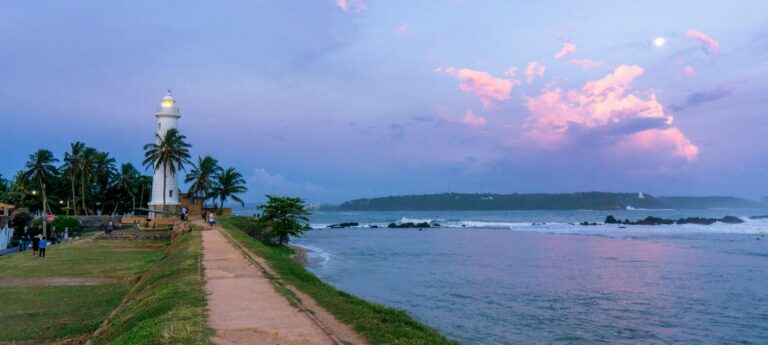
Galle Fort is a whole walled town on a headland, listed by UNESCO in 1988. The Dutch took Galle in 1640 and finished most of the present walls in 1663; the ramparts, with 14 bastions, enclose about 52 hectares of streets, churches, a mosque, museums and cafés. UNESCO calls it the best example of a fortified city built by Europeans in South and South-East Asia.
There’s no ticket. Walk the ramparts early or late, because there is almost no shade, and keep children close: much of the outer edge has no railing. Three bastions hold small galleries in their old powder stores. Our Galle guide covers the museums, and Galle: day trip or overnight makes the case for staying a night inside the walls.
The north: Jaffna, Mannar and Pooneryn
Jaffna Fort is a five-sided Dutch fort on the lagoon, rebuilt after the Dutch captured it in 1658 and held by the British until 1948. It was fought over during the civil war, which left the church, the governor’s houses and most buildings inside as ruins. The bastions and ramparts have since been rebuilt in coral stone, and you can walk them. Recent visitors (2025–26) report a fee of about USD 5 for foreign adults, paid in rupees.
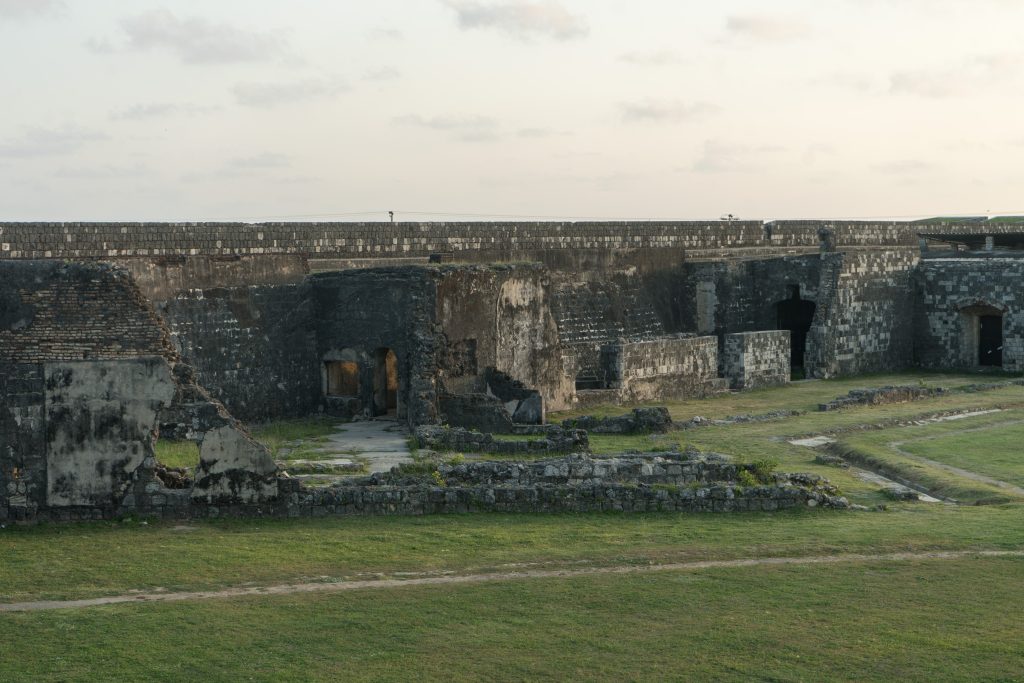
Mannar Fort, at the island end of the bridge onto Mannar, was built by the Portuguese in 1560, taken by the Dutch in 1658 and by the British in 1795. It’s small, with no displays, but you can walk all the way round the walls. Recent visitors describe walking straight in.
Pooneryn Fort, on the A32 between Mannar and Jaffna, is a ruin of low, overgrown walls, a short stop on a long drive. And on Delft Island, the coral-stone ruins of an old fort sit among the ponies and coral walls.
The east: Trincomalee and Batticaloa
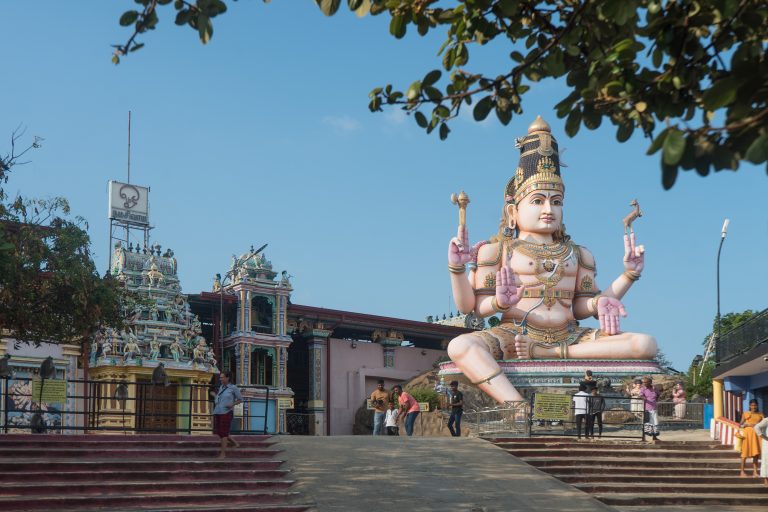
Fort Frederick guards the headland at Trincomalee, and everyone going up to Koneswaram Temple passes through its gate, which carries the words “Anno 1675”. It’s still an army base: you can use the approach road and see some of the ramparts, but photography is restricted in military areas. The Central Cultural Fund’s price list gives a Trincomalee ticket of USD 12 for foreign adults; visitors’ reports of what they actually paid vary.
Batticaloa Fort is a small square fort on an island in the lagoon. The Portuguese finished it in 1628, and in 1638 a Dutch fleet and the King of Kandy’s army took it together, then signed the treaty that sealed their alliance against the Portuguese. Recent visitors (2025–26) report that you can walk in free during the day and climb onto the ramparts.
The south: Matara
Matara has two Dutch forts a few minutes’ walk apart. The main fort, on the point between the Nilwala river and the sea, is still part of the town, with courts and offices inside its walls. Nearby, the six-pointed Star Fort, built between 1763 and 1765, has a carved gate, a restored drawbridge and a small Department of Archaeology museum. The department says there is no entrance ticket to its museums, but it doesn’t allow photographs of the antiquities.

The west coast: Kalpitiya and Colombo
The Dutch built the fort at Kalpitiya between 1667 and 1676 to command the entrance to the Puttalam Lagoon. It stands inside a navy base; visitors report being shown round by a sailor after showing ID, without photography.
In Colombo’s Fort district, the Old Dutch Hospital, built by the Dutch East India Company in the 17th century, is now a courtyard of restaurants and shops.
Visiting forts that are still bases
Fort Frederick and Kalpitiya are working military sites, and parts of Jaffna Fort are used by the army, recent visitors report. The same rules apply at all of them:
- Carry your passport or a copy for the gate.
- Don’t photograph soldiers, sentries, checkpoints or military buildings. Ask if you’re unsure.
- Keep to areas that are clearly open.
- Don’t fly a drone; see our drone rules guide.
At every fort, go early or late. Ramparts are open stone and grass with very little shade, and the edges are often unguarded.
Which forts to see
- One fort only: Galle, ideally with a night inside the walls.
- Exploring the north: Jaffna, with Mannar and Pooneryn on the road south. Our northern Sri Lanka in 7 days itinerary fits all three.
- On the east coast: Fort Frederick with Koneswaram, and Batticaloa as a day trip; see our east coast itinerary.
- On the south coast: Matara’s two forts, with Dondra Head the same morning.
Frequently asked questions (FAQs)
What is the best fort to visit in Sri Lanka?
Galle Fort. It is a lived-in old town on a headland, listed by UNESCO, with ramparts you can walk all the way round and no entrance ticket.
Who built the forts in Sri Lanka?
The Portuguese built the first ones in the 16th and early 17th centuries. The Dutch captured and rebuilt most of them between 1640 and 1658, and the British took them over from 1795.
Is there an entrance fee for Galle Fort?
No. The fort is a lived-in town; you pay only for the museums and bastion galleries.
Can you visit Fort Frederick in Trincomalee?
Yes. It’s still an army base, but visitors can use the approach road to Koneswaram Temple and see some of the ramparts. Photography is restricted in military areas.
Which forts are in northern Sri Lanka?
Jaffna Fort, Mannar Fort, the ruins of Pooneryn Fort and the old fort on Delft Island.
Header photo: Bel Adone / Wikimedia Commons, public domain.