Check before you travel Kumana and Gal Oya national parks: campsites closed because of drought Checked 3 October 2026
Because of severe drought, the Department of Wildlife Conservation closed the campsites inside Kumana National Park (Ada Kumbuka I and II, Gal Amuna, Heraligaskara and Moyakata) on 2 September 2026 and cancelled existing bookings. The same announcement closed the camping facilities at the Hathpotha entrance of Gal Oya National Park. The department has not given a reopening date; it says this depends on rainfall, and that visitors whose bookings were cancelled will be offered other dates. Check with the department before you plan to camp.
Gal Oya National Park lies in the east of Sri Lanka, where Eastern and Uva provinces meet, around Senanayake Samudraya, the country’s largest reservoir. Most visitors see it from a boat: you cross the reservoir from Inginiyagala, past wooded islands where birds nest and elephants come out to feed.
Is it worth visiting?
Go if you want a safari that feels nothing like a jeep queue: open water, forested hills on every side and, with luck, elephants on the shore or in the water. It also makes a good inland detour from the east coast around Arugam Bay.
Think twice if you only have a few hours. Gal Oya is off the main tourist routes and it takes planning to get a boat, but nothing is certain: some trips see plenty of elephants, others very few.
The park and the reservoir
The Gal Oya irrigation scheme, in the years just after independence, dammed the Gal Oya river at Inginiyagala to create Senanayake Samudraya. The reservoir takes its name from D. S. Senanayake, Sri Lanka’s first prime minister, though locally people simply call it “the sea”. The national park dates from 1954, and its purpose was to protect the reservoir’s catchment. According to the Department of Wildlife Conservation (DWC), parks like this one also aimed to give a home to animals displaced by the big irrigation projects.
The landscape is bigger and hillier than most lowland parks. Evergreen forest and open grassland run down to the water, and peaks such as Nilgala and Danigala rise behind. Danigala was once home to the Henebedda Veddas, Sri Lanka’s indigenous forest people. Several Vedda settlements disappeared with the creation of the reservoir, and families moved to new villages nearby.
The boat safari
Boats cross the reservoir from Inginiyagala, near the dam. On the way you pass Bird’s Island, where birds, eagles among them, nest. You also pass Makaraya (“dragon’s mouth”), where the Gal Oya river pours into the reservoir through a natural tunnel and forms a whirlpool. Sri Lanka Tourism describes elephants swimming out to the islands to feed as a common sight at dusk in the dry season.
Recent visitors (2025–26) describe elephants crossing between islands with only their trunks above the water, and a herd of 30 or 40, calves included, on a single island. Others, however, go out and see far fewer. Go early in the morning or late in the afternoon, when animals are most active and the light on the water is softer. Take sun protection too, because you are on open water the whole time.
To book, ask your lodge to arrange a boat or go to the DWC park office at Inginiyagala, ideally a day ahead. DWC sets the park fees, but its website doesn’t publish current Gal Oya rates. Confirm the full price, including the boat, guide and park ticket, before you go out. DWC also sells day-visitor permits online through its day-permit page.

Wildlife and birds
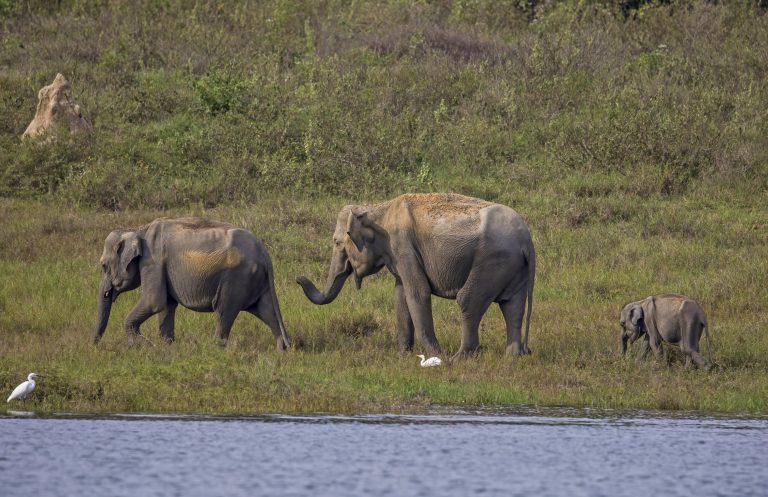
Elephants are the main draw, and you can see them in the park all year. Other mammals include leopards, sloth bears, sambar and spotted deer, water buffalo, wild boar, toque macaques and langurs, while mugger crocodiles live along the shore.
For birders, the reservoir brings in spot-billed pelicans, painted storks, cormorants and lesser whistling ducks. The big raptors are a highlight too, so look for white-bellied sea eagles and grey-headed fish eagles over the water. The lesser adjutant and the red-faced malkoha also live in the park.
Camping and travel updates
DWC runs campsites inside the park. However, they can close at short notice in a drought; see the travel update at the top of this page.
Getting there
Inginiyagala is in Ampara District, south-west of Ampara town. Ampara is the nearest town on the bus network. From there, or from the coast, you need a car, a tuk-tuk or a transfer arranged by your lodge. You reach the Nilgala side of the park from Bibila, where DWC has a range office.
Planning a wider trip in the east? Start with our east coast itinerary. Comparing ways to see elephants? Read Pinnawala or wild elephants.
Frequently asked questions (FAQs)
Can you see elephants swimming at Gal Oya?
It is possible, but not guaranteed. Sri Lanka Tourism describes elephants swimming out to the reservoir’s islands to feed, especially at dusk in the dry season. Recent visitors report seeing it, while others see few elephants.
Where does the Gal Oya boat safari start?
At Inginiyagala, near the Senanayake Samudraya dam, where the DWC park office is. Book through your lodge or at the office, ideally a day ahead.
What is Senanayake Samudraya?
Sri Lanka’s largest reservoir, created by damming the Gal Oya river at Inginiyagala and named after D. S. Senanayake. Gal Oya National Park protects its catchment.
Can you camp in Gal Oya National Park?
DWC has campsites in the park, but they can close during droughts. Check the travel update at the top of this page before you book.
Sources: srilanka.travel (attraction&), srilanka.travel (attraction&), srilanka.travel (attraction&), en.wikipedia.org (Gal Oya National Park), en.wikipedia.org (Senanayake Samudraya), lk.chm-cbd.net, dwc.gov.lk, dwc.gov.lk, dwc.gov.lk, newswire.lk and recent visitor reports. Header photo: G.Kiruthikan / Wikimedia Commons, CC BY-SA 4.0.