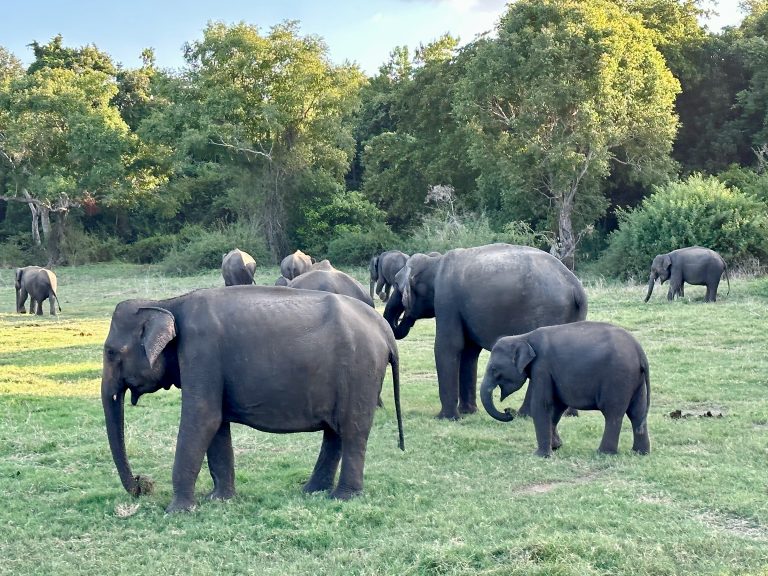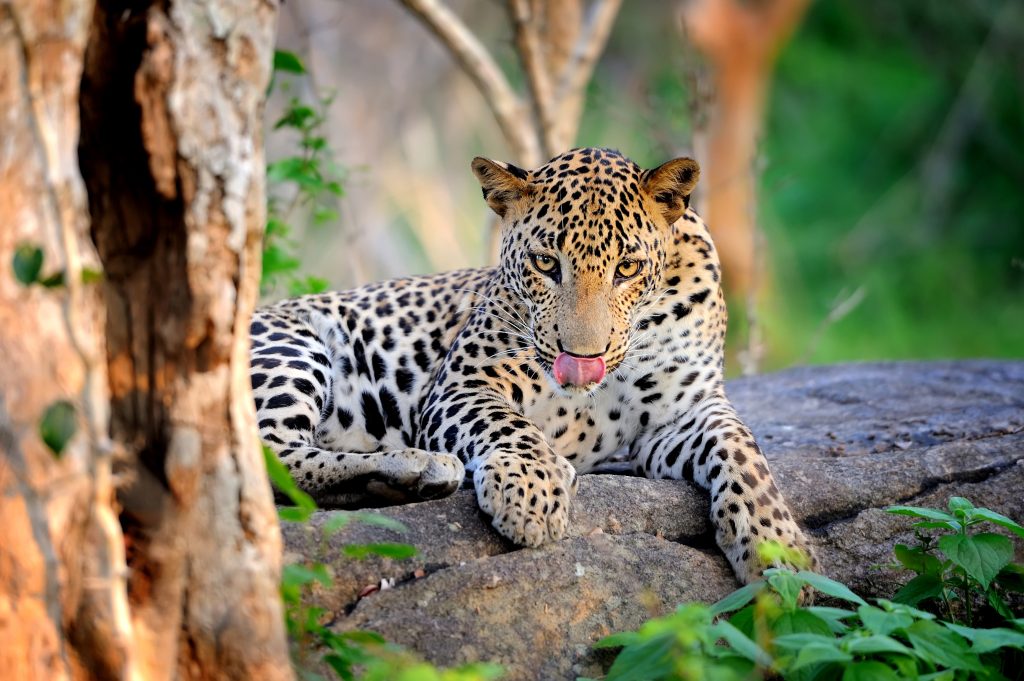

If you have time for one safari in the south, it is usually a choice between these two. The short version: go to Yala for the chance of a leopard, and to Udawalawe for elephants you can watch for as long as you like. Yala is wilder-looking and much busier; Udawalawe is open, easier and more predictable. If leopards are the point and your route also goes north, see Wilpattu or Yala.
Both are run by the Department of Wildlife Conservation (DWC), both are seen from a jeep, and both fit into a trip between the hill country and the south coast. This page compares them side by side. For tickets, rules and the detail of each park, see our guides to Yala National Park and Udawalawe National Park.
Choose Yala if
- A leopard is the animal you most want to see. Yala has one of the highest leopard densities in the world, and the DWC describes Blocks I and II as the best areas for them.
- You like variety: elephants, water buffalo, spotted deer, sloth bears and crocodiles live here too, and the lagoons draw storks and pelicans.
- You don’t mind company. Block I, where most safaris go, is very busy, and jeeps often bunch round a leopard.
Choose Udawalawe if
- Elephants are the point. Herds come to the reservoir and the rivers, and the open grassland makes them easy to see and watch.
- You’d like a calmer, simpler safari, or you’re travelling with children who may not enjoy hours of searching for a cat that may not show.
- You’re passing between the hill country and the coast and want a safari without much of a detour.

Side by side
- The big draw. Yala: leopards. Udawalawe: elephants. Leopards live in Udawalawe too, but visitors rarely see them.
- Landscape. Yala runs down to the Indian Ocean coast, with scrub, rocky outcrops, lagoons and tanks. Udawalawe is open grassland and scrub round a big reservoir, where dead trees still stand in the water.
- Crowds. Yala’s Block I is very busy, and crowding round leopards is a long-running problem there. At Udawalawe jeeps gather at the best spots too; recent visitors (2025–26) report that midweek mornings are quieter than weekends and holidays.
- Where you stay. For Yala, most people stay in or around Tissamaharama, the town closest to the main Palatupana entrance. For Udawalawe, the town of Udawalawe has jeep operators and guesthouses.
- Closures. The DWC has traditionally closed Yala’s main blocks in the driest months, around September and October, and heavy rain can close it at short notice. Udawalawe is open all year. Any current closure is shown at the top of the Yala guide.
- Extras. Udawalawe has the DWC’s Elephant Transit Home next door, where orphaned calves are raised for release. Yala has two old Buddhist sites inside the park, Sithulpawwa and Magul Vihara.
How the safari works at both
You go in a 4×4 with a driver, usually for three to four hours, early in the morning or late in the afternoon, when animals are most active and the heat is bearable. Sri Lanka Tourism says dawn and dusk are the best times for a safari at Yala. You need a DWC permit for the park as well as the jeep; the DWC doesn’t currently publish a fee table on its site, so confirm the total price before you set off. At both parks, stay in the vehicle: walking outside your jeep breaks park rules, and in June 2026 five visitors were arrested at Yala for doing it.
Recent visitors report that jeeps are hired by the vehicle, so the price is the same whether two or six people share it. If you’re travelling alone or as a couple, ask your guesthouse whether anyone else is going.
Can you do both?
Yes, and plenty of people do. They are close enough to combine on a route from the hills to the coast: Udawalawe on the way down, then Tissamaharama for Yala the next morning, or the other way round. If you only have one morning, pick by the animal you care about most. Our wildlife safari itinerary puts both into a longer trip, and our guide to Pinnawala or wild elephants explains why seeing elephants in a park beats a captive attraction.
Frequently asked questions (FAQs)
Which is better, Yala or Udawalawe?
It depends on what you want to see. Yala is the place for leopards, with one of the highest densities in the world. Udawalawe is better for elephants and for a calmer safari across open grassland.
Can you see leopards at Udawalawe?
Leopards live there, but visitors rarely see them. For a realistic chance, go to Yala, where the DWC says Blocks I and II are the best areas.
Is Yala too crowded?
Block I, where most safaris go, is very busy, and jeeps often bunch round leopard sightings. Udawalawe, with its open grassland, is the calmer choice.
Is Yala open all year?
Not always. The DWC has traditionally closed the main blocks in the driest months, around September and October, and heavy rain can close it at short notice. Udawalawe is open all year.
Can I visit Yala and Udawalawe on the same trip?
Yes. Both lie between the hill country and the south coast, so you can do Udawalawe on the way down and Yala from Tissamaharama the next morning.
Header photo: Volodymyr Burdiak / Wikimedia Commons, CC BY-SA 4.0.