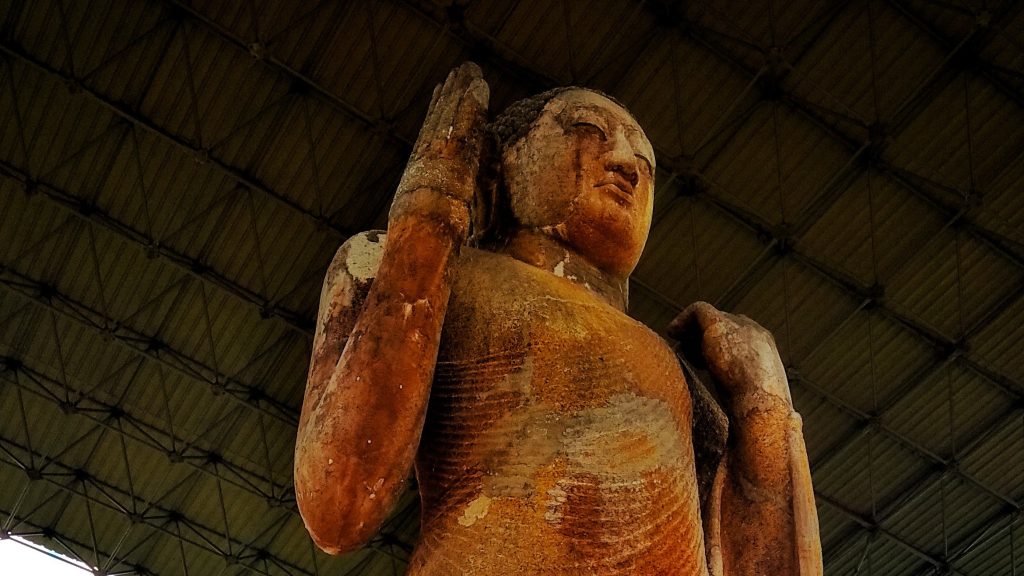
At Maligawila, in the dry-zone forest of Monaragala District, a colossal standing Buddha rises above the brick ruins of an ancient image house. It is carved from a single block of limestone. A short walk away, at the top of a long flight of steps, stands a second giant: the Dambegoda bodhisattva. Both statues were found fallen and broken in the 20th century, and both now stand upright again.
Is it worth visiting?
Go if early Buddhist sculpture interests you, or you are exploring the Monaragala area. Here you can see two huge ancient statues in a quiet forest setting, with cicadas and monkeys in the trees around you.
Think twice if you are short of time, because Maligawila is a detour into the countryside, away from the main tourist routes. Apart from the two statues and the ruins around them there is little else to see. It works best as part of a wider trip through the region.
The standing Buddha
The Department of Archaeology dates the Buddha to the 7th–8th century AD. It identifies Maligawila with the Ariyakara Vihara named in the chronicles. According to the chronicle tradition, a prince called Aggabodhi, who ruled Ruhuna in the 7th century, built a great Buddha statue here.
The department adds that King Aggabodhi also founded a hospital for the blind and the sick at this monastery. Archaeologists place that hospital in the village of Kanagama, close to Maligawila, the Sunday Observer reports.
The figure stands straight, in what the department calls the samabhanga posture. Its right hand is raised in the abhaya mudra, the gesture of reassurance. Meanwhile the left hand gathers the robe at the shoulder, and the robe falls in fine ridged folds to the feet. Sources disagree on its exact height, so we don’t quote a figure here. Either way, you will be craning your neck.
Next, walk round the brick walls that frame the statue. They belong to the image house that once stood around it, and the department singles out the moonstone at its entrance as a unique piece of work. The site also has a 10th-century pillar inscription from the reign of King Mahinda IV.
The statue itself was found in the 1950s, lying broken in pieces. It was later reassembled and raised again on its pedestal.
The Dambegoda bodhisattva
As you arrive, the path to the Buddha goes one way and the path to Dambegoda the other. The Sunday Times describes a short walk followed by a long flight of steps. Only at the top do you come face to face with the statue, which stands on a lotus pedestal on high ground above the forest.

Most writers, including the Sunday Observer, identify the figure as Avalokiteshvara, the bodhisattva of compassion. The small Buddha figure in the crown is the usual sign of him. Others link it to a statue of Maitreya, the future Buddha, recorded in the chronicles.
The date is debated too. According to the Department of Archaeology, some connect the statue with Aggabodhi in the 7th century. Scholars, however, date it to the 9th–10th century AD, the same period as the carvings at Buduruwagala near Wellawaya.
Close up, look at the jewellery, the pleated lower garment and the hands, both raised with the fingers curled. The Sunday Times also points out the empty eye sockets, which may once have held stones. The statue had fallen and lay broken in the jungle until 1990, when it was restored and stood upright again.

Visiting
- Tickets: there is no official published fee or opening time. Recent visitors (2025) report that entry is free on normal days, with a small parking charge during the Vesak celebrations.
- Respect: Maligawila is a place of worship, and many visitors come as pilgrims. The UK government’s travel advice asks you to cover shoulders and legs at Buddhist temples and take off shoes and hats. Never pose for a photo with your back to a Buddha statue.
- Timing: the site is spread out, with a long flight of steps up to Dambegoda. Go early in the morning or late in the afternoon to avoid the worst of the heat.
- Monkeys: they live in the trees around the site, so keep food out of sight.
Getting there
Maligawila lies in the Buttala Divisional Secretariat area of Monaragala District. The Department of Archaeology’s directions start at Kumbukkana junction on the Colombo–Monaragala road. Turn off there and follow that road for about 8 miles (13 km). Visitors also come from Buttala along the Okkampitiya road and report signboards on the way. There is no railway nearby, so come by car or tuk-tuk.
The rock-cut figures at Buduruwagala make the obvious pair with Maligawila. For a longer trip, the pilgrimage town of Kataragama lies further south in the same district.
Frequently asked questions (FAQs)
How old is the Maligawila Buddha statue?
The Department of Archaeology dates it to the 7th–8th century AD. The chronicle tradition credits a prince called Aggabodhi, ruler of Ruhuna in the 7th century.
How tall is the Maligawila Buddha?
Published figures disagree, so we don’t quote one. It is a colossal standing figure carved from a single block of limestone.
What is the Dambegoda statue?
A giant standing bodhisattva near the Buddha, usually identified as Avalokiteshvara. Scholars date it to the 9th–10th century AD, and it was raised again in 1990.
Is there an entrance fee at Maligawila?
There is no official published fee. Recent visitors (2025) report that entry is free on normal days.
How do I get to Maligawila?
Turn off the Colombo–Monaragala road at Kumbukkana junction and follow that road for about 8 miles (13 km). Alternatively, come from Buttala along the Okkampitiya road.
Sources: sketchfab.com, en.wikipedia.org (Maligawila Buddha statue), en.wikipedia.org (Maligawila), en.wikipedia.org (Bodhisattva statues of Sri Lanka), sundaytimes.lk, sundayobserver.lk, visituva.lk, gov.uk and recent visitor reports. Header photo: Hasitha D Wickramasinghe / Wikimedia Commons, CC BY-SA 4.0 (cropped).