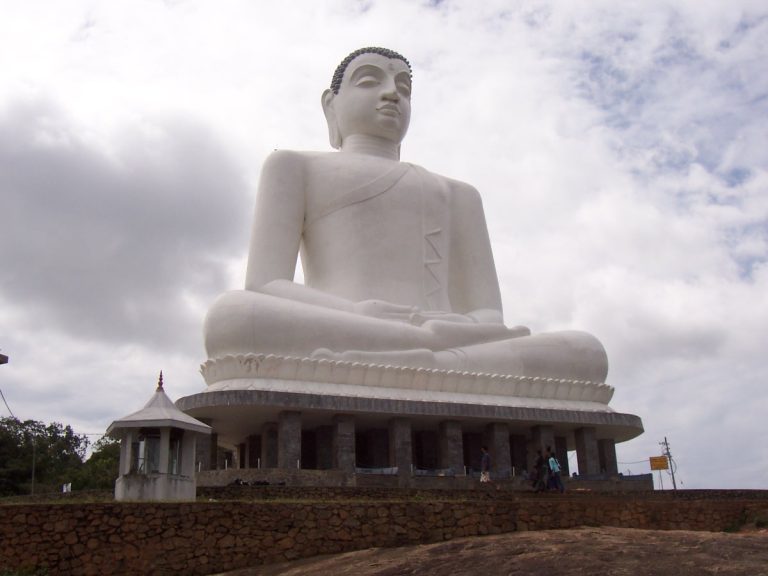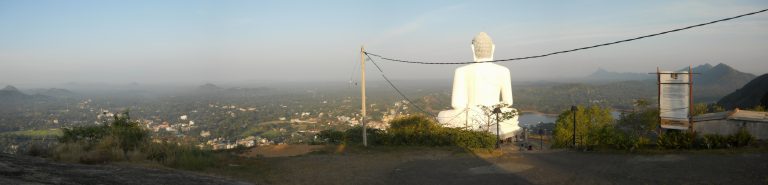
Kurunegala is the capital of Sri Lanka’s North Western Province, a busy crossroads town about 94 km from Colombo and 42 km from Kandy. Bare granite rocks rise out of the plain around it. The biggest, Ethagala or Elephant Rock, carries a huge white Buddha that looks down over the whole town. For about fifty years around 1300 this was the royal capital. Most travellers drive straight through, but it makes a good overnight stop and a practical base for the quieter sights of the north-west.
Is Kurunegala for you?
Go if you want to break the drive between Colombo and the ancient cities, or you’d like to see Yapahuwa, Arankele and Ridi Vihara from one base instead of as rushed detours.
Think twice if you’re picturing an atmospheric old town, because Kurunegala is a working city of offices, schools and traffic, with little of its royal past left above ground.
A capital among the rocks
The town takes its name from Ethagala. Kurune means a tusker and gala a rock, and the old Sanskrit name, Hasthishailapura, means the City of the Elephant Rock. Seven more rocks ring the town, most named after animals: Tortoise Rock, Eel Rock, Goat Rock, Beetle Rock and Monkey Rock among them. Local legend says that in a terrible drought these animals were drinking the town dry, until a witch turned them to stone. Fittingly, one of the eight is Yakdessagala, the Witch Rock.
The history is real enough. In the 13th century, invasions from south India drove the kings away from Polonnaruwa. The capital moved to Dambadeniya, then Yapahuwa, then Kurunegala, and each had its own temple for the Tooth Relic. Bhuvanekabahu II and Parakramabahu IV were among the kings who ruled from here. Today only a few stone steps, pillars and part of a doorway survive from their palace and relic temple. The relic itself is now in Kandy, at the Temple of the Sacred Tooth Relic.
In the centre, look out for the clock tower. It went up in 1922 in memory of the province’s men who died in the First World War. The central bus stand and market are close by.
Climbing Ethagala to the Buddha
Ethagala is the reason to stop. You can climb a stairway cut into the rock, or take a road of about 1.9 km that winds up through the trees. Recent visitors (2025–26) report 20 to 30 minutes on the steps, which are steep but partly shaded. The road has sharp hairpin bends, and a tuk-tuk can take you right to the top.
On the summit stand the Athugala Viharaya temple and a giant seated Buddha, painted brilliant white. Sources disagree on its height, though at its feet you won’t be counting. Walk round behind it for the view: the town below, the lake, and the other rocks rising out of the plain.

This is a working temple. Cover your shoulders and knees, take off your shoes and hat where others do, and don’t pose with your back to the Buddha; our guide to temple etiquette in Sri Lanka explains why. Recent visitors report no ticket, just a donation box. They also warn about monkeys near the top, so keep food out of sight and car windows closed.
Temperatures reach about 35°C in April, and the bare rock soaks up the heat. Go early, or in the late afternoon when it’s cooler and the statue is lit up. Bring a torch if you’ll walk down after dark.
Kurunegala Lake
Below Ethagala lies Kurunegala Lake, an old man-made reservoir that still supplies the town’s water. In 2020 the government finished a 2.1 km lakeside walking path, with a cycle path and an open-air exercise area. Local people come here to walk in the cool of the evening. It also gives you the classic view of the rock, with the Buddha on the skyline.
Day trips to the old capitals and temples
Kurunegala’s real value is as a base. The capitals that came before it are in the same district, and so are two unusual temples.
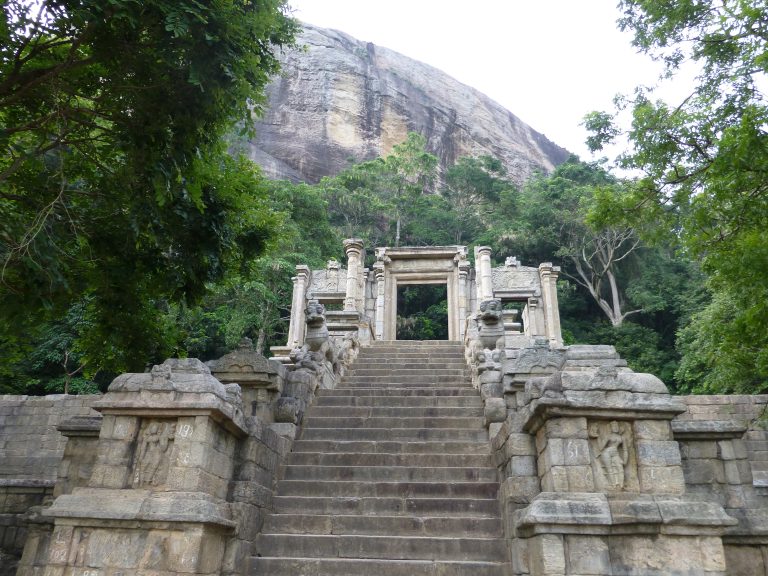
- Yapahuwa Rock Fortress: the capital before Kurunegala, on the way north towards Anuradhapura. It is famous for a steep stairway carved with dancers, dwarfs and two stone lions.
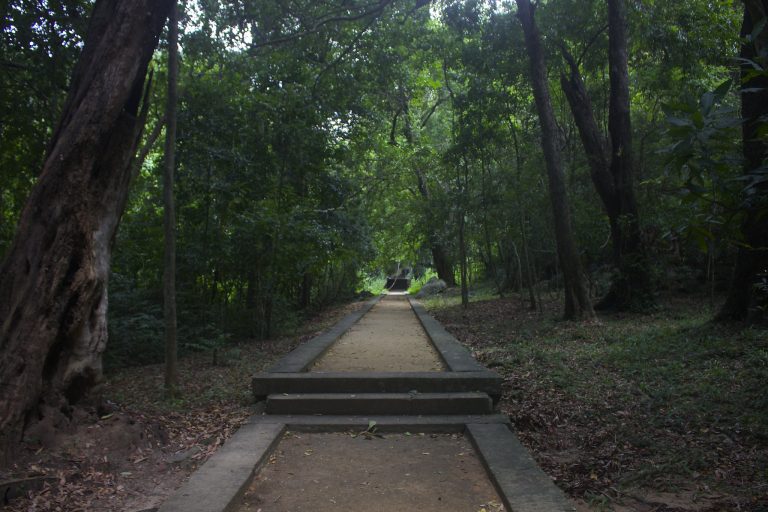
- Arankele Forest Monastery: stone meditation paths through shady forest, off the Kurunegala–Dambulla road at Ibbagamuwa. Monks still meditate here.
- Ridi Vihara: the Silver Temple at Ridigama, north-east of the town. Tradition says silver found here paid for the great Ruwanwelisaya stupa in Anuradhapura, in King Dutugemunu’s reign. Look for the cave shrine with Kandyan-period paintings, a large reclining Buddha, and blue-and-white Dutch tiles showing Bible scenes, a surprise in a Buddhist temple.
- Dambadeniya: the mid-13th-century capital, off the Kurunegala–Negombo road. Palace ruins top its rock, and the Vijayasundarama temple once held the Tooth Relic.
Don’t try all four in one day in this heat. Pair Yapahuwa with Ridi Vihara or Arankele, and save Dambadeniya for the drive back towards Negombo and the airport.
Getting there and around
Kurunegala is on the Northern Line, the railway from Colombo to Anuradhapura and Jaffna. Some intercity express trains don’t stop here, so check before you book. The station is about 2.2 km from the centre, an easy tuk-tuk ride. Reserved seats are sold on the Sri Lanka Railways seat reservation site.
By road, the finished section of the Central Expressway runs from Mirigama to Kurunegala. From here the main road continues north to Dambulla, so the town fits the first or last day of a trip like our 5 days in the Cultural Triangle. Buses from the central bus stand serve towns across the region. For the rock temples, though, a tuk-tuk or a car with a driver saves a lot of time.
Frequently asked questions (FAQs)
Is Kurunegala worth visiting?
Yes, as an overnight stop or a base. Climb Ethagala, walk by the lake in the evening, and take day trips to Yapahuwa, Arankele and Ridi Vihara.
How do you get to the top of Ethagala?
Climb the stairway cut into the rock, or take the winding road of about 1.9 km. Recent visitors report 20 to 30 minutes on the steps.
Is there an entrance fee for Ethagala?
Recent visitors report no ticket at the temple on the summit, just a donation box.
What is Kurunegala famous for?
Ethagala, the Elephant Rock with its giant white Buddha, and its time as Sri Lanka’s royal capital for about fifty years around 1300.
Can you get to Kurunegala by train?
Yes, it is on the Northern Line from Colombo, though some intercity express trains don’t stop. The station is about 2.2 km from the centre.
Sources: en.wikipedia.org (Kurunegala), en.wikipedia.org (Ethagala), sundaytimes.lk (looking down at a kingdom 115443.html), sundaytimes.lk (kurunegala a regal city 119722.html), ft.lk (Kurunegala once the Malaria Capital), ccf.gov.lk (dambadeniya), ccf.gov.lk (yapahuwa rock fortress), en.wikipedia.org (Dambadeniya), en.wikipedia.org (Kurunegala Clock Tower), ft.lk (Kurunegala Lake round recreational area…), en.wikipedia.org (Ridi Viharaya), srilanka.travel, ft.lk (Legend of the silver temple…), en.wikipedia.org (Kurunegala railway station) and recent visitor reports. Header photo: Cherubino / Wikimedia Commons, CC BY-SA 3.0.