

Check before you travel Hill-country railway: repairs after Cyclone Ditwah Checked 5 October 2026
Cyclone Ditwah damaged the hill-country railway in November 2025, and it is reopening in stages. Since 2 October 2026, trains run again from Colombo Fort to Peradeniya and Gampola, but Kandy station itself is not served yet. On 5 October 2026 earth and rocks fell onto the line between Kadigamuwa and Gangoda after heavy rain and derailed an early train; services restarted later the same day, but expect delays or short suspensions after heavy rain. Trains between Nanu Oya and Badulla, which stop at Haputale, Ella and Demodara, restarted on 20 June 2026. The section between Gampola and Nanu Oya is still under repair, so you cannot yet go by train from Colombo or Kandy all the way to Ella. Check the latest services before you plan a rail journey, and book reserved seats on the Sri Lanka Railways seat reservation site.
Sri Lanka’s Cultural Triangle is the centre of the island, roughly the area between Anuradhapura, Polonnaruwa and Kandy, three of its old royal capitals. Five UNESCO World Heritage Sites lie inside it, and five days can’t do justice to all of them. This five-day plan concentrates on the best of them: Sigiriya and the rock opposite it, the medieval capital at Polonnaruwa, the painted caves of Dambulla, an elephant safari, and two nights in Kandy. Each sight gets the time of day that suits it.
Is this route right for you?
Go if ruins, temples and old kings are the reason you came, and you would rather see four places well than eight in a blur. It works as well for a first trip as for a return visit that is all about history.
Think twice if you dislike heat, steps or taking your shoes off. Almost every day starts with a climb or a long walk on sun-baked stone, and most of the sites are places of worship with dress rules. If you want tea country or a beach in the same five days, this isn’t the plan for you: there’s no room for either without spending most of the trip in a car.
The plan at a glance
- Nights 1–3: Sigiriya, Habarana or Dambulla (one base for the ancient sites and the safari)
- Nights 4–5: Kandy
On the morning of Day 6 you head for the airport or carry on into the hills.
Sigiriya, Habarana or Dambulla?
Sigiriya puts you closest to the rock, which matters when you want to be at the gate as the ticket counters open at 7 am, and Pidurangala is a short tuk-tuk ride away. Habarana is a small roadside town on the A6, where the A11 turns off towards Polonnaruwa; the Minneriya park office is near it, at Ambagaswewa, and it has a station on the Batticaloa line. It has no sights of its own, though, so every outing needs a drive. Dambulla is a proper town where the main roads meet, handy if you’re travelling by bus, with the cave temple on its doorstep.
For this route, Sigiriya or Habarana works best. Both are within easy reach of Minneriya, and recent visitors report that most safari jeeps start from there.
Day 1: Into the dry zone
Most international flights land at Bandaranaike International Airport at Katunayake, north of Colombo, so you can head north without going into the city. The road runs through Kurunegala and Dambulla, using the finished stretch of the Central Expressway between Mirigama and Kurunegala on the way. Drivers and recent visitors report four to five hours from the airport or Colombo to Sigiriya, and an early start helps a lot, because traffic around Colombo gets heavy later in the morning.
If you land late in the day, sleep near the airport in Negombo and drive up the next morning. You’ll lose an afternoon, but you won’t be climbing Sigiriya after a night flight.
Day 2: Sigiriya and Pidurangala
Early morning: Sigiriya. King Kassapa I made this granite rock his capital in the late 5th century, and you still climb past what’s left of his work: through water gardens and boulder gardens, up to a sheltered pocket of painted frescoes, along the Mirror Wall with its old visitors’ verses, and on to the giant brick Lion’s Paws, where metal staircases take you to the palace foundations on the summit. Be there when the counters open at 7 am. Recent visitors (2025–26) report about 45 minutes to climb to the top and around three hours for the whole site.

A few things catch people out. You can’t photograph the frescoes. Wasps nest on the rock, and in August 2024 attacks put dozens of visitors in hospital, so if staff close the climb, accept it. And the upper staircases are steep and exposed, which matters if heights bother you.
Midday: back to your room. The middle of the day is hot, and nothing out here is worth seeing at 1 pm.
Late afternoon: Pidurangala. The rock just north of Sigiriya has a monastery at its foot that is older than Kassapa’s palace, and a view from the top straight across to Sigiriya itself. The path climbs through the temple, past a large brick reclining Buddha under a rock overhang. Recent visitors report 30 to 45 minutes to the top, with the last part a scramble over boulders using your hands, so wear shoes with grip. Cover your shoulders and knees for the temple section.
People argue about whether to do Pidurangala at sunrise or sunset. Sunrise is lovely, but then you climb Sigiriya in the full heat. This order keeps both climbs in the cooler hours. Take a torch for the walk down, and if you’re on a scooter or bicycle after dark, watch for elephants crossing the roads around Sigiriya, as recent visitors warn.
Day 3: Polonnaruwa and the elephants
Morning: the Ancient City of Polonnaruwa. Polonnaruwa took over as the capital after Anuradhapura was destroyed in 993, and it was at its height under Parakramabahu the Great in the 12th century. Drivers report about an hour and a quarter by road from Sigiriya, so leave early again: the ticket counters open at 7 am and the stone gets hot quickly. Recent visitors report that tickets are sold at the archaeological museum near the lake and that the ticket includes the museum, which is worth half an hour before you start.
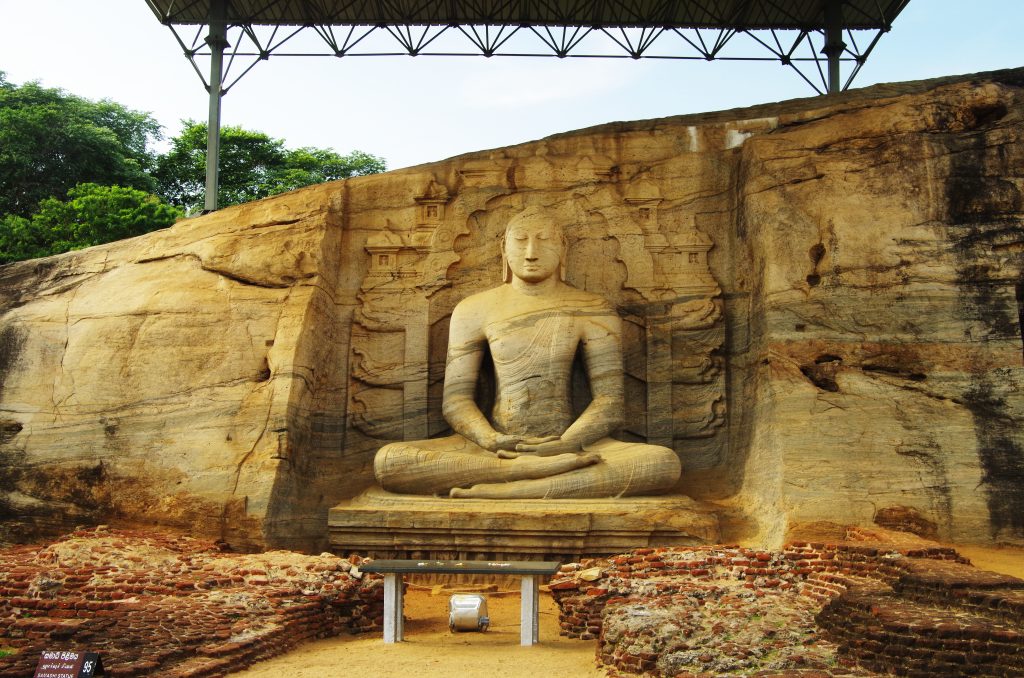
The site is spread out, so hire a bicycle in town or keep your car or tuk-tuk. A sensible order is the royal palace with its massive brick walls and the council chamber, then the Sacred Quadrangle with the circular Vatadage, then the brick image houses of Lankatilaka, and Gal Vihara at the northern end: four Buddhas carved from one granite face in the 12th century, two seated, one standing and one reclining. Recent visitors (2025) allow at least half a day. Bring socks for the hot stone, as shoes come off at many shrines.

Afternoon: a jeep safari at Minneriya or Kaudulla. Minneriya lies off the Habarana–Polonnaruwa road, with Kaudulla next door, so a safari fits neatly on the way back. In the dry season, elephants come out of the forest to graze the grass on the banks of the shrinking tanks, an event known as the Gathering. Sri Lanka Tourism names May to October as the popular time; recent visitors say numbers usually peak in August and September, and that many herds move on to Kaudulla around September. Your driver will know which park is better that week, so ask rather than insisting on one.
Half-day safaris start at about 2 pm, according to recent visitors. Entry is by a Department of Wildlife Conservation permit, paid at the prescribed fee. Stay in the vehicle and keep your distance. One honest warning: jeeps tend to bunch up around the herds, so this isn’t a quiet wilderness experience.
If safaris aren’t for you: go to Ritigala instead, the ruins of an ancient forest monastery on a mountain just off the A11 between Habarana and Maradankadawala. It is all stone paths, platforms and bridges in the trees, with no stupas or statues, and a good deal quieter than the big sites.
Day 4: Dambulla’s caves, then Kandy
Morning: the Rangiri Dambulla Cave Temple. Five cave shrines high on a rock above Dambulla, filled with murals covering about 2,100 square metres and 157 statues, including a great reclining Buddha cut from the rock. Monks lived here from the 3rd century BCE, and the interiors took their present form in the 18th century. Sri Lanka Tourism recommends going in the morning or evening because of the long climb up granite steps.

Don’t be fooled by the large golden Buddha on a modern building at the foot of the rock: that’s a museum, and the caves are at the top of the climb. Cover your shoulders and knees, take off your shoes and hat before you enter, and don’t pose for photos beside the statues or use flash.
Afternoon: on to Kandy. Dambulla is 72 km north of Kandy on the A9, and drivers and recent visitors report about two and a half to three hours from Sigiriya. Drop your bags and walk round Kandy Lake, which the last king of Kandy, Sri Vikrama Rajasinha, created beside the temple.
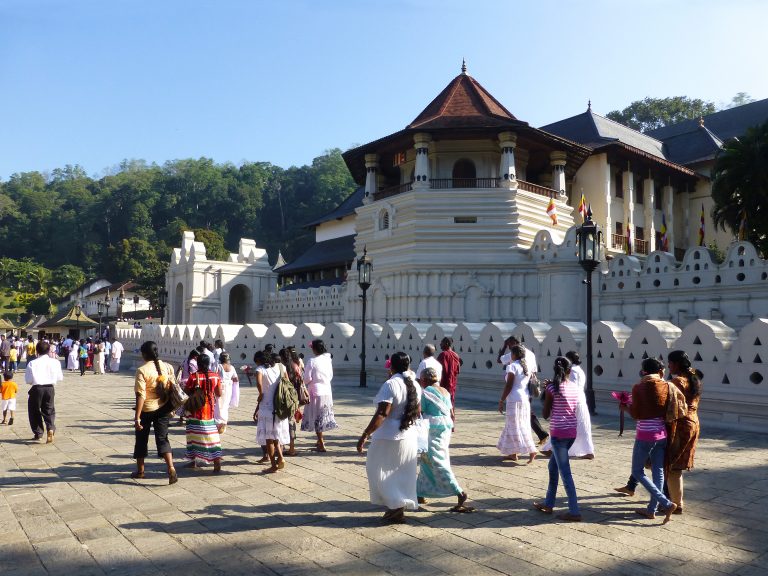
Evening: the Temple of the Sacred Tooth Relic. The temple that houses the Buddha’s tooth relic holds its evening ritual, with drumming and offerings, from about 6.30 to 8 pm. Everyone is screened at the entrance, and shorts, sleeveless or revealing clothes aren’t allowed. Buy your ticket only from the machines inside the temple; tickets from anyone else aren’t valid.
Day 5: Kandy at an easier pace
After four early starts, Kandy is the place to slow down. Pick two of these:
- Udawattakele: the forest on the ridge behind the temple, once the Kandyan kings’ private garden. The entrance is 15 to 20 minutes’ walk uphill from the temple, and about 80 bird species have been recorded there. Leeches wait on the paths when it’s wet.
- The Royal Botanic Gardens, Peradeniya: about 5.5 km west of the city on the Colombo road, open every day from 7.30 am to 6 pm, with orchids, palm avenues and a giant Java fig on the Great Lawn. The suspension bridge over the Mahaweli was badly damaged in the floods of late 2025, so don’t plan your walk around it.
- The temple again: your ticket also covers the temple’s museums, and the restored Royal Palace in the complex reopened to the public in December 2024. On a Wednesday, the ceremonial bathing of the relic is at 9.30 am.
If your flight is on Day 6, leave a good half day for the drive from Kandy to the airport. The hill road and the traffic nearer Colombo make it slower than the map suggests, so don’t cut it fine.
Tickets and dress
- Central Cultural Fund sites: Sigiriya, Polonnaruwa and Ritigala are ticketed by the Central Cultural Fund. Its price list (September 2026) gives USD 35 for Sigiriya and USD 30 for Polonnaruwa for foreign adults, with half tickets for children aged 6 to 12. Buy at the site or order online through the CCF eTicket service and collect at the counter. A ticket is valid on the day it is issued.
- Temple of the Tooth: LKR 3,000 for foreign visitors, according to the temple.
- Pidurangala and Dambulla: no official price is published for either; pay at the site.
At every temple, shoulders and knees must be covered and shoes come off, so a light scarf or sarong in your daypack saves a lot of trouble.
Getting around
Many visitors hire a car and driver for the whole loop, or use tuk-tuks from their base for the short hops to Pidurangala, Polonnaruwa and the parks. Buses run between Dambulla and Sigiriya. Habarana and Polonnaruwa are on the Batticaloa railway line from Colombo Fort, which you can book on the Sri Lanka Railways seat reservation site.
The railway into Kandy was damaged by Cyclone Ditwah; see the travel update at the top of this page. This plan does the Kandy legs by road.
When to go
The Central Cultural Fund’s ticket counters open every day, all year. If the elephant Gathering matters to you, come in the dry season, between about May and October; recent visitors report the biggest herds in August and September. In July or August Kandy holds the Esala Perahera, its great series of night processions; the Temple of the Tooth publishes the dates on its Esala Perahera page. Whatever the month, the mornings are the time to be out.
With a day more, or a day less
Six days: add a day for the older capital, the Sacred City of Anuradhapura, with its great stupas and the Sri Maha Bodhi, and the hill monastery at Mihintale. The colossal Avukana Buddha, near Kekirawa, faces east, so see it in the morning light.
Four days: keep Days 1 to 4 and see the Temple of the Tooth on the evening you arrive in Kandy. You lose the gardens and the forest, not the essentials.
More time overall? Our guide to how many days you need in Sri Lanka shows how the ancient cities fit with the hill country and the coast.
With a full week, our seven-day classic route adds the hill country around Ella.
Frequently asked questions (FAQs)
Is five days enough for the Cultural Triangle?
Yes, for the main sights: Sigiriya, Pidurangala, Polonnaruwa, Dambulla, an elephant safari and Kandy. Anuradhapura needs an extra day.
Should I climb Sigiriya or Pidurangala?
Both if you can. Sigiriya has the history, gardens and frescoes; Pidurangala has the view of Sigiriya. Climb Sigiriya when the counters open at 7 am and Pidurangala in the late afternoon.
Can I see Polonnaruwa and go on a safari on the same day?
Yes. See Polonnaruwa in the morning, then take an afternoon jeep safari at Minneriya or Kaudulla, both close to the road back towards Habarana.
Where should I stay for Sigiriya and Polonnaruwa?
Sigiriya or Habarana. Sigiriya is closest to the rock; Habarana is handy for Polonnaruwa and the Minneriya park office.
When is the best time to see the elephants?
In the dry season. Sri Lanka Tourism names May to October for Minneriya, and recent visitors report the biggest numbers in August and September.
Sources: en.wikipedia.org (Cultural triangle), whc.unesco.org (list), whc.unesco.org (list), whc.unesco.org (list), whc.unesco.org (list), whc.unesco.org (list), ccf.gov.lk (ticket issuance), ccf.gov.lk (index.php), eservices.ccf.gov.lk, srilanka.travel (sigiriya a heavenly palace on earth), dailymirror.lk (Visits to Sigiriya suspended), dailymirror.lk (sigiriya frescoes photographing prohibited), en.wikipedia.org (Pidurangala Rock), srilanka.travel (attractions.php), en.wikipedia.org (Polonnaruwa), en.wikipedia.org (Gal Vihara), en.wikipedia.org (Polonnaruwa Vatadage), srilanka.travel (attraction&), srilanka.travel (wild safaris), en.wikipedia.org (Minneriya National Park), en.wikipedia.org (Kaudulla National Park), dwc.gov.lk, en.wikipedia.org (Ritigala), srilanka.travel (attraction), en.wikipedia.org (Dambulla cave temple), en.wikipedia.org (Dambulla), en.wikipedia.org (Habarana), en.wikipedia.org (A6 highway (Sri Lanka)), en.wikipedia.org (Batticaloa line), en.wikipedia.org (Central Expressway (Sri Lanka)), en.wikipedia.org (Bandaranaike International Airport), sridaladamaligawa.lk (faq), sridaladamaligawa.lk (kandy esala perahera), sridaladamaligawa.lk (kandyan world heritage royal palace…), en.wikipedia.org (Kandy Lake), en.wikipedia.org (Udawattakele Forest Reserve), botanicgardens.gov.lk, sundaytimes.lk, english.newsfirst.lk, seatreservation.railway.gov.lk and recent visitor reports. Header photo: Balou46 / Wikimedia Commons, CC BY-SA 3.0.