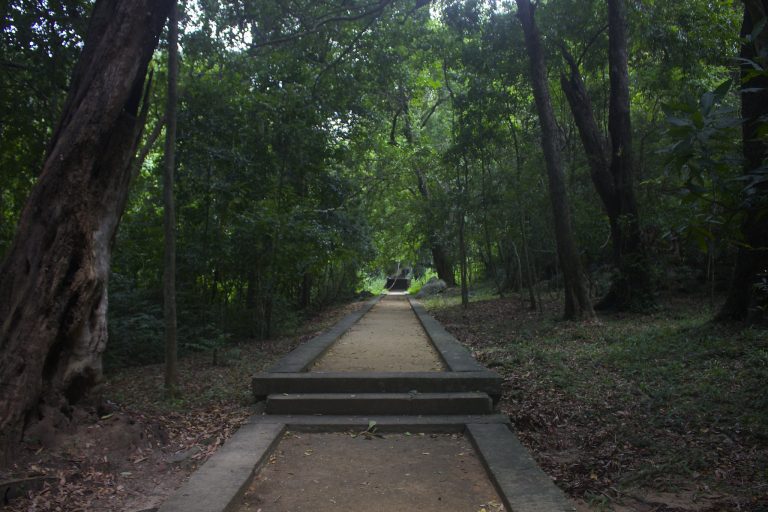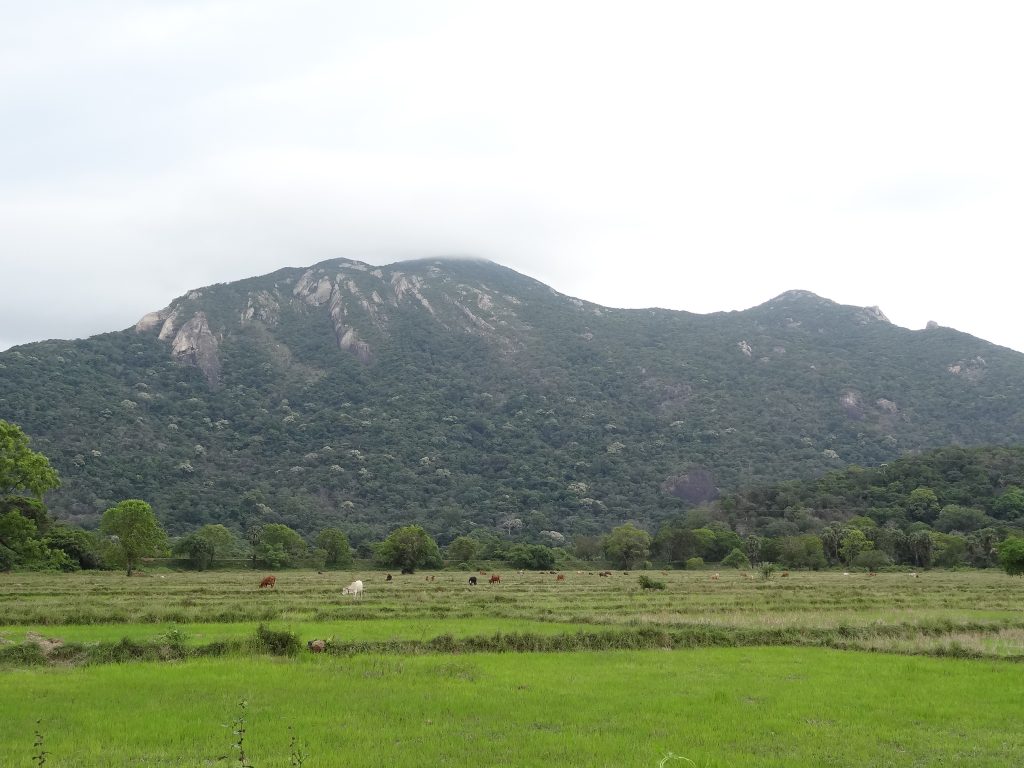
Forest covers Ritigala, a mountain range in Anuradhapura District in Sri Lanka’s North Central Province. On its lower slopes lie the ruins of an ancient Buddhist forest monastery. You can visit the monastery site with a Central Cultural Fund (CCF) ticket. The rest of the mountain, however, is a strict nature reserve that the public cannot enter.
Is it worth visiting?
Go if you like quiet ruins in the forest: the monastery is a place of stone paths, platforms and bridges, very different from the stupas and statues of the ancient capitals. It also pairs well with a visit to the Sacred City of Anuradhapura, in the same district.
Think twice if you are hoping to climb the mountain, because the strict nature reserve beyond the archaeological site is off limits to visitors.
History
Ritigala takes its name from Arittha Pabbata, the name used in the ancient chronicles. The chronicles place the founding of monasteries here in the 2nd and 1st centuries BCE. More than 70 rock caves with carved drip ledges also show that monks lived on the mountain from early times. Later, in the 9th century CE, King Sena I built a monastery here for the Pamsukulika monks, an order of ascetics who wore robes made from discarded rags. Much of what survives is attributed to this monastery.
What to see
- Banda Pokuna: a large ancient reservoir with stone steps near the start of the site.
- The stone path: a paved path of fitted stone slabs that climbs through the forest and links the main buildings of the monastery.
- Double platforms: about 50 pairs of raised stone platforms, each pair joined by a stone bridge. You find similar platforms at other ancient forest monasteries, such as Arankele, but scholars still debate their exact use.
- Austere design: unlike most ancient Buddhist sites in Sri Lanka, the monastery has no stupas and no bodhi tree, and only a few broken Buddha statues survive in some of the caves.
The strict nature reserve
The Ritigala massif is about 6.5 km long, and the Maha-Degala gorge splits it into northern and southern blocks. It became a strict nature reserve on 7 November 1941 and covers about 1,528 hectares. Its upper slopes are cooler and wetter than the dry plains around it. According to the Department of Wildlife Conservation, they also shelter three plant species and one animal species found nowhere else in the world. No one may enter the reserve except for official duties or authorised research with the permission of the Director General of the Department of Wildlife Conservation.
Tickets and practical tips
- Tickets: the CCF price table (updated 24 September 2026) lists a full ticket for Ritigala at USD 6. A half ticket, for children aged 6 to 12, is USD 3, and both prices include 18% VAT. The rupee price follows the CCF exchange rate; on that date, for example, it was LKR 2,004 ($6.02 · convert) and LKR 1,002 ($3.01 · convert).
- Hours: CCF ticket counters are open from 7 am to 5 pm, and a ticket is valid for one entry on the day of issue.
- Stay on the site: the CCF ticket does not cover the strict nature reserve. Some CCF sites also lie inside sanctuaries and reserves, and the CCF asks visitors to follow its officers’ instructions about wild elephants and wasps.
- Getting there: Ritigala lies just north of the A11 highway between Habarana and Maradankadawala. You reach it by road, either from the west via Ganewalpola or from the east via Galapitagala.
Frequently asked questions (FAQs)
Can you climb Ritigala mountain?
No. The mountain is a strict nature reserve, and nobody may enter it except for official duties or authorised research. However, visitors can see the monastery ruins on the lower slopes.
How much is the entrance ticket?
The Central Cultural Fund lists USD 6 for a full ticket and USD 3 for children aged 6 to 12, including VAT. You pay in rupees at the CCF rate (price list updated 24 September 2026).
Who lived at the Ritigala monastery?
Buddhist monks from at least the 1st century BCE. Then, in the 9th century, King Sena I built a monastery here for the Pamsukulika monks, ascetics who wore robes made from discarded rags.
Where is Ritigala?
In Anuradhapura District, just north of the A11 highway between Habarana and Maradankadawala.
Header photo: Cherubino / Wikimedia Commons, CC BY-SA 3.0.