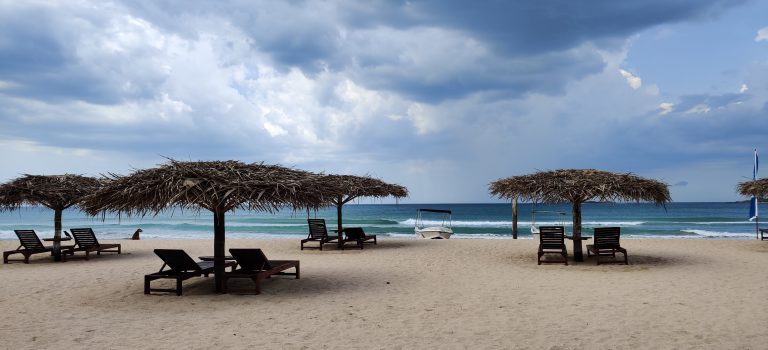
Kitesurfing arrived at Kalpitiya, the long, narrow peninsula between the Puttalam Lagoon and the Indian Ocean, about 15 years ago. The Sunday Times reported in 2025 that more than 30 schools now operate there. The draw, as an International Kiteboarding Organisation examiner told the Daily Mirror, is consistent wind, shallow water and a giant lagoon of flat water. This page is about doing it: when the wind blows, where the kite centres are, what a beginner’s course involves and how to tell a careful school from a careless one.
Is it right for you?
Go if you want to learn to kitesurf from scratch, or you already ride and want a few weeks of flat water and reliable wind. You do need to swim confidently in open water; schools are expected to check.
Think twice if you have a heart condition, epilepsy, a spinal problem or recent surgery, or you’re pregnant: the Sri Lanka Tourism Development Authority’s guideline says people in those situations shouldn’t be taken kiteboarding. Skip it too if you’re only passing through for a day or two. Some days have no usable wind, and learning takes several days of lessons.
When the wind blows
Kalpitiya’s wind follows the monsoons. The Department of Census and Statistics gives the south-west monsoon as May to September and the north-east monsoon as December to February. In the inter-monsoon months between them, it says, winds are generally light.
Within that pattern, the exact months vary from year to year, so treat any dates as a guide. The Sunday Times described the season in June 2026 as June to October, “when wind conditions are at their best”. Kite schools and recent visitors (2025–26) report a stronger main season from about May to September or October. A second, lighter season runs from about December to February or March. In that winter season, they say, mornings are often calm and the wind builds from around midday until sunset. April and November are reported as unpredictable.
If your dates are fixed, ask your school how many days in that month they usually get on the water.
Where you’ll ride
Most riding happens in the lagoons, not on the open sea. The Sunday Times describes Dutch Bay as a lagoon stretching about 32 km north from Kudawa, and says its southern part is popular with kiteboarders for its shallow, calm water and steady wind. Wave riding, for experienced kiters, is on the ocean side.
The kite centres on Sri Lanka Tourism’s list of registered water sports centres are mostly around Kandakuliya, Kudawa and Sethawadi on the peninsula, with others at Anawasal and Kappalady. Recent visitors also describe boat trips to sandbanks and islands further north, such as Vella Island and the so-called Dream Spot. Those trips are for riders who can already look after themselves: the authority’s guideline says kite trips, like kite rentals, should only be for experienced independent riders who can ride upwind.
Learning: what a course involves
Kalpitiya’s kite schools commonly sell a beginner course of about 9 hours, spread over three to five days. It takes you to the International Kiteboarding Organisation’s Level 3, where you can ride on your own. How long it really takes depends on the wind and on you. Schools start with kite control, usually with a small trainer kite on the beach, and the board comes later.
The authority’s guideline gives a good picture of a properly run lesson. There should be:
- a weather check before each session, displayed for students, and a safety briefing that covers the equipment, the boundaries of the riding area, rescue procedures and the conditions;
- a map of the area showing safe and hazard zones;
- small trainer kites for land drills, and bars with short lines for beginners;
- a life jacket or buoyancy aid, a harness and a helmet in your size, with the buoyancy aid worn the whole time you’re in the water;
- the instructor doing the pre-flight check and launching your kite;
- a trained lifeguard and instructors present, and a rescue boat nearby whenever you train in open water.
You’ll also be asked to sign a waiver, declare any medical conditions and stay sober: the guideline bans alcohol and drugs during the activity and for six hours before it. Lessons shouldn’t run in the dark, and should preferably end an hour before nightfall.
Choosing a school
More than 30 schools work the lagoons, but in October 2026 Sri Lanka Tourism’s list of registered water sports centres had only about a dozen in Puttalam District. Registration means a centre has been inspected against the authority’s standards, so ask for a registration number.
Then ask about the instructors. The guideline expects a kite instructor to hold a qualification from a recognised national or international kiteboarding body, at least three years’ experience, a valid first aid and CPR certificate, a powerboat licence and an open-water lifeguard certificate. Ask too about the instructor-to-student ratio, whether there is a rescue boat, and what happens to your lessons on days without wind.
Red flags are easy to spot: no briefing, no buoyancy aids, big kites handed to beginners on long lines, or a rental kite offered to someone who can’t yet ride upwind.
On the water
The lagoon isn’t empty. Recent visitors and kite schools warn of fishing nets and poles in the water, often marked only by small buoys or flags, and of sharp shells, sea urchins and sometimes stingrays on the bottom. Wear lagoon shoes, and ask the school where the nets are before you launch. In the main season the lagoon can be busy with kites, so keep your distance from other riders and from the fishing boats. Remember that you’re sharing the water with fishing families who were here long before the kites, and follow the guideline’s own rule: leave no trace.
The sun is strong and there’s little shade on the sandbanks. Recent visitors say a rash vest and good sun protection are usually enough, with no need for a wetsuit.
Fitting it into a trip
Give it a week if you’re learning, so a few days without wind don’t wreck the course. On calm days, Kalpitiya has dolphin-watching trips and the Bar Reef (see our Kalpitiya guide), and Wilpattu National Park is to the north. Our best time to visit Sri Lanka guide shows how the same monsoons shape the rest of the island.
Frequently asked questions (FAQs)
When is the kitesurfing season in Kalpitiya?
The wind follows the monsoons. Kite schools report a main season from about May to September or October and a lighter one from about December to February or March; April and November are unpredictable.
Is Kalpitiya good for beginner kitesurfers?
Yes. The lagoons are shallow and flat, which suits learners. Choose a school with a safety briefing, trainer kites, buoyancy aids, helmets and a rescue boat.
How long does it take to learn kitesurfing in Kalpitiya?
Kite schools commonly sell a beginner course of about 9 hours over three to five days. Allow extra days in case the wind drops.
Do I need to be able to swim to learn kitesurfing?
Yes. The Sri Lanka Tourism Development Authority’s guideline says lessons should only be given to students who can swim in open water.
Can I rent a kite in Kalpitiya without lessons?
Only if you’re an experienced rider. The authority’s guideline says rentals and kite trips should be for independent riders who can ride upwind.