
Most of the waterfalls in Sri Lanka are in the hill country, where rivers drop off the edges of the central highlands on their way to the plains. Some you see from a car window on the A5 or the A7; others take a long staircase, a forest walk or a bumpy tuk-tuk ride. The best one for you depends less on height than on where you’re staying and how much walking you want.
One thing is the same everywhere: these falls are fullest after rain, and that is exactly when they are most dangerous. Read the safety section before you plan a swim.
Roadside falls: stop, look, carry on
These four need almost no walking, so they fit into a travel day.
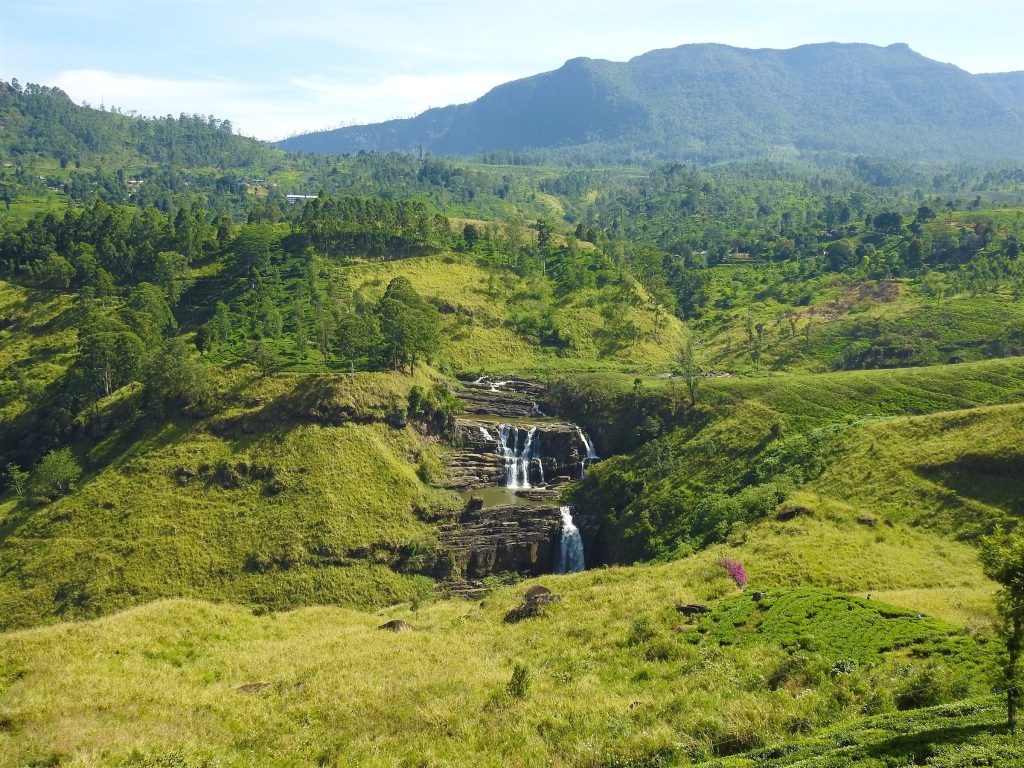
- St Clair’s Falls, on the A7 about 3 km west of Talawakele. One of the widest falls in the country, a double cascade seen from a lookout beside the road. It sits below the Upper Kotmale dam, and visitors report a thin flow at times.
- Devon Falls, a few kilometres further along the same road towards Hatton. A tall, narrow fall of about 97 m in three steps, with a tea centre across the road. There’s no access to the base, so the stop takes 15 to 30 minutes.
- Ramboda Falls, beside the A5 on the climb from Kandy to Nuwara Eliya. The Central Province tourism board gives a drop of about 109 m, and a stepped path of about 500 m takes you closer than the road view.
- Ravana Falls, beside the Ella–Wellawaya road a few kilometres south of Ella. Tiered and easy to reach, but much reduced in the dry season.
St Clair’s and Devon are the obvious pair: both on the A7 between Hatton and Nuwara Eliya, a few minutes apart.
Falls with a walk attached
- Dunhinda Falls, about 5 km from Badulla. A walk of about a kilometre on concrete, forest track and steps leads to a viewing platform above a deep pool. The way back is uphill. Sri Lanka Tourism says the falls carry the most water from November to March.
- Bomburu Ella, above Welimada. Several streams pour side by side over one rock face, which is why it’s often called one of the widest falls in the island. Allow about 45 minutes each way through forest.
- Laxapana Falls, between Norton Bridge and Maskeliya. Sri Lanka Tourism gives the height as 126 m. A long concrete staircase takes you down through tea, and you pay for it on the climb back up.
- Bambarakanda Falls, near Kalupahana on the A4. Sri Lanka Tourism lists it as the tallest waterfall in Sri Lanka, though published heights differ. A rough road climbs about 5 km from the main road, then a short walk through pines reaches the foot of the cliff.
- Lover’s Leap Falls, just above Nuwara Eliya. A short, steep climb from the Pedro estate road; the view back over the town is as good as the fall.
Falls people swim at
Two falls are known as places to bathe, and both need care.
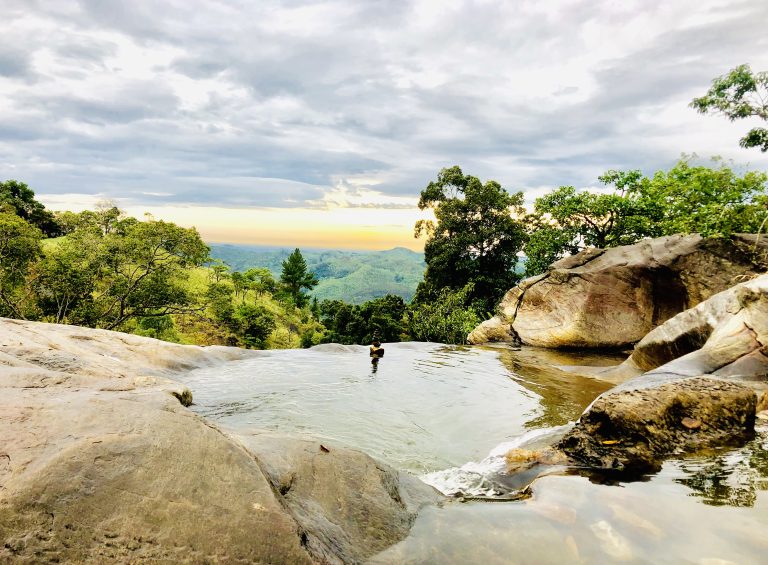
Diyaluma Falls drops off a sheer cliff between Koslanda and Wellawaya. You can see it from the road, but most people come for the rock pools on the stream above the drop, reached by a walk of 20 to 45 minutes from Poonagala, recent visitors (2025–26) report. Some pools are deep, the rock slopes towards an unguarded edge, and a swimmer had to be pulled out of one in February 2025. Choose a pool well back from the lip.
Bopath Ella, at Kuruwita on the Colombo–Ratnapura road, is a family bathing spot. The water widens below a narrow notch, like a bo leaf. The Sinhala daily Lankadeepa says there are safe places to bathe away from the fall but not at its foot, and that people have died climbing the rock when the stream is high.

Staying safe at any waterfall
Waterfalls here claim lives, and several of the falls above have seen a death in recent years. A few rules cover most of the risk:
- Stay out of the water at the foot of a fall. At Dunhinda and Laxapana the pools are deep, and at Ramboda the flow can rise quickly in wet weather. At Bomburu Ella, bathing at the base is reported to be not allowed.
- Get out when the water changes. Sri Lanka’s Life Saving Association warns that rain upstream can raise rivers and waterfalls suddenly, and that if the water turns muddy brown you should leave at once. At Laxapana, reservoirs upstream can also raise the level.
- Don’t climb the rock beside a fall. A university student died climbing at Bambarakanda in 2023, and a young visitor died after a fall at Ravana Falls in 2024.
- Wear shoes with grip and expect leeches on forest paths after rain. Long socks tucked over your trousers help.
- Listen to local people. If someone at the gate or the tea shop says the water is too high today, believe them.
When to go
Every fall on this page looks better after rain, so a dry spell can turn a fine sight into a trickle. Ravana Falls shrinks dramatically in the dry season, and Lover’s Leap now runs strongly mainly in the rainy months. St Clair’s, Devon and Laxapana also depend on how the hydropower reservoirs upstream are being run.

The hills catch both monsoons, so there isn’t one perfect month for the whole country: our best time to visit Sri Lanka guide explains the pattern. A good rule is to go the morning after a wet day, when the falls are full but the path has had a few hours to drain. Mornings are also quieter at the busy ones such as Bopath Ella and Ramboda.
Good bases for a waterfall trip
- Ella: Ravana Falls is beside the road south of town, and Diyaluma and Dunhinda are day trips.
- Nuwara Eliya: Lover’s Leap on the edge of town, Ramboda on the A5, and St Clair’s and Devon on the drive towards Hatton.
- Haputale: Bambarakanda on the A4 and Diyaluma towards Wellawaya.
- Hatton: Laxapana, plus St Clair’s and Devon.
Most visitors see two or three falls in passing on the drive between Kandy and Ella, and that is a fine way to do it. If you want one that feels like an outing, pick Dunhinda or Bomburu Ella for the walk, or Diyaluma for the pools.
Frequently asked questions (FAQs)
What is the tallest waterfall in Sri Lanka?
Sri Lanka Tourism lists Bambarakanda Falls, near Kalupahana in Badulla District, as the tallest. Published height figures differ.
Which waterfalls in Sri Lanka can you swim at?
People bathe in the rock pools above Diyaluma Falls and in the calm water away from the fall at Bopath Ella. Stay out of the pools at the foot of falls such as Dunhinda, Laxapana and Ramboda, and out of any water after heavy rain.
Which waterfalls can you see from the road?
St Clair’s and Devon Falls on the A7 near Talawakele, Ramboda Falls on the A5 and Ravana Falls on the Ella–Wellawaya road.
When are Sri Lanka’s waterfalls at their best?
After rain, when they carry the most water. That is also when they are most dangerous, so keep out of the water when it is high or muddy.
Which waterfalls are near Ella?
Ravana Falls is beside the road a few kilometres south of town. Diyaluma and Dunhinda make day trips.
Header photo: Rehman Abubakr / Wikimedia Commons, CC BY-SA 4.0.