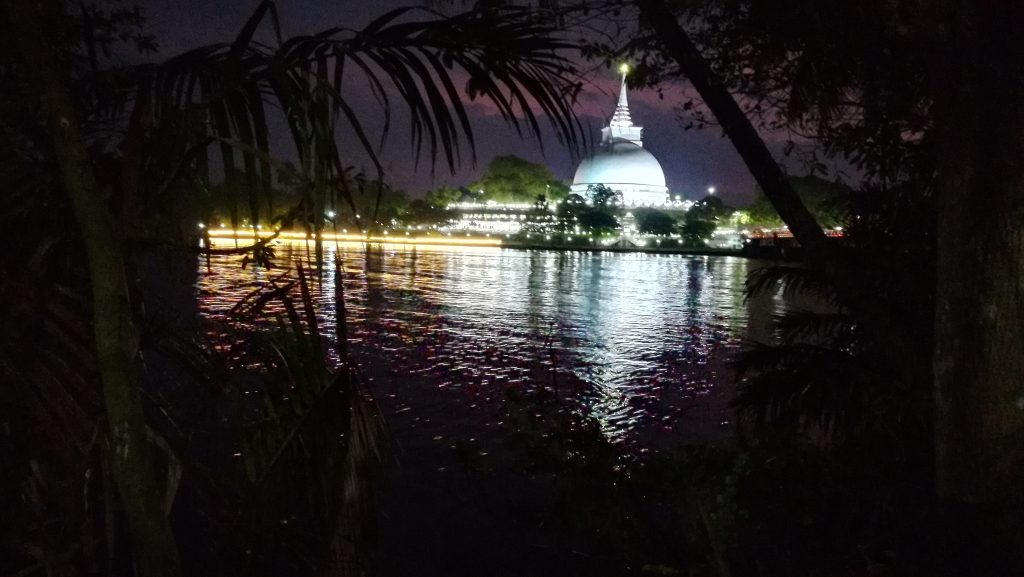
Kalutara Bodhiya is a Buddhist temple at the southern end of the Kalutara bridge, 43 km south of Colombo. It grew up around a sacred bo tree beside the Kalu Ganga. It is also home to something you rarely find: a white stupa that is hollow, so you can walk inside the dome. Drive the coast road and you will see people pulling over here to drop an offering into the roadside boxes.
Is it worth visiting?
Go if you are travelling the coast road anyway and want to see a temple that matters deeply to Sri Lankan Buddhists, with the chance to stand inside a stupa.
Think twice if you are looking for ancient ruins. The tree’s story goes back many centuries, but the buildings are modern: work on the stupa began in 1964 and finished in 1980.
The bo tree and its history
The Bodhivamsa, a Sinhala chronicle, tells how 32 saplings of the Jaya Sri Maha Bodhi in Anuradhapura were planted around the country. Tradition holds that the Kalutara tree is one of them. Sri Lanka Tourism adds that a Pandyan prince, Wickrema Pandya, planted a bo tree here in 1042.
The colonial centuries were hard on the site. The Portuguese levelled the Gangatilaka temple that stood beside the river and built a fort on the spot. The Dutch and then the British held the fort after them. Later, the British built a residence for their Government Agent on the hill. According to the Sunday Times, the bo tree on the hilltop survived, but nobody cared for it.
Things changed after independence in 1948. The government handed the Government Agent’s residence back to the temple. A Kalutara lawyer, Sir Cyril de Zoysa, then persuaded the authorities to move the government offices away. In November 1951 he founded the Kalutara Bodhi Trust, which still runs the site. Galle Road runs between the two halves of the sacred ground, so today there is an upper compound (Uda Maluwa) and a lower compound (Pahala Maluwa) on either side of the traffic.
Inside the hollow stupa
The stupa was Sir Cyril’s project. Builders laid the foundation in 1964 and set the pinnacle in place in January 1974. Finally, on 28 February 1980, the pinnacle was unveiled and relics went into the inner chamber. The engineer A. N. S. Kulasinghe worked on the design, which rests on a prestressed concrete frame. The dome measures 300 feet round.
Step inside and you are under the dome itself. Paintings of the Buddha’s life and of Jataka stories cover the walls, and small stupas stand within the space. A ring of windows runs round the base of the dome. This is a working place of worship, so move quietly and give people who are praying the space they need.

The stone bodhighara
Look out, too, for the granite shrine around another of the site’s three sacred bo trees. A bodhighara is a shrine that encloses a bo tree, and this one copies the ancient bodhighara at Nillakgama in Kurunegala District, down to its carved lions. It opened for worship on 26 October 2015. The seated Buddha inside is a half-size version of the Toluvila statue, which stands in the Colombo National Museum.
According to the Bodhi Trust, this tree grew from an offshoot brought from Buddha Gaya in India. The Trust also notes that pregnant women, and women hoping for children, still come here to pray at it.
Visiting: dress, offerings and timing
- Dress: cover your shoulders and knees, and leave your shoes at the entrance. Our guide to temple etiquette in Sri Lanka covers the rest.
- Photos: Sri Lanka Tourism says posing for photos in front of or beside statues and murals is strictly forbidden. It also warns that flash can damage murals, so leave the flash off inside the stupa.
- Tickets: we found no official information about an entrance fee. Most of the Bodhi Trust’s income comes from the collection boxes along the Galle Road boundary.
- Offerings: the roadside boxes are part of the ritual of passing Kalutara. According to the Bodhi Trust, people from all walks of life stop to make an offering before they continue their journey.
- When to go: the temple is at its busiest around Vesak. In past years the Bodhi Trust has lit the grounds and the road with lanterns for a week, and big crowds gather in the evening.
- Crossing the road: you have to cross the busy Galle Road to get between the two compounds, so use the crossings and take your time.
Getting there
The temple sits right on the Galle Road at the southern end of the bridge. Any Colombo–Kalutara or Colombo–Galle bus will drop you in town. By train, get off at Kalutara South, the main station on the coastal line, and take a tuk-tuk. If you are driving between Colombo and Bentota, you will pass the door.
Frequently asked questions (FAQs)
Why is Kalutara Bodhiya famous?
Its bo tree is believed to be one of 32 saplings of the Jaya Sri Maha Bodhi in Anuradhapura. The temple also has a hollow stupa that visitors can walk inside.
Can you go inside the Kalutara stupa?
Yes. Inside the hollow dome you will find paintings of the Buddha’s life and Jataka stories, small stupas and a ring of windows.
When was the Kalutara stupa built?
Work began in 1964 and the pinnacle went up in January 1974. The pinnacle was unveiled and the relics enshrined on 28 February 1980.
What should I wear to Kalutara Bodhiya?
Cover your shoulders and knees, and take your shoes off at the entrance. Don’t pose for photos in front of or beside statues.
Is there an entrance fee at Kalutara Bodhiya?
We found no official information on a fee. The temple relies mainly on offerings in the collection boxes along the Galle Road.
Sources: srilanka.travel (attraction&), kalutarabodhiya.com (about sir cyril de zoysa), kalutarabodhiya.com (about kalutara), kalutarabodhiya.com (how we work), kalutarabodhiya.com (bodhighara), kalutarabodhiya.com (annual events), en.wikipedia.org (Kalutara Bodhiya), en.wikipedia.org (Kalutara Chaitya), en.wikipedia.org (Kalutara), sundaytimes.lk (plus 11.html), sundaytimes.lk (famed garden castle and taste…), srilanka.travel (travel tips) and recent visitor reports. Header photo: Dhammikask / Wikimedia Commons, CC BY-SA 4.0.