Check before you travel Hill-country railway: repairs after Cyclone Ditwah Checked 5 October 2026
Cyclone Ditwah damaged the hill-country railway in November 2025, and it is reopening in stages. Since 2 October 2026, trains run again from Colombo Fort to Peradeniya and Gampola, but Kandy station itself is not served yet. On 5 October 2026 earth and rocks fell onto the line between Kadigamuwa and Gangoda after heavy rain and derailed an early train; services restarted later the same day, but expect delays or short suspensions after heavy rain. Trains between Nanu Oya and Badulla, which stop at Haputale, Ella and Demodara, restarted on 20 June 2026. The section between Gampola and Nanu Oya is still under repair, so you cannot yet go by train from Colombo or Kandy all the way to Ella. Check the latest services before you plan a rail journey, and book reserved seats on the Sri Lanka Railways seat reservation site.
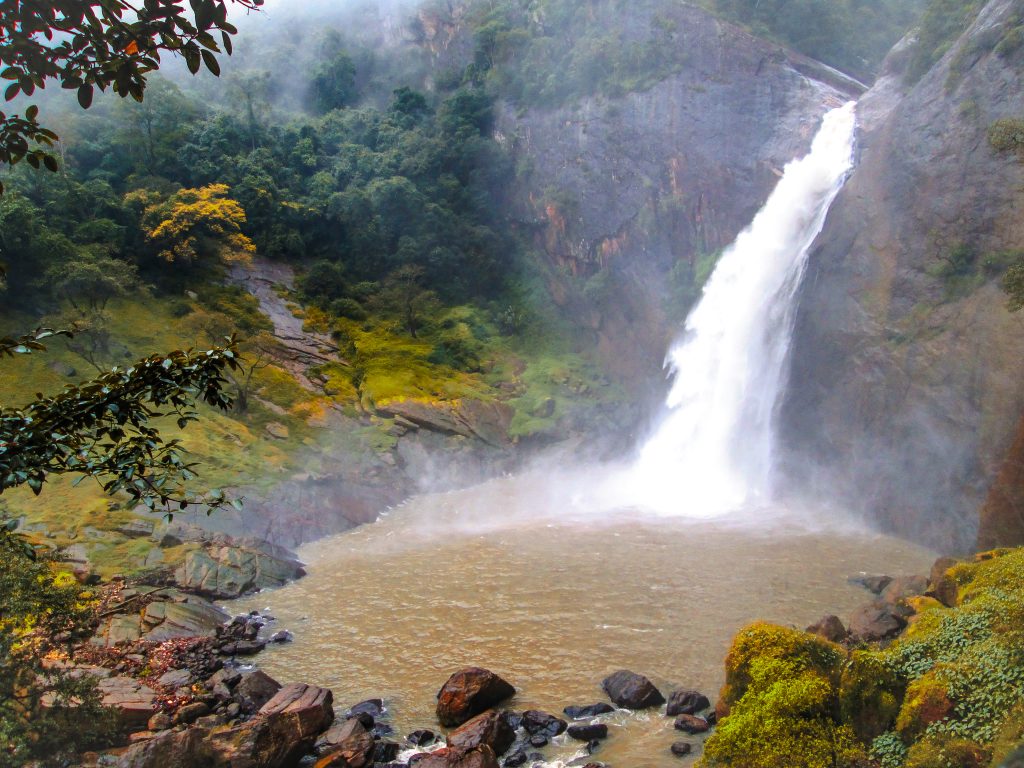
Dunhinda Falls is where the Badulu Oya, the river that runs through Badulla, pours into a deep, rocky bowl about 5 km outside the town. The name comes from dun, Sinhala for mist or smoke, after the spray that hangs over the pool at its foot. You can’t drive to it: from the road you walk about a kilometre along a forest path, and that walk is half the visit.
Is it worth visiting?
Go if you are staying in Badulla, or riding the train to the end of the line, and want an easy half-day out. It isn’t one of Sri Lanka’s tallest falls, but it is powerful, it lands in a wide pool in a steep gorge, and the path passes a second, smaller fall on the way.
Think twice if steps are hard for you, because the path goes down to the falls and you come back up the same way, or if you were hoping for a swim: the pool is not safe for bathing.
The walk down
The entrance is on the Badulla–Mahiyangana road. Tickets are sold at the entrance by the Soranathota Pradeshiya Sabha, the local council. Recent visitors (2026) report LKR 200 for foreign visitors and LKR 20 for Sri Lankans, opening hours of 7 am to 5 pm, and a separate charge for parking; we found no official published list of these.
The path is about a kilometre long, a mix of concrete, forest track and steps that drop towards the river. Along the way, stalls sell herbal drinks, grains and snacks, and they are as much a part of Dunhinda as the falls: more than 45 families depend on the site for their income, according to the Sunday Times. Keep food out of sight, because monkeys work the path too, and don’t feed them.
The path is uneven in places, and storms damage it from time to time: Cyclone Ditwah in late 2025 left stretches blocked by mud and rock. If you are unsteady on your feet, ask at the ticket counter about the state of the path before you set off, and allow plenty of time for the climb back.

Partway down you see Kuda Dunhinda, “little Dunhinda”, a smaller fall below the path. Enjoy it from the path: reaching it means scrambling down a rougher forest track.
At the falls
The path ends at a viewing platform looking across the gorge to the main fall. On a full day the spray drifts over the pool and you understand the name. Some people call it Bridal Falls, from the veil-like shape of the water.
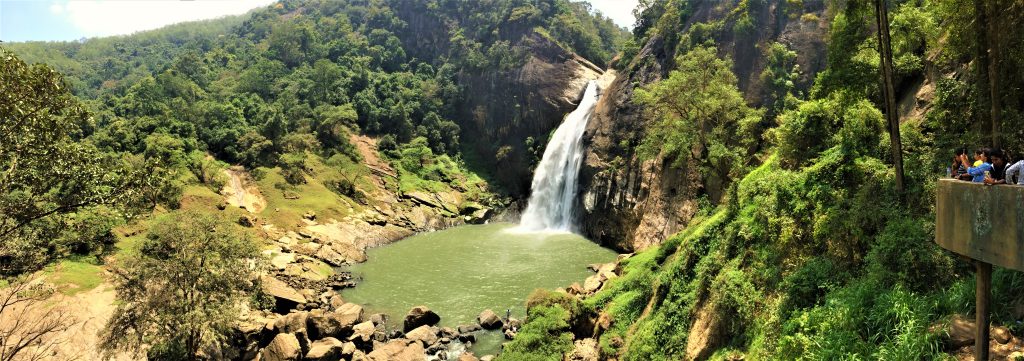
Don’t climb down to the pool or go in the water. Sri Lanka Tourism warns that it is deep, with treacherous rocks near the base, and the current under the fall is strong. The view is better from the platform anyway.
When to go
Sri Lanka Tourism says the falls carry the most water from November to March, during the rainy season in this part of the country. Morning visits are quieter than the middle of the day, visitors report, and the climb back is easier before the heat builds.
Getting there
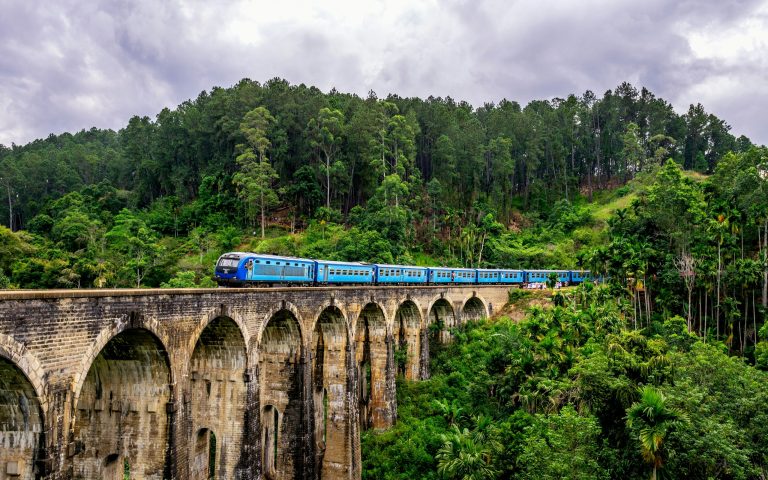
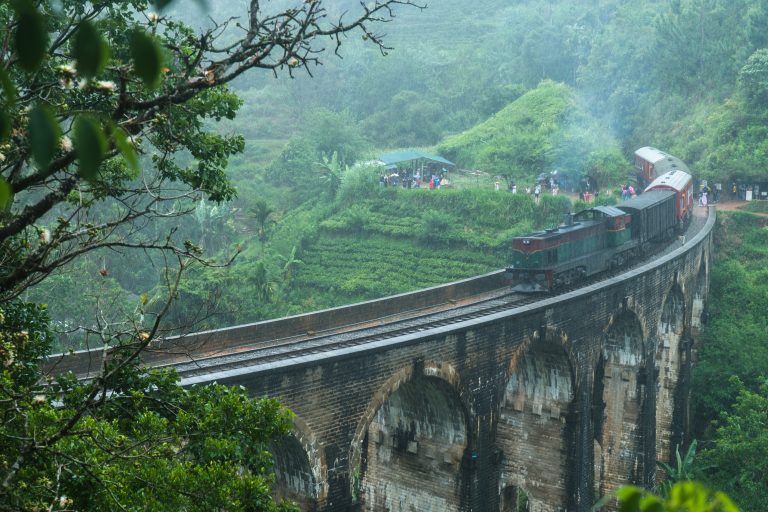
Badulla is the end of the railway line from Colombo, and trains between Ella and Badulla cross the Nine Arch Bridge on the way; see the travel update at the top of this page for the current service. Our guide to train travel in Sri Lanka explains tickets and classes, and reserved seats are sold on the Sri Lanka Railways seat reservation site. From Badulla town, take a tuk-tuk or a bus along the Badulla–Mahiyangana road to the entrance.
Frequently asked questions (FAQs)
How far is Dunhinda Falls from Badulla?
About 5 km. The entrance is on the Badulla–Mahiyangana road, and from there you walk about a kilometre to the falls.
How long is the walk to Dunhinda Falls?
About a kilometre each way, on concrete, forest track and steps. The return is uphill, so allow extra time for it.
Can you swim at Dunhinda Falls?
No. The pool is deep, with strong currents and hidden rocks near the base; watch from the viewing platform.
What is the best time to visit Dunhinda Falls?
November to March, when Sri Lanka Tourism says the falls carry the most water. Mornings are quieter.
Is there an entrance fee?
Yes, tickets are sold at the entrance by the local council. Recent visitors (2026) report LKR 200 for foreign visitors and LKR 20 for Sri Lankans.
Sources: srilanka.travel, en.wikipedia.org (Dunhinda Falls), sundaytimes.lk, en.wikipedia.org (Main Line (Sri Lanka)), en.wikipedia.org (Nine Arch Bridge) and recent visitor reports. Header photo: Nethmi Hasara / Wikimedia Commons, CC BY-SA 4.0.