Aluvihara is a Buddhist cave temple built into a jumble of huge boulders about 4 km north of Matale, right beside the road to Dambulla. For centuries, monks carried the Buddha’s teachings in their memories alone. Then, according to the chronicles, monks here wrote the whole Pali Canon, the Tripitaka, on palm leaves in the 1st century BC. That is why Buddhists hold the place in such regard.
Is it worth visiting?
Go if you are interested in Buddhism or in how ancient texts survived, or if you want a painted cave temple on the Kandy–Dambulla road that is smaller and quieter than the caves at Dambulla.
Think twice if steep, uneven steps are hard for you, or if you are travelling with young children who might be upset by one cave’s very graphic scenes of punishment in hell.
Where the scriptures were first written down
After the Buddha’s death, monks learned his teachings by heart and recited them, generation after generation. In the 1st century BC, during the reign of King Valagamba (Vattagamani Abhaya), Sri Lanka went through a 12-year famine and invasions from South India. Monks scattered to the hills and to India, living on roots and leaves, and the learned among them feared that the teachings would be lost. So, once the famine was over, they decided to write them down.
The chronicle Dipavamsa records the writing, and tradition places it at the Aloka cave in the Matale area, the place now called Aluvihara. They wrote in Pali on leaves of the talipot or palmyra palm, cutting the letters with a metal stylus. Later accounts put the number of monks at 500. Most explanations trace the name itself to aloka, “light”, although local stories differ on why.
Not every historian agrees on the place. A Daily Mirror feature reports a minority view that the writing happened at Alulena, a cave temple in Kegalle District. Even so, most accounts, including Sri Lanka Tourism’s, place it here.
What to see
The temple climbs up and around the boulders, with shrines set into rock shelters. Some of these shelters carry early Brahmi inscriptions, a sign that monks lived here well before the scriptures were written. The paintings and statues you see today are much more recent, since the temple needed restoring after damage in the British period.
- The main cave: a large reclining Buddha, with standing and seated figures around it and painted walls and ceilings.
- The hell cave: at the entrance to another cave, paintings and sculptures show the punishments that await sinners after death. They are gruesome, and deliberately so.
- Buddhaghosa’s cave: tradition says that Buddhaghosa, the 5th-century scholar who wrote commentaries on the Pali texts, spent time here, and one cave is dedicated to him.
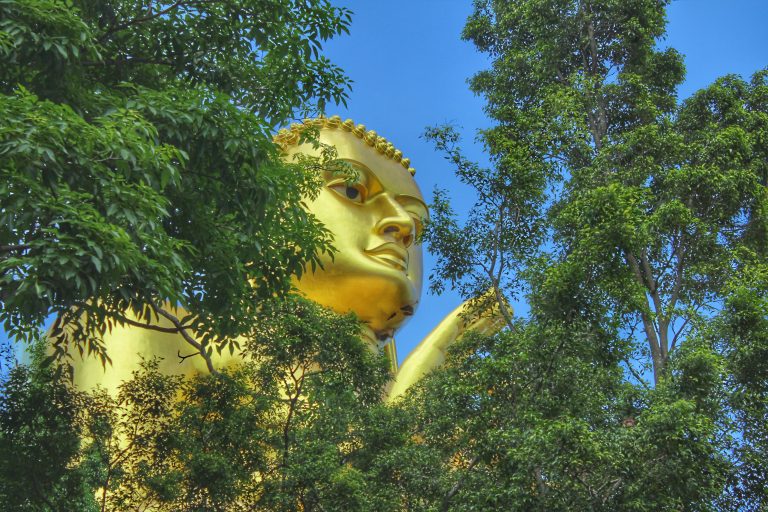
- The top of the rock: steep stone steps lead up through the boulders to a stupa. From there you look across the valley to a large golden Buddha statue on a nearby hill.
- The library and museum: palm-leaf manuscripts and Buddha statues given by other Buddhist countries. Monks at the temple still copy scriptures on palm leaves, and the Daily FT describes the librarian demonstrating the technique and writing visitors’ names on a leaf as a keepsake, for which a small tip is welcome.
Later history
British troops damaged the temple more than once. Sri Lanka Tourism says it was burnt in 1803, when the British invaded Kandy, and repaired in 1820. Then, during the Matale Rebellion of 1848, British soldiers burnt manuscripts in the temple’s library. The monks later set about writing the canon out again. According to the Sunday Times, monks began a full new edition on palm leaves here in 1981, and it took ten years. In January 2019, the President declared the Tripitaka a national heritage at a ceremony held at Aluvihara.
Tips for your visit
- Dress: this is a working temple. Cover your shoulders and knees, and take off your shoes and hat at the shrines. See our guide to temple etiquette in Sri Lanka.
- Steps: the climb is on steep stone stairways and through narrow gaps between the rocks. Shoes that slip on and off easily help, since you remove them at each shrine.
- Time: visitors report that about an hour is enough to see the caves and climb to the top.
- Tickets: recent visitors report a small entrance ticket for foreign visitors, but the amounts they quote differ, and there is no official published fee. Carry some small notes.
Getting there
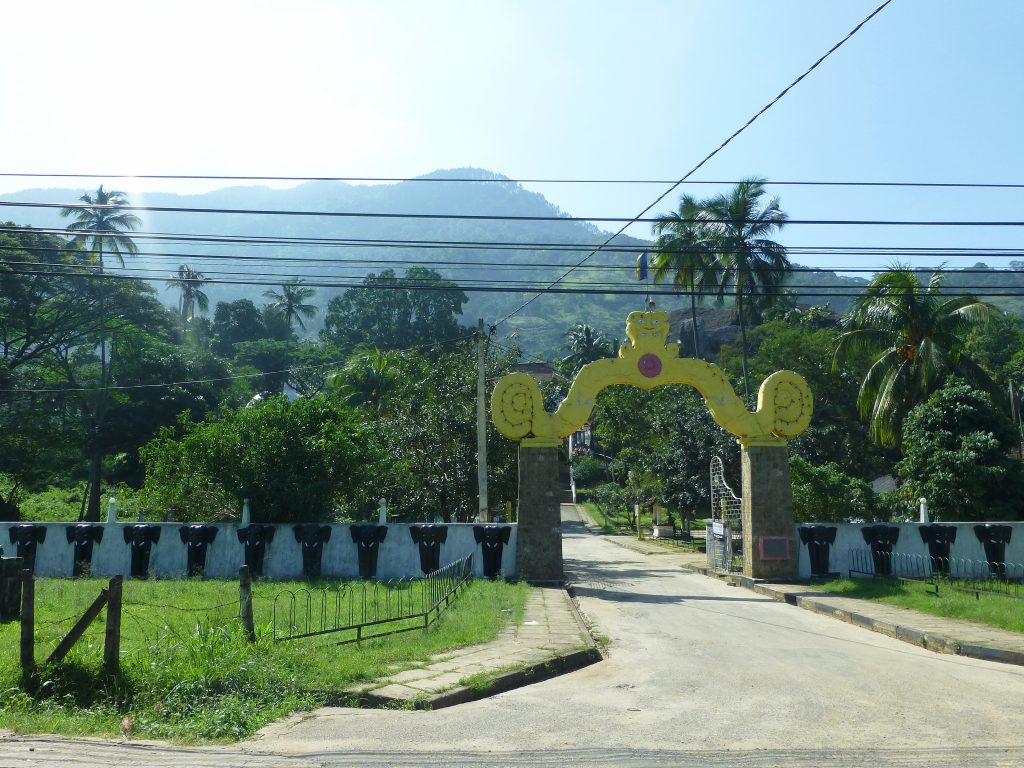
Aluvihara is on the A9, the main road from Matale to Dambulla, about 4 km north of Matale town. An arch beside the road marks the entrance. From Matale, take a tuk-tuk, or any bus heading north towards Dambulla. It is easy to combine with the Dambulla Cave Temple and Sigiriya further north, or with a day based in Kandy.
Frequently asked questions (FAQs)
Why is Aluvihara important?
According to the chronicles, monks wrote down the Pali Canon, the Buddhist scriptures, here in the 1st century BC. Until then, monks had passed the teachings on by memory.
Where is Aluvihara Rock Temple?
On the A9 Matale–Dambulla road, about 4 km north of Matale town in Central Province.
Was the Pali Canon really written at Aluvihara?
The chronicles and most accounts say so, including Sri Lanka Tourism. A minority of historians argue for Alulena, a cave temple in Kegalle District.
Is Aluvihara suitable for children?
The climb is short, but one cave has very graphic scenes of punishment in hell, which may upset young children.
How long do I need at Aluvihara?
Visitors report that about an hour is enough to see the caves and climb to the stupa at the top.
Sources: srilanka.travel, en.wikipedia.org (Aluvihare Rock Temple), sundaytimes.lk (tripitaka declared a national heritage…), ft.lk, sundaytimes.lk (kt21.html), dailymirror.lk, en.wikipedia.org (Matale rebellion) and recent visitor reports. Header photo: Pierre André Leclercq / Wikimedia Commons, CC BY 4.0.