Long before Sri Lanka had great stupas, its monks lived in caves. Early Brahmi inscriptions cut below the drip ledges of rock shelters record who gave them, and many of those shelters became shrines, painted and filled with Buddha images over the centuries. The cave temples in Sri Lanka range from Dambulla, a UNESCO World Heritage Site, to small working temples where a monk shows you round.
Dambulla is the one most people see. If you’ve been there and want more, or want somewhere quieter, the others below are worth a detour.
Dambulla: the biggest and best preserved
The Rangiri Dambulla Cave Temple is a complex of five cave shrines high on a rock above Dambulla. UNESCO calls it the largest, best-preserved cave-temple complex in Sri Lanka, with murals covering about 2,100 square metres and 157 statues. Forest monks lived in the caves from the 3rd century BCE; the interiors took their present form much later, with masterpieces of 18th-century Kandy-school painting.
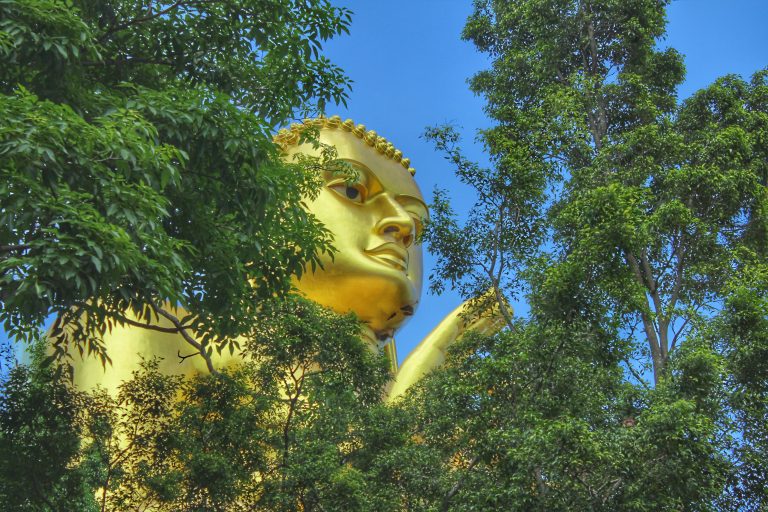
The first cave holds a great rock-cut reclining Buddha, and the second, Maharaja Lena, is the largest. A long climb up granite steps leads to the caves, so Sri Lanka Tourism recommends the morning or evening. Don’t confuse the modern golden Buddha at the foot of the rock with the caves themselves.

On the road from Kandy: Aluvihara
Aluvihara Rock Temple is built into a jumble of huge boulders about 4 km north of Matale, right beside the A9 to Dambulla. According to the chronicles, monks here first wrote down the Pali Canon, the Buddhist scriptures, on palm leaves in the 1st century BC. Monks still copy texts on palm leaves in the temple library.
One cave has very graphic paintings and sculptures of punishments in hell, which may upset young children. Visitors report that about an hour is enough.
In the hill country: Dowa
Dowa Rock Temple sits just below the Badulla–Bandarawela road, a few kilometres from Bandarawela towards Ella. The cave shrine has Kandyan-period murals, but most people come for the huge standing Buddha carved into the rock beside it and never finished: the face is clear, the body only roughed out. Tradition links the temple with King Valagamba. Recent visitors (2025–26) report that entry is free and a donation is welcome.
On the south coast: Mulkirigala
Mulkirigala Rock Temple climbs a 205-metre rock inland from Tangalle, with seven image houses spread over terraces joined by steep steps. Early Brahmi inscriptions on the rock date from the 2nd–1st centuries BC, and the Kandyan-period murals show the life of the Buddha and the Jataka stories. A large reclining Buddha lies in one of the shrines. Go early, before the heat, and take water.

Near Yala: Sithulpawwa
Sithulpawwa Rock Temple is an ancient monastery on a rocky hill inside the area of Yala National Park, reached by a rough road from Kataragama or Tissamaharama. Monks adapted rock shelters as their homes, and the main cave temple has paintings from the Anuradhapura period, which few sites can show. Recent visitors (2025–26) suggest allowing two to three hours, and say the view from the stupa on top is the reason to climb.
Quieter cave monasteries
These are forest monasteries more than painted temples, but their caves are the point.
- Rajagala, north of Ampara: dozens of monks’ caves high on a forested rock, many with inscriptions below their drip ledges, reached by ancient stone stairways.
- Dimbulagala, south-east of Polonnaruwa: a living forest hermitage with caves carrying Brahmi inscriptions and a fragment of old painting.
- Mihintale, near Anuradhapura: Sri Lanka Tourism records 68 caves given to monks, including Mahinda’s Cave with its stone bed.
- Arankele, north of Kurunegala: a forest monastery whose caves were in use long before its stone buildings. Monks still meditate here.
Older than the temples: prehistoric caves
Some caves were lived in tens of thousands of years before the monks arrived. Batadombalena, above Kuruwita, was used from around 36,000 years ago, and Belilena, above Kitulgala, from around 30,000 years ago. Human remains from both are attributed to Balangoda Man, the island’s Stone Age hunter-gatherers. There are no museums at either cave; you come for the shelter itself, and Batadombalena means a steep, muddy walk.
How to visit a cave temple
- Cover your shoulders and knees, and take off your shoes and hat at the shrines. At Dambulla, recent visitors (2024–26) report that staff turn away people who don’t cover up.
- No flash, no posing. Sri Lanka Tourism asks visitors never to pose for photos beside statues and murals, and warns that flash can damage old paintings. At Dowa, ask the monk before taking photos inside.
- Carry socks. Rock and stone get very hot by late morning, and you’ll be barefoot.
- Expect steps. Almost every cave temple involves a climb, often steep and uneven.
- Carry small notes. Several temples have no published fee, and visitors report small tickets or donations.
Our cultural etiquette guide covers temple manners in more detail.
Fitting them into a trip
Dambulla sits beside Sigiriya, and Aluvihara is on the way there from Kandy, so both fit a Cultural Triangle route such as our 5 days in the Cultural Triangle. Dowa is a short stop from Ella, Mulkirigala a half-day from the south-coast beaches, and Sithulpawwa pairs with a Yala safari.
Frequently asked questions (FAQs)
What is the most famous cave temple in Sri Lanka?
The Rangiri Dambulla Cave Temple. UNESCO calls it the largest, best-preserved cave-temple complex in Sri Lanka, with five cave shrines, about 2,100 square metres of murals and 157 statues.
Can you take photos inside cave temples?
Follow each temple’s rules. Sri Lanka Tourism asks visitors not to pose beside statues or murals and not to use flash, which can damage old paintings. At smaller temples such as Dowa, ask the monk first.
What should I wear to a cave temple?
Clothes that cover your shoulders and knees. Shoes and hats come off at the shrines, so carry socks for hot rock.
Is there a cave temple near Ella?
Yes. Dowa Rock Temple, on the Badulla–Bandarawela road, has a cave shrine with murals and an unfinished standing Buddha carved into the rock.
Where was the Pali Canon first written down?
At Aluvihara, near Matale, according to the chronicles and most accounts, in the 1st century BC.
Header photo: Dan Lundberg / Wikimedia Commons, CC BY-SA 2.0.