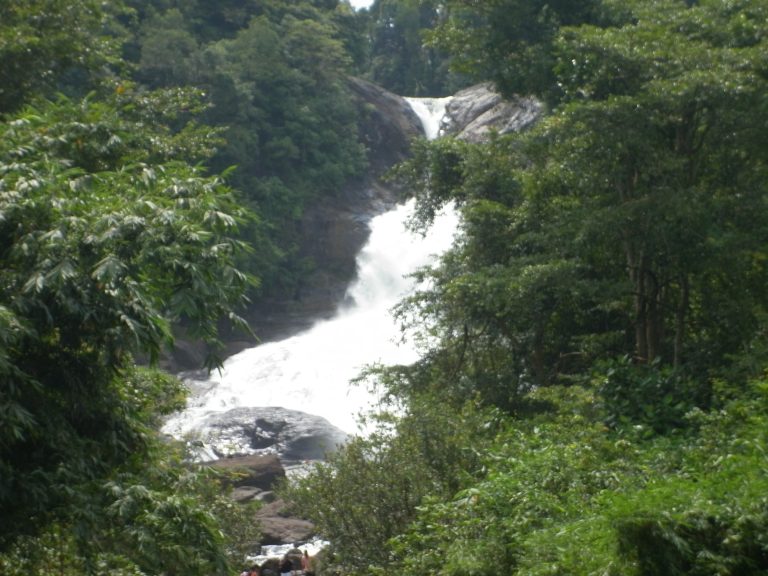
Belilena (also written Beli-lena) is a large prehistoric cave in the rubber-covered hills above Kitulgala, in Kegalle District. It is one of the key sites for Sri Lanka’s earliest people. The Department of Archaeology excavated it between 1978 and 1983, and the human remains found here are attributed to Balangoda Man, the island’s Stone Age hunter-gatherers. You reach it by a rough estate road and a flight of steps, and in the rainy months a waterfall pours over the rock beside the cave mouth.
If you’re staying in Kitulgala, it makes a half-day outing with a real story behind it: a short walk through the trees, a deep rock shelter, and the thought that people cooked and made tools here tens of thousands of years ago. Don’t expect a museum, though. The finds aren’t displayed at the cave, and what you see is the shelter, the excavated area and a few information boards, so the visit means much more if you know the story first.
What was found here
The excavations turned up stone tools, among them tiny geometric “microliths”. They also found evidence of fire, the bones of hunted animals and human bones.
Siran Deraniyagala, a former Director-General of Archaeology who took part in the excavations, said in a 2004 lecture that the cave’s layers start around 30,000 years ago, dated by radiocarbon from charcoal.
The human remains are attributed to Balangoda Man, like those from Batadombalena near Kuruwita. The name comes from the Balangoda area, where the first remains of Sri Lanka’s prehistoric people were found.
Food remains bring these people closer. Burnt seeds of wild breadfruit were found in the deposits, and so were shells. In fact, the Sabaragamuwa tourism office links the cave’s name to all those shells (“lena” is Sinhala for cave). The game identified from the bones includes sambar deer, wild boar, monkeys and porcupine.
Much later, Buddhist monks used the cave. According to the provincial tourism office, there are ruins of a 19th-century temple here, and a monk lived in the cave until 1970. Today the whole site is an archaeological reserve of the Department of Archaeology.
What you see at the cave
The main shelter is a deep overhang in the hillside, with smaller caves around it. Take your time looking at its floor, since this is where the excavators dug down through the layers.
In the wet season a waterfall comes down over the cliff at one end. Recent visitors (2025) describe slipping behind the curtain of water into a smaller cave beyond it. You will get wet, and the rock is slippery.
Keep your voice down near the overhangs. One visitor report mentions large insect nests high on the rock and warns that loud noise could disturb them.
Getting there
- The route: the cave is about 8 km from Kitulgala. Leave the town on the A7 towards Hatton and turn off at the Inoya estate. Then follow a narrow road up through the rubber, past the estate school. The last stretch, roughly a kilometre, is on foot and ends in a long flight of steps.
- Transport: recent visitors report that the estate road is rough. A tuk-tuk from Kitulgala or a vehicle with good clearance is the practical choice, and your guesthouse can find a driver who knows the turn.
- Tickets: there is no official published fee, and recent visitors (2025) report that entry is free.
- What to bring: shoes with grip, water and a snack, since visitors report no shops near the cave. Avoid the walk in heavy rain, when the path and steps get slippery.
Frequently asked questions (FAQs)
How old is Belilena cave?
According to Siran Deraniyagala, a former Director-General of Archaeology, radiocarbon dates put the start of its layers at around 30,000 years ago.
What was found at Belilena?
Stone tools including tiny microliths, evidence of fire, burnt wild breadfruit seeds and shells. The bones of hunted animals and human remains attributed to Balangoda Man were found too.
Where is Belilena cave?
In the hills about 8 km from Kitulgala, in Kegalle District. An estate road leaves the A7, and the last part is a short walk with steps.
Is there an entrance fee?
There is no official published fee. Recent visitors (2025) report that entry is free.
Can you see the waterfall all year?
It flows mainly in the rainy months. In dry spells there is much less water over the cliff.