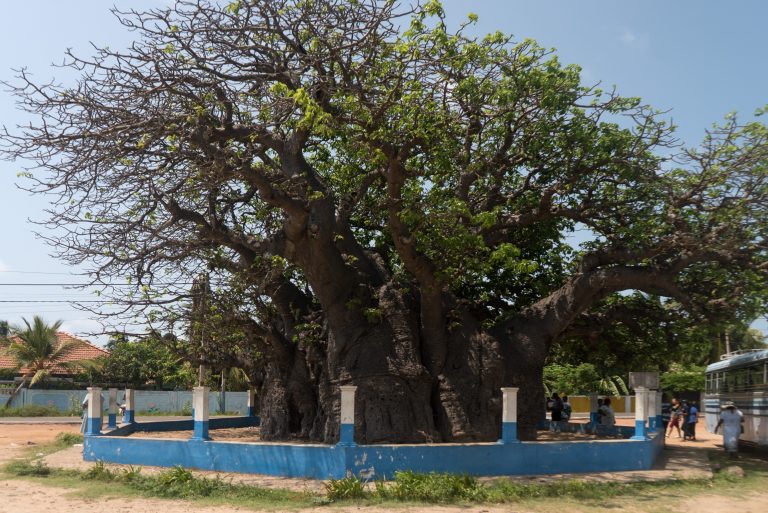
Pooneryn Fort is a ruined Portuguese and Dutch fort beside the main road at Pooneryn (also spelled Poonakary), on the southern shore of the Jaffna lagoon in Kilinochchi District. Only low, overgrown walls survive, but the spot is easy to reach and makes a good stop between Mannar and Jaffna.
Is it worth visiting?
Go if you are driving the A32 coast road anyway, like ruins that nobody has tidied up, or want to see the less-visited side of the Northern Province’s colonial past. It takes well under an hour to look round.
Think twice if you want a restored fort with displays and a ticket office. This is not Jaffna Fort: no official visitor information, opening hours or entry fee turned up in our research, and recent visitors (2025–26) describe a neglected site with cattle wandering over the grass.
A short history of the fort
The Portuguese built the fort to protect their holdings around Jaffna. The Dutch took it over (Wikipedia gives 1658) and classed it as a redoubt, a small outpost guarding the coastal route between Mannar and Jaffna and helping them watch for smuggling from southern India. In 1770 the fort was described as square, with a bastion at each of two opposite corners and walls roughly 30 metres long. It had fallen into ruin by 1792, and in 1805 the British built a rest house on the site, after taking the area in 1796.
Sources disagree on when the first fort went up, so we leave that date out.
The fort was also caught up in the civil war. The army held it until it withdrew from Pooneryn in the 1990s, the LTTE held the area for years afterwards, and the military retook it in November 2008. Since then the site has been open to the public.
What you’ll see
Expect brick-and-stone wall remains, trees growing out of the masonry and open ground around them, not a complete circuit of ramparts. The site is listed as a protected archaeological monument in the Kilinochchi District list on Wikipedia, registered in 2016. Read the walls as a quick, atmospheric stop, then move on.
Take care on uneven ground and loose stone. As at any ruin, don’t climb on the walls.
Getting there
Pooneryn is the northern end of the A32, the road along the north-western coast from Mannar. The Sangupiddy Bridge, opened in January 2011, now carries that road across the lagoon, so you can reach Jaffna without a ferry. Visitors have long described the fort as easy to spot from the road.
- From Mannar or Jaffna: it sits on the A32, so a car, hired driver or tuk-tuk can stop here on the way. Check current road conditions locally, because older reports mention rough, potholed stretches.
- From Colombo: road guides give about 335 to 365 km depending on the route, either via Anuradhapura and Kilinochchi or via Puttalam and Mannar.
- Combine it with: Mannar Fort, Jaffna, or the wider route in Northern Sri Lanka in 7 days.
Tips for a visit
- Aim for the cooler hours of the morning or late afternoon; there is little shade beyond the trees.
- Follow the instructions of police or army officers at checkpoints, and do not photograph military installations or use a drone near them, as the UK government’s travel advice warns. See our drone rules guide.
- Bring water and any food; we found no confirmed facilities at the site.
Frequently asked questions (FAQs)
Where is Pooneryn Fort?
In Pooneryn (Poonakary) in Kilinochchi District, on the southern shore of the Jaffna lagoon, next to the A32 road.
Who built Pooneryn Fort?
The Portuguese built it to protect Jaffna, and the Dutch took it over. The British turned what remained into a rest house in 1805.
Is there an entry fee?
We found no official fee or opening hours. Recent visitors describe an open, unstaffed ruin.
How long do you need?
Most visitors need well under an hour, so it works best as a stop on a longer drive.
Can you visit Pooneryn Fort from Jaffna?
Yes, it is on the A32 and reachable by road. The Sangupiddy Bridge opened in January 2011, so there is no ferry crossing.
Header photo: AntanO / Wikimedia Commons, CC BY-SA 4.0.