
Check before you travel Hill-country railway: repairs after Cyclone Ditwah Checked 5 October 2026
Cyclone Ditwah damaged the hill-country railway in November 2025, and it is reopening in stages. Since 2 October 2026, trains run again from Colombo Fort to Peradeniya and Gampola, but Kandy station itself is not served yet. On 5 October 2026 earth and rocks fell onto the line between Kadigamuwa and Gangoda after heavy rain and derailed an early train; services restarted later the same day, but expect delays or short suspensions after heavy rain. Trains between Nanu Oya and Badulla, which stop at Haputale, Ella and Demodara, restarted on 20 June 2026. The section between Gampola and Nanu Oya is still under repair, so you cannot yet go by train from Colombo or Kandy all the way to Ella. Check the latest services before you plan a rail journey, and book reserved seats on the Sri Lanka Railways seat reservation site.
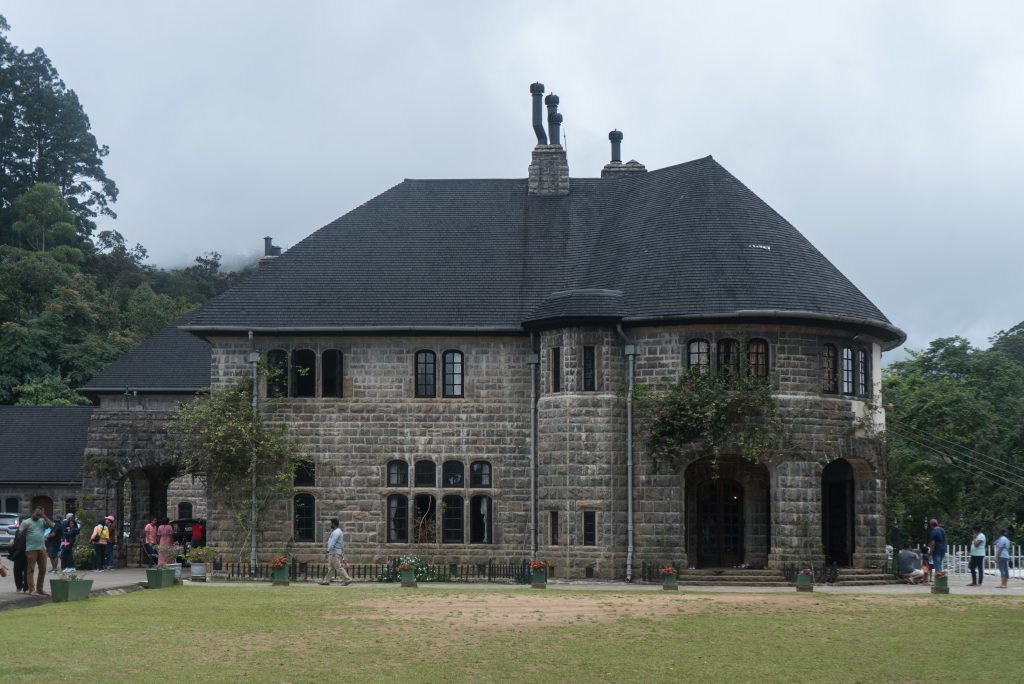
Adisham Bungalow is a stone country house in the hills just outside Haputale, built for the British planter Sir Thomas Villiers and completed in 1931. Designed along the lines of Leeds Castle in Kent, it is now St Benedict’s Monastery, and visitors come for the house, its gardens and the monks’ jams and cordials.
Is it worth visiting?
Go if you are staying in Haputale and enjoy colonial-era houses and gardens; it pairs well with a morning at Lipton’s Seat.
Think twice if you can only come on a weekday: it is a working monastery, and visiting days are limited (see below).
History
Sir Thomas Villiers, a planter and businessman, named the house after Adisham, his birthplace in Kent. The British architects R. Booth and F. Webster designed it, and it was completed in 1931. It passed to the Benedictines in the early 1960s and has been a monastery ever since.
What you can see
Recent visitors (2025–26) report that a few of the house’s rooms, with their period furniture, are open to view. You can walk in the gardens and lawns and buy the jams and cordials the monastery is known for, made from its own gardens and orchards. The grounds adjoin the Thangamale sanctuary, declared in 1938.

Visiting days
The monastery does not publish its visiting times online, and recent visitor reports (2025–26) disagree: most say it opens to visitors only at weekends and on public, poya and school holidays, while one says it opens daily. They also mention a small entrance fee. Check locally in Haputale before making the trip, and remember that it is a religious community.
Getting there
Adisham is a short tuk-tuk ride from Haputale town. For trains to Haputale, see our Haputale guide.
Frequently asked questions (FAQs)
Who built Adisham Bungalow?
Sir Thomas Villiers, a British planter, who named it after his birthplace in Kent. It was completed in 1931.
Is Adisham open every day?
Not necessarily. There are no official published times, and most recent visitors report it opens only at weekends and on holidays. Check locally before you go.
What can you buy at Adisham?
Jams and cordials made by the monastery from its own gardens and orchards.
Sources: sundaytimes.lk (plus 10.html), sundaytimes.lk (sundaytimesmagazine 03.html), en.wikipedia.org (Adisham Hall), en.wikipedia.org (Thomas Lister Villiers), en.wikipedia.org (List of wildlife sanctuaries of…) and recent visitor reports. Header photo: Alexey Komarov / Wikimedia Commons, CC BY-SA 4.0.