Seruwila Mangala Raja Maha Vihara is an ancient Buddhist temple in the south of Trincomalee District, beyond Muttur. King Kavantissa built its white stupa in the 2nd century BC. By tradition it enshrines the Buddha’s forehead bone relic, so for pilgrims this is far more than a sightseeing stop.
Is it worth visiting?
Go if you want to see a working pilgrimage temple far from the tourist trail, especially if you are already driving the coast road between Trincomalee and Batticaloa.
Think twice if you are hoping for ruins on the scale of the Cultural Triangle, because the draw here is one restored stupa and the meaning it holds rather than its size.
The forehead relic and the king who built the stupa
Seruwila’s story starts with the relic. The Dhatuvamsa, a Sri Lankan chronicle of the Buddha’s relics, tells how the forehead relic passed from India through a line of monks to the kings of Ruhuna. King Kavantissa, the father of King Dutugemunu, then enshrined it in a stupa beside a lake called Seru, on the southern bank of the Mahaweli River. According to the same tradition, hair relics of the Buddha lie here too.
Two rock inscriptions have turned up at the site, and the older one calls the monastery Tismaha Vehera. For this reason Seruwila is identified with the Tissa Maha Vihara of the chronicles. That makes it one of the Solosmasthana, the sixteen places Buddhists hold most sacred. Not every list agrees, however; some give that place to Tissamaharama in the far south.
In 2010 Sri Lanka added an ancient pilgrim route to its UNESCO tentative list. It follows the Mahaweli valley from Seruwila to Sri Pada (Adam’s Peak). Along the way it links relic shrines, from the forehead relic here to the footprint on the summit.
Lost in the jungle and found again
For centuries the stupa lay abandoned in the forest. Then, in the early 1920s, a young monk named Dambagasare Sumedhankara Thero arrived by sea from the south. His reading of the chronicles had convinced him that the relic stupa lay here, and he found the ruins deep in the jungle. He restored the stupa with help from the Archaeological Department, using the ancient remains around it as a guide. He looked after the temple for the rest of his long life, until he died in 1984.
Today the stupa and its grounds are a protected archaeological site. The area is still rural and wooded, close to the eastern bank of the Allai tank. The Sunday Times described the jungle around it as home to peacocks and wild elephants.
What you see at the temple
The restored stupa is the centre of everything. It is a tall, whitewashed dome with a square relic chamber and a spire on top. Steps lead up to its terrace from an open, sandy courtyard shaded by old trees.
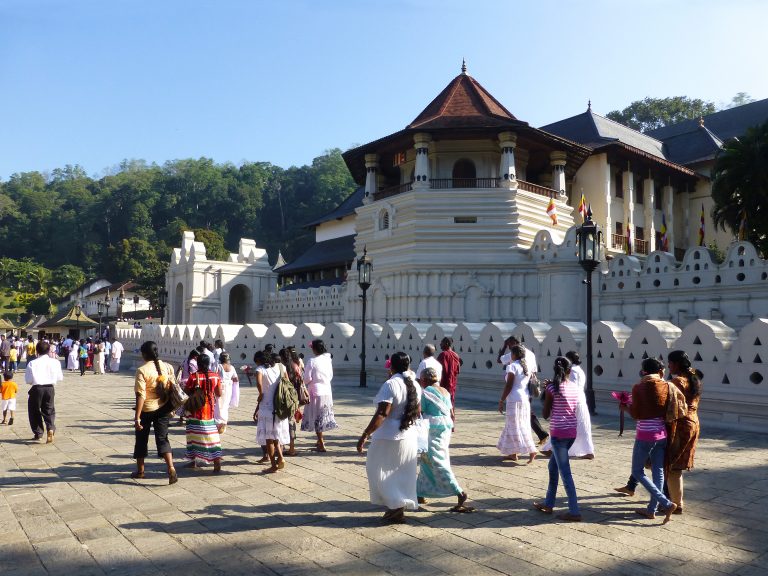
Around it lie the remains of the ancient monastery. Look for old entrances with guard stones and moonstones, a carved stone lotus, the base of a pillared building and a Bodhi tree shrine. Pilgrims walk around the stupa clockwise, offer flowers and light oil lamps. On busy days the courtyard fills with families dressed in white.
Dress and conduct
Seruwila is a place of worship first. Cover your shoulders and knees; white or light colours fit in best. Take off your shoes and hat before you step onto the stupa terrace, and keep your voice down. Never pose for a photo with your back to the stupa or a Buddha statue. Our guide to cultural etiquette in Sri Lanka covers temple manners and Poya days in more detail.
The sand gets hot underfoot by midday, so come early in the morning or late in the afternoon. Full-moon Poya days bring the biggest crowds. We could not find official opening hours or an official fee. Visitor reports mention no entry charge, although donations are welcome.
Getting there
From Trincomalee, follow the A15 coast road south through Kinniya and Muttur to Palaithoppur. There, turn inland on the road to Seruwawila. From the Cultural Triangle you can also come in from the west, through Kantale and Allai.
Recent visitors (2025) report that buses from Trincomalee towards Akkaraipattu use the A15. Even so, a car or a tuk-tuk hired for the day is far more practical. Plan to drive in daylight, because wild elephants roam the forest and farmland around Seruwila and recent visitors advise against travelling at night.
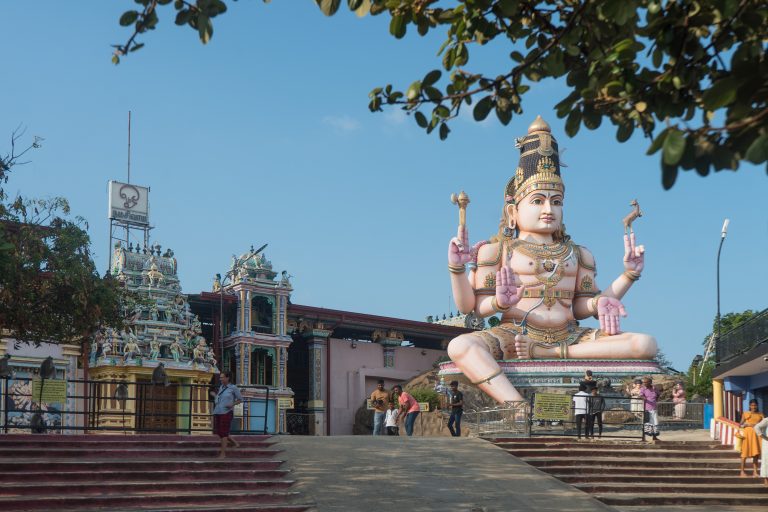
From a base in Trincomalee, Seruwila makes a day out on its own, so keep Koneswaram Temple in town for another day. Alternatively, fit Seruwila into a slow drive down the coast, as on our east coast itinerary.
Frequently asked questions (FAQs)
Where is Seruwila temple?
It is in the south of Trincomalee District, in Sri Lanka’s Eastern Province. The temple lies inland from the A15 coast road at Palaithoppur, beyond Muttur, near the Allai tank.
Why is Seruwila sacred?
By tradition its stupa, built by King Kavantissa in the 2nd century BC, enshrines the Buddha’s forehead bone relic. Many lists also count it among the Solosmasthana, the sixteen places Buddhists hold most sacred.
Who rediscovered Seruwila?
A young monk, Dambagasare Sumedhankara Thero, found the overgrown stupa in the early 1920s. He looked after the temple until his death in 1984.
Is there an entrance fee at Seruwila?
We found no official fee. Visitor reports mention no entry charge, although donations are welcome.
What should I wear to Seruwila?
Wear clothes that cover your shoulders and knees, ideally white or light-coloured. You will need to take off your shoes and hat at the stupa terrace.
Sources: en.wikipedia.org (Seruwila Mangala Raja Maha Vihara), whc.unesco.org, sundaytimes.lk, dailymirror.lk, en.wikipedia.org (Solosmasthana), en.wikipedia.org (Kavan Tissa, Prince of Ruhuna), en.wikipedia.org (A15 highway (Sri Lanka)) and recent visitor reports. Header photo: L Manju / Wikimedia Commons, CC BY-SA 4.0.