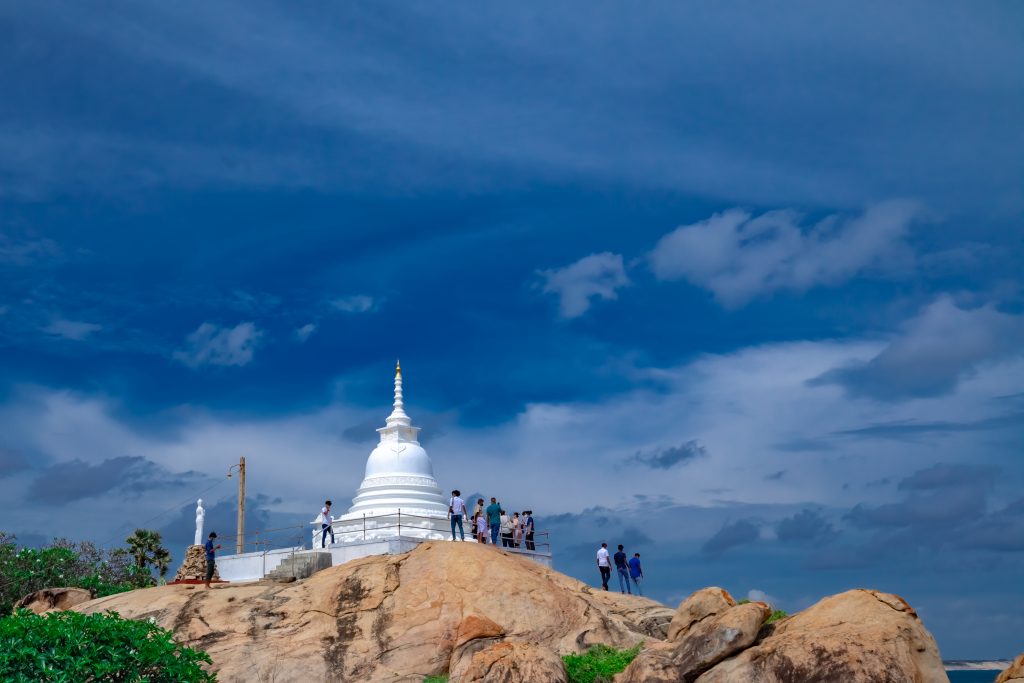

Kirinda Temple is a white dagoba on a rocky outcrop right above the sea, in the fishing village of Kirinda on the Hambantota coast. It’s a short run from Tissamaharama. Locals link it to one of the best-known legends in southern Sri Lanka: the sea voyage of Vihara Maha Devi, mother of King Dutugemunu.
Is it worth visiting?
Go if you want wide views over the Indian Ocean and a good story, without the crowds of the bigger sites. It’s also only a short detour if you’re already around Tissamaharama.
Think twice if you’ve already got a full day of temples planned. What makes Kirinda worth the stop is the setting and the legend, more than any single building.
The legend of Vihara Maha Devi
The story begins in Kelaniya, near today’s Colombo. According to the legend, its king, Kelanitissa, punished an innocent monk by boiling him alive in oil. In anger, the gods then made the ocean rush inland and flood the land. So, to calm the sea, the king placed his young daughter in a decorated boat and set her adrift.
She finally came ashore at a spot called Dovera in Kirinda, in what was then the kingdom of Ruhuna. King Kavantissa heard her story, and her courage so impressed him that he married her. Later she became Vihara Maha Devi, and she bore him two sons, Dutugemunu and Saddhatissa. Dutugemunu grew up to become one of Sri Lanka’s greatest heroes.
What’s on the rock
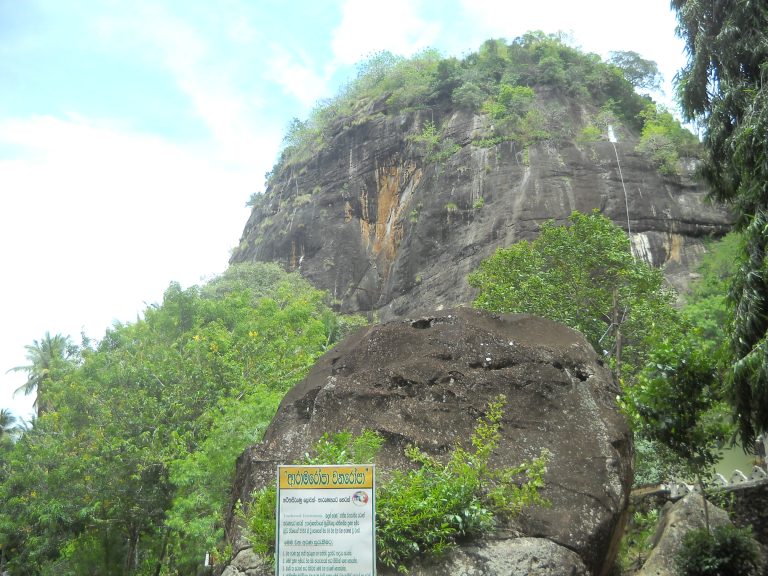
The white dagoba crowns the top of the rock. Beside it, a white statue of Vihara Maha Devi looks out over the sea that, in the story, she crossed. Below, a standing Buddha statue in saffron robes rises against the dark rock face. Then climb to the top for the view out over the Indian Ocean.

Kirinda village
Kirinda itself is a fishing village with its own history. It grew up as a Malay settlement, and Sri Lankan Malay is still its main language, used even for teaching in its school.
Far out to sea lies the Great Basses reef, whose lighthouse first shone in March 1873. Later, in 1961, Arthur C. Clarke and Mike Wilson found the wreck of an early 18th-century Indian ship there, carrying a treasure of silver rupees.
Getting there and visiting
Kirinda sits on the Tissamaharama–Kirinda road, a short tuk-tuk or taxi ride from Tissamaharama. We also found no official information on opening hours or an entrance fee. It’s a working, publicly accessible shrine rather than a ticketed site, so go respectfully. Dress modestly for the climb up the rock, and bring a hat, because there’s little shade at the top.
Afterwards, pair a visit with the Tissamaharama Raja Maha Vihara in town. Alternatively, Mulkirigala Rock Temple, further along the coast, is another rock-top shrine with a similar feel.
Frequently asked questions (FAQs)
Where is Kirinda Temple?
On a rocky outcrop above the sea in Kirinda, a fishing village on the Hambantota coast. It’s also a short distance from Tissamaharama.
Who was Vihara Maha Devi?
A princess from Kelaniya. According to legend, her father set her adrift at sea, and she came ashore at Kirinda. She then married King Kavantissa of Ruhuna and became the mother of King Dutugemunu.
What can you see at Kirinda Temple?
A white dagoba on top of the rock, a white statue of Vihara Maha Devi facing the sea, and a standing Buddha statue against the rock face. But the view over the ocean is the main reward for the climb.
Is there an entrance fee for Kirinda Temple?
We found no official fee information. It’s a working temple that visitors can enter respectfully rather than a ticketed attraction.
Header photo: Sarala Gamage / Wikimedia Commons, CC BY-SA 4.0.