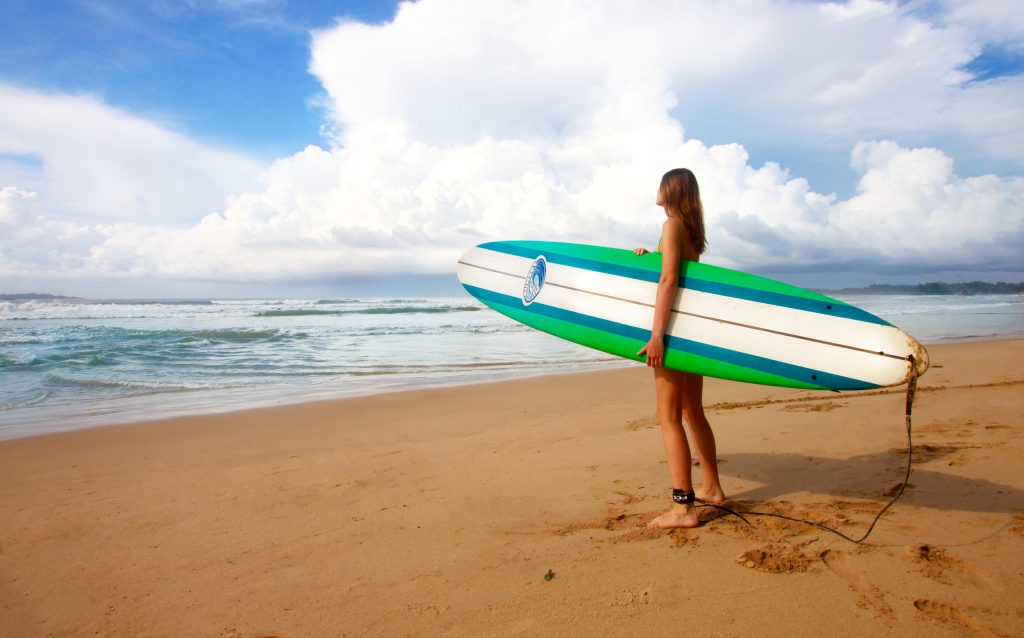
Weligama is where a lot of people stand up on a surfboard for the first time. The wide bay at Weligama, on the south coast, has a sandy bottom and, recent visitors report, small, slow waves, with surf schools and board stands all along the beach. This page is about learning there: picking a school, what to ask, how to handle the crowd and the sea, and what to do once you’re hooked.
Is it right for you?
Go if you’ve never surfed, or not for years, and want to learn somewhere you can take a lesson every morning without travelling to the break. You need to be reasonably comfortable swimming in the sea; good schools will ask.
Think twice if you’re coming in the south-west monsoon, from May to September, when the sea on this coast is rough. Experienced surfers may also find the main bay too gentle and too busy, and will want the reef breaks further along the coast instead. Our guide to the south coast or Arugam Bay for surfing covers which coast is in season when.
When to learn
There is no official surf season for Weligama, and surf guides don’t quite agree: recent visitors (2025–26) put the main season at about November to April, others at December to April. Either way it is the dry season on the south-west coast. The Department of Census and Statistics gives the south-west monsoon as May to September, which is when rain and rough seas arrive.
Within the day, recent visitors find the waves cleaner in the early morning, before the wind picks up, and the beach busier later. An early lesson also keeps you out of the worst of the midday sun.
Choosing a surf school
Surf schools and board stands line the beach, so you won’t be short of offers. The Sri Lanka Tourism Development Authority’s guideline for surf schools is a useful checklist, because it sets out what a registered school is expected to have:
- basic lessons on soft boards, every board fitted with a leash and the right fins;
- instructors with an International Surfing Association Level 1 award plus a surf lifeguard or aquatic safety award;
- the instructor in a vest of a different colour from the students, so you can spot them in the water;
- a first-aid kit and a rescue board of at least 8 feet on the beach;
- a check of your swimming ability and health before you start, and a briefing on signals and what happens in an emergency.
The same guideline says pregnant women shouldn’t take part. A school that ticks these boxes will usually be happy to tell you so; one that shrugs at the questions has told you something too.
Sri Lanka Tourism publishes a list of [registered water sports centres](https://www.srilanka.travel/water-sport-centres) with registration numbers. When we checked in October 2026 it had 30 centres for the whole island, most of them diving, kite or rafting operators, so most surf schools on the beach won’t be listed. Registration does mean the centre has been through an inspection, so it is worth asking whether a school is registered.
Also ask how many students share one instructor, how long the lesson lasts and how much of it is in the water, and agree the price before you start. There is no official price list.
In the water
Weligama’s gentle waves bring a crowd. Recent visitors (2025–26) describe the inside of the bay as packed with learners on a busy morning, and warn about loose soft-top boards flying around. A few habits keep you and everyone else safer:
- Keep your distance from other learners, and look before you go for a wave.
- Watch the sea for a few minutes before you paddle out, and keep your leash on.
- Stay in the area your instructor shows you, and stay within your depth.
- Don’t go out alone, and come in when you’re tired.
When the swell is big, recent visitors report waves closing out across the main bay, so take your instructor’s word if they say it’s not a day for beginners.
Currents and emergencies
Gentle surf doesn’t mean a safe sea. In August 2026 a young visitor surfing off Weligama was swept away by a strong current in rough seas and died; our Weligama guide has the details. The UK government warns that many Sri Lankan beaches have dangerous surf or rip currents at certain times of year, and advises asking your hotel or operator before you go in.
If a current pulls you away from the beach, beach-safety services in the US and Australia give the same advice: stay calm, stay with your board, don’t fight the current, and paddle parallel to the shore until you feel it weaken. Then head back in at an angle, and wave and shout if you can’t get out. In an emergency, call 1990 for the free national ambulance service or 119 for the police; Sri Lanka Tourism’s hotline is 1912.
Hiring a board on your own
Once you can paddle out past the white water and catch waves on your own, the guideline counts you as an intermediate. That is the point at which renting a board makes sense. Before you take one, check the leash and fins, photograph any dings, as recent visitors suggest, and agree what you’d pay if it comes back damaged. Recent visitors also recommend a rash vest against the sun; they report that you won’t need a wetsuit.
After the first week
From Weligama it’s a short ride along the coast to the reef breaks at Ahangama and around Midigama, where more experienced surfers go. Recent visitors warn of sharp coral and sea urchins on the south coast’s reef breaks, so move on only when your instructor thinks you’re ready, and wear booties if you have them. On a flat day, Mirissa is next door. Off the beach, cover up in town and at temples, as our cultural etiquette guide explains.
Frequently asked questions (FAQs)
Is Weligama good for beginner surfers?
Recent visitors describe a sandy-bottomed bay with small, slow waves and plenty of surf schools. It gets crowded, and currents can still be dangerous, so learn with an instructor.
When is the best time to learn to surf in Weligama?
Recent visitors put the main season at about November or December to April, the dry season on this coast. The south-west monsoon, from May to September, brings rough seas.
How do I choose a surf school in Weligama?
Ask for soft boards with leashes, instructors with an International Surfing Association Level 1 award and a lifeguard award, a rescue board on the beach and a swimming check. That is what the Sri Lanka Tourism Development Authority expects of registered schools.
Do I need to be able to swim to learn to surf?
Yes. The Sri Lanka Tourism Development Authority’s guideline asks schools to check your swimming ability before the lesson.
What should I do if I’m caught in a current?
Stay with your board, don’t fight the current and paddle parallel to the beach until you are free of it. Raise an arm and shout for help; the national ambulance number is 1990.
Header photo: Filipp Nekhaev / Wikimedia Commons (Unsplash), CC0.