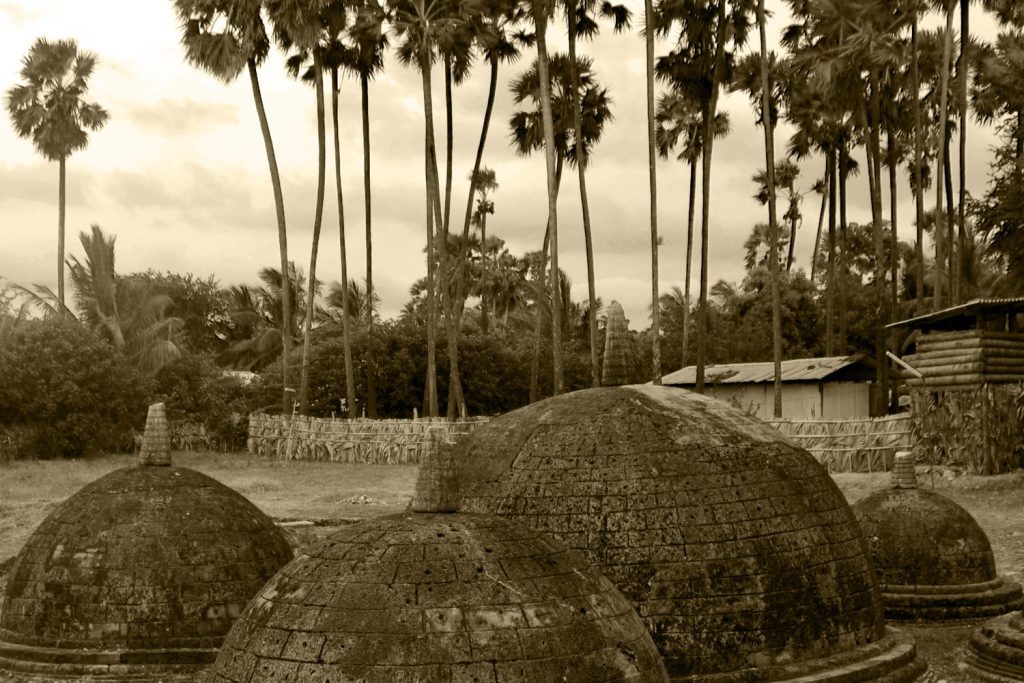
In a village of palmyra palms and farm plots north of Jaffna, a fenced field holds something that looks nothing like the stupas further south. Small, round stupas of grey coral stone crowd together like a family of mushrooms. These are the Kandarodai stupas (also spelt Kantharodai), near Chunnakam on the Jaffna peninsula. They are the remains of the ancient Buddhist monastery known as Kadurugoda Vihara.
It is a small site and a short stop, best fitted into a day around the peninsula. In short, come expecting a quiet field rather than a ruined city. It is a reminder that the north has a Buddhist past as well as its great Hindu temples and Dutch fort.
What you see
About 20 stupas still stand, with the foundations of several more around them. The domes use porous coral stone, pitted with small holes. They range from around 8 feet across to about 23.5 feet. Unlike most Sri Lankan stupas, they don’t have the square railed box on top. Each one ends instead in a fixed, umbrella-shaped pinnacle. That is a large part of why the site looks so different from Anuradhapura or Polonnaruwa.
Also look low as well as up. Between the domes you can trace stepped bases and the outlines of stupas that have lost their upper parts.
A short history
In 1917 the Jaffna District Magistrate, Paul E. Pieris, found Buddhist ruins at Kandarodai and identified them as the ancient Kadurugoda Vihara. He reported about 56 stupas. Excavations between 1917 and 1919 turned up a shrine-room ruin, coloured tiles, parts of Buddha and Bodhisattva statues, Buddha footprints, a guard stone and old coins. Today the Jaffna museum keeps some of the finds.
However, how old the stupas are is still debated. Some accounts place them in the Anuradhapura period, while others describe what you see as later reconstructions. Local tradition links them with the relics of Buddhist monks.
The Department of Archaeology bought about seven acres here in 1948. Houses and farm plots later spread over much of that land, so the protected area today is far smaller. Finally, in May 2013 the government gazetted the site as an archaeological protected monument.
Visiting
Kandarodai is near Chunnakam, in the Valikamam South division of Jaffna District. Ask for “Kandarodai”, “Kantharodai” or “Kadurugoda”.
There is no published entry fee or opening times, so check on arrival. It is a Buddhist site: dress modestly and don’t climb on the domes.
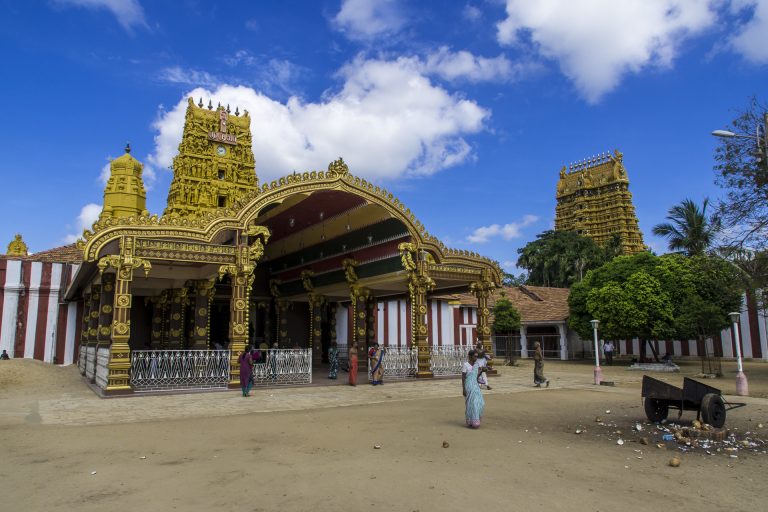
The stupas pair well with the other northern sights. Head on to the sacred bathing place at Keerimalai Springs on the north coast, or back towards town for the Nallur Kandaswamy Temple and Jaffna Fort. Our northern Sri Lanka itinerary shows how the peninsula fits into a longer trip.
Frequently asked questions (FAQs)
Where are the Kandarodai stupas?
In the village of Kandarodai, near Chunnakam, on the Jaffna peninsula in Northern Province.
What is Kadurugoda Vihara?
The ancient Buddhist monastery linked to the Kandarodai ruins, identified in 1917.
How many stupas are there?
About 20 stand today, with the foundations of others. In 1917 Paul E. Pieris reported about 56.
Is the site protected?
Yes. The government gazetted it as an archaeological protected monument in May 2013.
Is there an entrance fee?
There is no published fee or opening times, so check on arrival.
Header photo: Gane Kumaraswamy / Wikimedia Commons, CC BY-SA 2.0 (cropped).