
Sri Lanka has surf somewhere for most of the year, but not in the same place. The south and south-west coast, from Hikkaduwa through Weligama to Hiriketiya, is in season from about November to March; Arugam Bay, on the east coast, from about April to October. Choose by the month first, then by your level: both coasts have gentle waves for learners and harder breaks for experienced surfers.
Which coast suits you?
Choose the south coast if you are travelling between November and March, you are learning or getting back into it, and you want lots of surf schools, places to stay and other things to do within a short ride. It is the main winter season, so expect busy line-ups and to book ahead around Christmas and New Year.
Choose Arugam Bay if you are travelling between April and October, you want point breaks with long rides, and you don’t mind a smaller, more remote surf town on the far side of the island. Outside its season it is quiet and the waves are rarely good.
Surf season by month
- November to March: the south coast. Sri Lanka Tourism gives Hikkaduwa’s best surf as November to March, in its dry season. Surf schools and recent visitors (2025–26) report January and February as the peak.
- April: a changeover month. Sri Lanka Tourism dates the Arugam Bay season from April, while the south coast tails off.
- May to September: Arugam Bay. Surf schools report the most powerful waves and the biggest crowds in July and August.
- October: Arugam Bay’s season ends, according to Sri Lanka Tourism. Surf schools call October and April the choppiest months on both coasts.
The pattern follows the monsoons. From May to September the south-west monsoon brings rain and rough seas to the south-western side of the island; Sri Lanka Tourism says the sea at Mirissa gets rough from May to October, while the east coast has its driest months. From December to February the north-east monsoon brings rain to the eastern half of the island, and the south coast has its calm, dry season. Surf schools report that outside the season at Arugam Bay the water turns murky and the swell is weak. Our guide to the best time to visit Sri Lanka covers the monsoons in more detail.
The south coast: Weligama, Hiriketiya, Hikkaduwa
Weligama is the usual place to learn. Recent visitors describe the main bay as a sandy-bottomed beach break with small, slow waves, with surf schools and board-rental stands along the beach. The flip side is the crowd: on a busy morning the inside is full of beginners and loose boards, so keep your distance from other learners. Our guide to learning to surf in Weligama covers choosing a school and hiring a board in more detail.
Hiriketiya, a small horseshoe bay at Dikwella, further east, is well sheltered with a sandy bottom, and surf schools describe it as suiting beginners and intermediates. It has become very popular, so go early, when the line-up is quieter.
Hikkaduwa, on the south-west coast, hosted Sri Lanka’s first local surf competition, in 1993. Sri Lanka Tourism describes waves of 4 to 11 feet and four main spots, and the beach has a mix of reef and sand breaks for different levels. Part of the shore is a coral reef and marine park, so the reef breaks are for surfers who can control where they fall. Recent visitors warn of sea urchins and sharp coral on the reef breaks around the south coast; wear booties if you have them.

Between Weligama and Galle, surf schools point intermediate surfers ready to move on from the beginner bays to the reef breaks around Midigama and Ahangama.
Arugam Bay and the east coast
Arugam Bay has hosted most of Sri Lanka’s international surf contests since 2004, including the World Surf League’s So Sri Lanka Pro in September 2019. Sri Lanka Tourism names the point at Arugam Bay itself (Main Point to surfers), Pottuvil Point and Crocodile Rock among the main breaks, and says the season runs from April to October.
Main Point is a long point break for confident surfers. For beginners, surf schools and recent visitors point to the softer waves at Baby Point and at Elephant Rock (the same break as Crocodile Rock), south of the bay; Whiskey Point suits intermediates. Most breaks outside the bay itself are a tuk-tuk ride away, so agree the fare and the waiting time before you go. Recent visitors report wild elephants on the roads to the southern breaks and crocodiles in the lagoons, so travel in daylight and don’t swim in lagoon water. Our guide to surfing around Arugam Bay covers the breaks, lessons and line-up manners in full.
Sri Lanka Tourism’s description of Pottuvil Point adds a practical tip: the surf increases during the day, so be on the beach by about 10 am.
By ability
- Beginners: Weligama or Hiriketiya from November to March; Baby Point or Elephant Rock at Arugam Bay from May to September. Book lessons with an instructor rather than hiring a board and paddling out.
- Intermediate: the reef breaks around Midigama and Ahangama in the winter season; Whiskey Point mid-year.
- Experienced: Main Point and Pottuvil Point at Arugam Bay in July and August, and the reef breaks at Hikkaduwa and along the south coast in winter.
Sea safety
The surf season is not the same as a safe sea. The UK government’s travel advice warns that many beaches in Sri Lanka have dangerous surf or rip currents at certain times of year, and advises asking your hotel or tour operator before going in.
Recent cases show what that means. On 19 December 2025, in the middle of the south-coast season, a 54-year-old visitor from Belarus was dragged offshore by a strong current while swimming off Hikkaduwa and died; the same day, police lifeguards rescued another visitor caught in a similar current nearby. On 8 August 2026, outside the south-coast season, a 21-year-old Tunisian visitor surfing at Weligama was swept away in rough seas and found dead the next morning.
- Surf with an instructor until you can read a rip current and get yourself out of one.
- Ask lifeguards or surf schools about currents each day, and stay out when red flags are up.
- Don’t surf alone, and don’t go out on the wrong coast for the season.
- Respect the line-up: one surfer per wave, and beginners stay on the inside.
If you are fitting surf into a longer trip, our guide to how many days you need in Sri Lanka shows how the season changes the route.
Frequently asked questions (FAQs)
When is the surf season in Arugam Bay?
From April to October, according to Sri Lanka Tourism. Surf schools report the most powerful waves and the biggest crowds in July and August.
When is the surf season on Sri Lanka’s south coast?
From about November to March. Sri Lanka Tourism gives Hikkaduwa’s best surf as November to March, and surf schools report January and February as the peak.
Where is the best place to learn to surf in Sri Lanka?
From November to March, Weligama’s sandy bay and Hiriketiya are the usual places to learn; from May to September, Baby Point and Elephant Rock at Arugam Bay.
Can you surf in Sri Lanka all year?
Yes, if you move with the seasons: the south coast from about November to March and Arugam Bay from about April to October. April and October are changeover months on both coasts.
Is Arugam Bay good for beginners?
Main Point is for confident surfers, but surf schools teach beginners at the softer waves of Baby Point and Elephant Rock during the season.
Is it safe to surf in Sri Lanka?
Rip currents are a real risk on many beaches, even in season. Learn with an instructor, ask lifeguards about conditions and stay out when red flags are up.
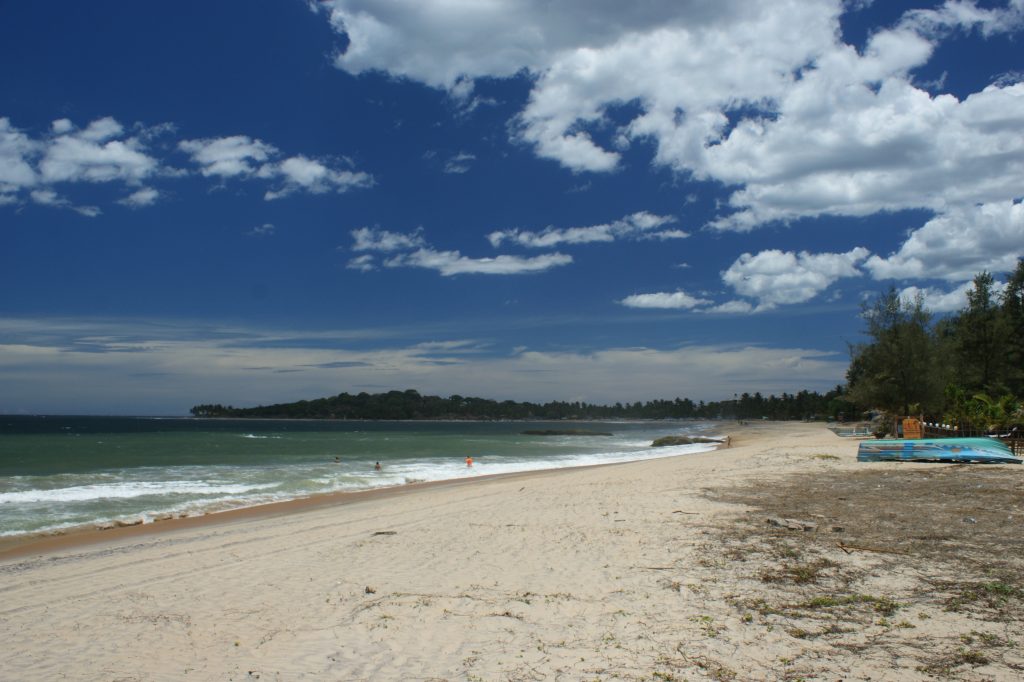
Header photo: Kondephy / Wikimedia Commons, CC BY-SA 4.0.