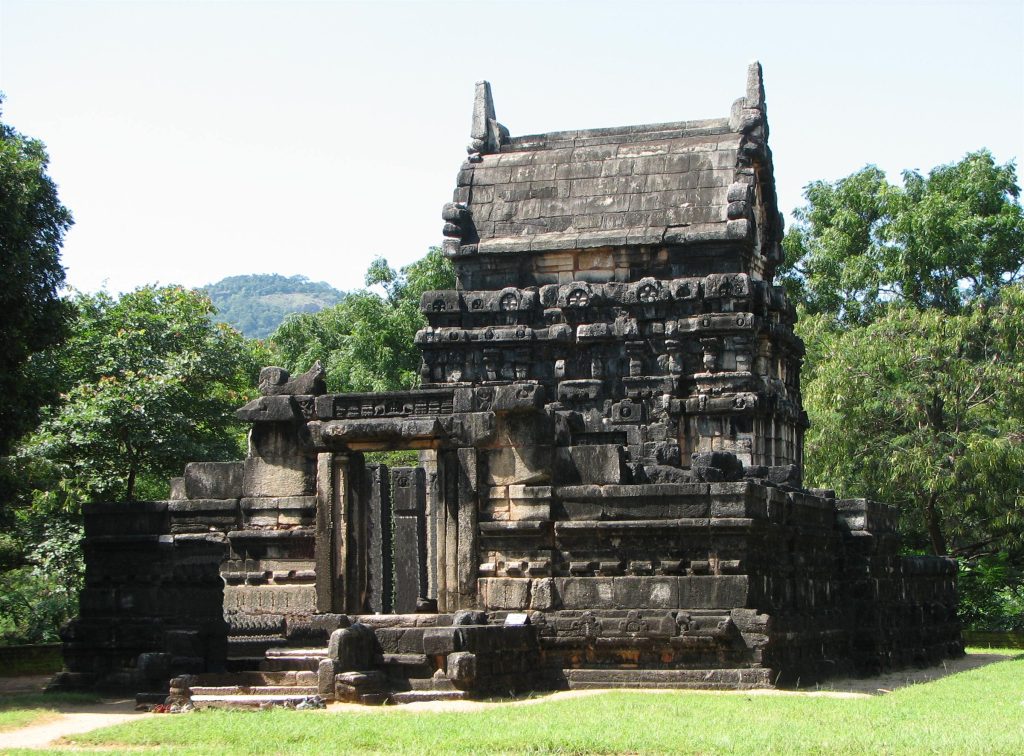

Nalanda Gedige is a small stone temple beside the Bowatenne reservoir, about 1 km east of the A9 road in Matale District. It is an odd building: a Buddhist monastery site that looks, at first glance, like a South Indian Hindu shrine.
Is it worth visiting?
Go if you are driving the A9 between Kandy and Dambulla or Sigiriya and want a short, quiet stop with something unusual to look at. Most visitors need under half an hour.
Think twice if you want a big site with a lot to walk around. Nalanda Gedige is one compact building, and it is easier to enjoy if you know what you are looking at.
What makes it unusual
The temple is built in the Dravidian style, with Pallava influence, and follows a Hindu temple plan: an entrance hall, a short passage and a shrine with a walkway around it. Over the doorway is a carved figure of the god Kubera. Reference sources describe this mix of Buddhist and Hindu elements as rare in Sri Lanka.
It is still a Buddhist site. A pillar inscription found here, dated to the 9th or 10th century, identifies it as a Buddhist monastery. Experts disagree about when the temple itself was built, with estimates between the 8th and 11th centuries.

Archaeological work began in 1893 under H. C. P. Bell, after the ruin had lain in the jungle. The temple later had to be moved, because the new Bowatenne Tank threatened to submerge it. It was taken apart and rebuilt on higher ground, beside the water, in the 1980s.
What to see
- The shrine: the carved base, the stepped tiers above the doorway and the walkway around the inner room.
- Museum and display boards: a 2017 Daily FT article describes a small museum at the car park, where a guide explains the carvings and the inscriptions on stone slabs.
- The setting: the same article describes a tree-lined path to the temple, with the reservoir close by.
Practical tips
- Getting there: the temple lies about 1 km east of the A9, so a car or tuk-tuk is the simplest way. Ask your driver to confirm the turning, since there is little traffic on the side road.
- Fees and hours: no official fee or opening-hours notice is published. The 2017 Daily FT article said entry was free and that the Department of Archaeology looks after the site, so confirm on the day. The Department’s website is archaeology.gov.lk.
- Respect: it is a religious site, so dress modestly and take your shoes off where asked.
- Time of day: go in the morning or late afternoon to avoid the dry-zone heat.
Around Nalanda Gedige
It combines well with Aluvihara Rock Temple near Matale and Dambulla Cave Temple further along the A9. For where to stay and eat, see Matale and Dambulla. Sigiriya is also on the same side of the island.
Frequently asked questions (FAQs)
Where is Nalanda Gedige?
In Matale District, Central Province, about 1 km east of the A9 road.
How old is Nalanda Gedige?
Estimates for the temple range from the 8th to the 11th century. A 9th–10th century pillar inscription shows that a Buddhist monastery stood here.
Why was the temple moved?
The Bowatenne Tank threatened to flood the original site, so the temple was dismantled and rebuilt on higher ground in the 1980s.
Is Nalanda Gedige Hindu or Buddhist?
It is a Buddhist monastery site built in a style that borrows from Hindu temples, so it has features of both.
Is there an entrance fee?
No official fee is published. A 2017 Daily FT article said entry was free, so check on arrival.
Header photo: Bernard Gagnon / Wikimedia Commons, CC BY-SA 3.0.